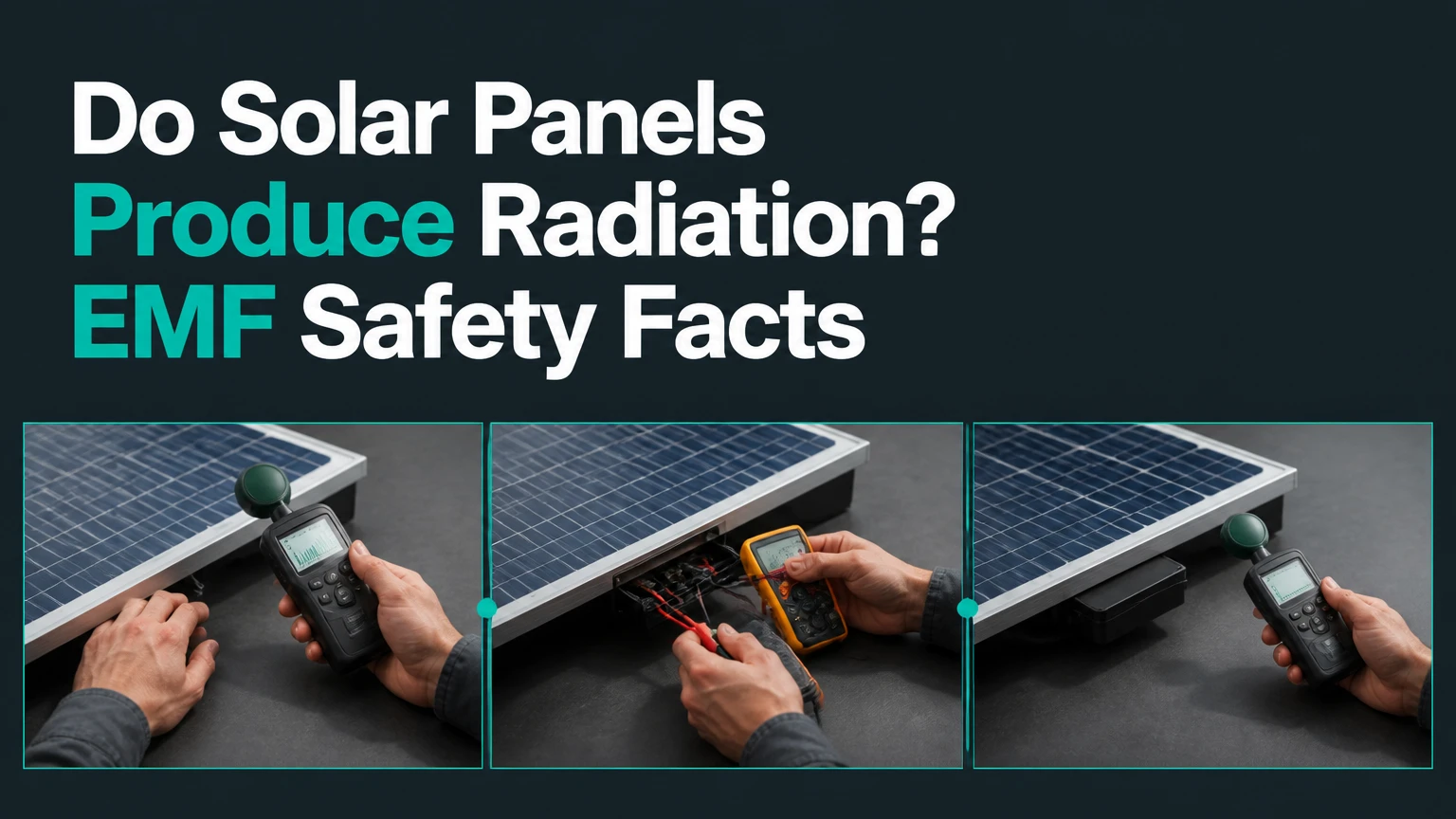
Solar panels interact with radiation from the Sun, but photovoltaic panels do not generate ionizing radiation such as X-rays or gamma rays. A functioning solar energy system produces ordinary non-ionizing electromagnetic fields from DC current, AC current, switching electronics, and communications hardware, with field strength that generally decreases rapidly as distance increases.
Key Facts at a Glance
- Photovoltaic panels do not create nuclear radiation or X-rays during normal operation.
- Solar cells absorb visible and infrared sunlight and convert part of that energy into direct-current electricity.
- Inverters produce 50 or 60 hertz electric and magnetic fields because they convert DC electricity into household AC electricity.
- Radiofrequency emissions may come from inverter communications, rapid-shutdown devices, optimizers, or poorly suppressed switching noise.
- EMF exposure depends on current, voltage, frequency, wiring geometry, equipment design, distance, and operating condition.
- Grounding protects against electric shock and fault current; grounding alone does not eliminate magnetic fields.
What Does Radiation Mean in a Solar System?
Solar radiation means electromagnetic energy traveling from the Sun, while electromagnetic fields from solar equipment arise from voltage and current. Those are related physical phenomena, but they are not interchangeable health hazards. The word radiation describes energy transfer, not a diagnosis of danger.
Ionizing radiation has enough energy per photon to remove electrons from atoms and molecules. Ultraviolet-C, X-rays, and gamma rays fall into that category. Ordinary photovoltaic modules, wiring, and inverters do not generate those photon energies.
Non-ionizing radiation includes radiofrequency signals, infrared heat, visible light, and extremely low-frequency fields. Non-ionizing does not mean every exposure is harmless in every circumstance, because intense ultraviolet light can burn skin and powerful radiofrequency sources can heat tissue. Residential solar equipment operates in a very different exposure regime.
| Energy or field type | Solar-system source | Typical frequency or property | Main safety issue |
|---|---|---|---|
| Visible light | Sunlight and reflected module surfaces | About 400-700 nanometers | Glare and eye exposure |
| Infrared radiation | Sunlight, warm modules, inverter heat | Longer than visible wavelengths | Heat |
| Static or low-frequency magnetic field | DC conductors and AC circuits | 0 Hz DC, 50/60 Hz AC | Field exposure near conductors |
| Radiofrequency energy | Wi-Fi, cellular, monitoring, switching noise | Approximately 3 kHz-300 GHz | Communications interference or heating at high power |
| Ionizing radiation | Not produced by normal PV operation | UV-C, X-rays, gamma rays | DNA and cellular damage at sufficient exposure |
The Centers for Disease Control and Prevention explains, “Ionizing radiation has enough energy to remove electrons from atoms,” which is the defining distinction for radiation biology. Solar panels receive high-energy sunlight, but the modules do not turn that incoming sunlight into X-rays.
How Do Photovoltaic Panels Convert Sunlight Into Electricity?
Photovoltaic cells absorb photons with enough energy to move electrons within a semiconductor, creating a voltage and current that leave the panel as direct-current electricity. The panel performs energy conversion, not radioactive decay and not the production of ionizing radiation.
A crystalline-silicon cell contains semiconductor layers that create an internal electric field. When sunlight enters the cell, photons transfer energy to electrons. Conductive contacts collect those charges, and the resulting DC power travels through module cables toward an inverter.
The operating sequence is:
- Sunlight reaches the cell. Glass and encapsulant transmit much of the usable visible and near-infrared spectrum.
- Silicon absorbs photons. Photons with sufficient energy create mobile electron-hole pairs.
- The cell separates charges. The semiconductor junction directs electrons toward electrical contacts.
- Modules deliver DC electricity. Multiple cells connect into modules, and modules connect into strings.
- The inverter produces AC electricity. Power electronics switch and filter the DC waveform for household loads or grid export.
The electrical current creates magnetic fields around conductors. A DC conductor produces a relatively steady field, while an AC conductor produces a changing field. In a well-designed circuit, closely spaced outgoing and returning conductors partially cancel one another’s external magnetic field.
Do Solar Panels Emit EMF?
Solar panels and their cables emit measurable non-ionizing electromagnetic fields, but the field is not equivalent to ionizing radiation. The panel itself is usually less important than the current-carrying conductors, inverter, optimizers, battery equipment, and the distance between those components and occupied rooms.
Electric fields are associated mainly with voltage. Magnetic fields are associated mainly with current. A disconnected high-voltage DC cable can have an electric field, while a heavily loaded cable can create a magnetic field. The two fields require different measurement methods and may behave differently around building materials.
The International Commission on Non-Ionizing Radiation Protection, or ICNIRP, publishes exposure guidelines for low-frequency electric and magnetic fields. Its limits depend on frequency and exposure category, so a single universal milligauss number cannot represent every solar installation.
| Component | Primary electrical condition | Main field source | What changes the reading |
|---|---|---|---|
| PV module | Low-voltage DC cells in series | DC current and module voltage | Sunlight level, load, conductor spacing |
| DC string wiring | High-voltage DC | Electric field and steady magnetic field | String current, cable separation, routing |
| String inverter | DC input and 50/60 Hz AC output | Switching circuits and AC current | Power output, distance, enclosure design |
| Microinverter | DC input and AC output below each module | Local switching and AC conductors | Module output, roof construction, cable layout |
| Battery inverter | DC battery current and AC conversion | High current, switching, cooling fans | Charge rate, discharge rate, battery state |
| Monitoring gateway | Low-power digital communications | Radiofrequency signal | Transmission duty cycle and antenna location |
A practical rule is more reliable than a generic equipment label: field strength normally falls as distance from the source increases, but the exact rate depends on whether the source behaves like a point, line, loop, transformer, or distributed circuit.
Which Solar Component Produces the Most EMF?
The inverter and high-current wiring usually deserve the most attention because those components handle conversion and load current. The answer changes with system architecture: a string inverter concentrates electronics in one location, while microinverters distribute smaller conversion units across the roof.
String inverters
A string inverter receives DC from one or more panel strings and converts it to AC at a central location. The roof contains DC wiring, but the main switching electronics are usually mounted near a service panel, garage, utility room, or exterior wall.
String inverter systems offer a straightforward exposure-management advantage when the inverter can be placed several feet from bedrooms or frequently occupied spaces. They also create a concentrated service location, so installation quality, ventilation, clearance, and weather protection matter.
Microinverters
A microinverter converts power beneath an individual panel. Each unit handles less power than a central inverter, but many units operate across the roof and connect to an AC trunk cable.
Microinverters do not create a universal “safe roof” or “unsafe roof” result. Their field levels depend on equipment design, output current, cable routing, roof distance, and operating load. A bedroom directly below a roof-mounted device deserves a site-specific assessment rather than a blanket assumption about attenuation.
DC optimizers
A DC optimizer changes the voltage or current behavior of an individual panel while a separate inverter performs the main DC-to-AC conversion. Optimizers add switching electronics, but their effect on indoor EMF depends on the model, wiring arrangement, and inverter location.
Hybrid inverters and batteries
A hybrid inverter manages PV input, household loads, grid exchange, and battery charging. Battery systems can carry substantial DC current, especially at lower battery voltages, so conductor size, protection, ventilation, fire separation, and working clearance are more important safety issues than vague claims about “dirty electricity.”
| Architecture | Conversion location | Typical residential placement | Main practical trade-off | Battery integration |
|---|---|---|---|---|
| String inverter | One central unit | Garage or exterior wall | Concentrated equipment and easier service | Often available |
| Microinverter | Under each panel | Roof | Distributed electronics and roof access | Requires compatible AC-coupled or hybrid design |
| DC optimizer plus inverter | Optimizer at module, inverter central | Roof plus garage or exterior wall | More electronics and complex troubleshooting | Model-dependent |
| Hybrid inverter | Central conversion and energy management | Utility room, garage, exterior wall | Higher system complexity | Built for direct integration |
| AC-coupled battery | Separate battery inverter | Garage or utility area | Extra conversion stage | Compatible with existing PV |
| Off-grid inverter | Central conversion from battery bank | Equipment room or outbuilding | High fault current and ventilation demands | Core component |
Are Solar Panels Safer Than Household Appliances?
Solar equipment cannot be ranked against a hairdryer or microwave using one milligauss table because field frequency, distance, load, duration, and measurement direction differ. A nearby appliance may produce a higher short-range magnetic-field reading, while a solar cable may produce a lower but persistent field at another location.
The World Health Organization and ICNIRP evaluate low-frequency EMF using frequency-specific exposure guidance, not a universal household comparison chart. Consumer meter readings also vary substantially by sensor type, calibration, bandwidth, and whether the instrument measures electric fields, magnetic fields, or radiofrequency energy.
The following values are useful only as order-of-magnitude examples, not guaranteed readings. Manufacturer design and installation geometry can move results outside these ranges.
| Source | Example measurement distance | Typical field behavior | Why comparison is limited |
|---|---|---|---|
| Hairdryer motor | 15 centimeters | Can be relatively high near motor | Short duration and close distance |
| Refrigerator compressor | 30 centimeters | Usually localized during operation | Intermittent duty cycle |
| PV DC cable pair | 30 centimeters | Depends on current and conductor spacing | DC and cancellation effects vary |
| String inverter enclosure | 1 meter | Usually decreases with distance | Output load and model affect reading |
| Microwave oven exterior | 30 centimeters | Leakage is regulated; magnetic field differs by location | 2.45 GHz RF and 50/60 Hz fields are different |
| Battery inverter | 1 meter | Depends strongly on charge or discharge current | High-current operation can change field levels |
The supplied overview’s example values, including 10-30 milligauss at three feet from a string inverter and 100-300 milligauss near a microwave, should not be treated as general specifications. No responsible installer can promise those readings without naming the equipment, electrical load, meter, frequency band, and measurement protocol.
Can Solar Panel Radiation Cause Cancer?
Current public-health guidance does not establish that residential photovoltaic panels cause cancer through their non-ionizing electromagnetic fields. The National Cancer Institute describes the evidence on extremely low-frequency fields as limited and mixed, while agencies distinguish a possible statistical association from proof that a particular household device causes cancer.
The International Agency for Research on Cancer classified extremely low-frequency magnetic fields as “possibly carcinogenic to humans” in 2002, based largely on limited epidemiological evidence concerning childhood leukemia. That classification does not identify solar panels as a cause, does not establish a dose-response mechanism for residential PV systems, and does not mean ordinary exposure produces the same risk as ionizing radiation.
The American Cancer Society notes that the evidence has not established a clear causal relationship between residential EMF exposure and cancer. The strongest established hazards around solar installations are more conventional: falls, arc flash, electric shock, fire, battery failure, glare, and heat.
Solar equipment is also not a substitute for UV protection. Sunlight around a PV array still contains ultraviolet radiation, and workers should use eye protection, gloves, fall protection, and safe electrical isolation procedures.
Which Solar Configuration Minimizes Indoor EMF?
A central inverter placed on an exterior wall or in a non-living utility area usually minimizes electronics near bedrooms, while microinverters reduce the concentration of conversion equipment but distribute it across the roof. Neither configuration can be declared universally superior without the roof plan, room locations, cable routes, and equipment specifications.
| Household situation | Usually practical configuration | Placement priority | Main limitation |
|---|---|---|---|
| Bedroom below roof panels | Central inverter away from bedroom | Keep inverter and high-current routes away from headboard wall | Roof wiring still requires evaluation |
| Small home with exterior garage | String inverter | Exterior garage wall with code clearances | One central failure point |
| Complex roof with shading | Microinverters or optimizers | Keep AC trunk and junctions accessible | More roof electronics |
| Solar plus new battery | Hybrid inverter | Dedicated utility or garage area | Higher installation complexity |
| Off-grid cabin | Inverter near protected battery room | Short, correctly sized DC conductors | High current and fire-safety requirements |
| Electrically sensitive occupant | Site-specific design and measurement | Increase distance before buying shielding | Sensitivity does not determine field level |
Distance is usually the first design variable to change. Moving an inverter from a bedroom-adjacent wall to a garage corner can reduce exposure more predictably than adding improvised foil or conduit.
Does Grounding or Metal Conduit Remove Solar EMF?
Grounding does not remove magnetic fields created by current, and metal conduit does not automatically eliminate every field from a solar circuit. Grounding provides a low-impedance fault path and helps keep exposed conductive parts at a controlled electrical potential; it is an electrical-safety measure, not a universal radiation treatment.
Metal conduit can reduce electric-field coupling when correctly installed and bonded, but low-frequency magnetic fields often pass through ordinary steel or aluminum conduit. Magnetic shielding requires suitable material, geometry, continuity, and engineering verification. Increasing distance and keeping supply and return conductors close together are often more effective.
“Dirty electricity” is not a standardized exposure metric in mainstream electrical codes or public-health guidance. Audible buzzing, radio interference, nuisance tripping, overheating, or inverter fault codes are legitimate reasons for inspection, but they do not prove a health hazard.
What should an installer verify?
- Equipment is listed for the jurisdiction and installed under the applicable electrical code.
- DC and AC conductors have correct insulation, overcurrent protection, labeling, and separation.
- Racking, module frames, conduit, and service equipment are bonded as required.
- Inverter clearances, ventilation, and disconnect access meet the manufacturer’s instructions.
- Battery systems have the required temperature control, fire separation, ventilation, and emergency access.
- Communication antennas and wireless gateways are not placed where they create avoidable interference.
- The installer documents conductor routes and equipment locations before wall finishes conceal them.
How Should You Measure EMF From a Solar Installation?
Measure magnetic fields with a calibrated gaussmeter or teslameter, electric fields with an appropriate field meter, and radiofrequency energy with an RF meter. A single inexpensive “tri-field” meter cannot reliably diagnose every field type, frequency, harmonic, or wiring fault.
A useful assessment records the system state and the measurement geometry. Measure with the inverter idle, producing moderate power, and near its maximum expected output if safe; record distance, height, orientation, frequency band, weather, battery charge direction, and nearby appliances.
| Measurement item | Minimum useful record | Why it matters |
|---|---|---|
| Magnetic field | µT or mG, distance, three-axis maximum | Field varies with orientation and current |
| Electric field | V/m, probe height, equipment state | Voltage and grounding affect readings |
| Radiofrequency | Frequency range, peak and average value | Wi-Fi and switching noise require different bands |
| Operating condition | PV output, battery charge or discharge, inverter status | Load changes current and emissions |
| Location | Room, wall, cable route, height above floor | Distance determines exposure |
| Instrument | Brand, model, calibration date | Meter bandwidth and accuracy affect results |
One microtesla equals 10 milligauss. The conversion is exact, but the health meaning of a number depends on frequency and exposure guideline. A reading above an arbitrary household threshold is not evidence of danger, and a low reading does not excuse faulty wiring.
What Problems Can Make a Solar System Appear Unusually Noisy?
Unusual radio interference, buzzing, heating, repeated inverter faults, or inconsistent meter readings warrant an electrical inspection rather than an immediate assumption of harmful radiation. Loose terminations, damaged insulation, poor connector assembly, failing filters, grounding faults, and defective power electronics can create safety risks and electromagnetic interference.
Use this troubleshooting order:
- Check the inverter display and monitoring portal. Record fault codes, output power, temperature, and event times.
- Listen for abnormal sounds. A new buzz, clicking pattern, or fan noise may indicate a mechanical or electrical problem.
- Inspect without opening energized equipment. Look for melted connectors, discoloration, water ingress, cracked cable insulation, or damaged conduit.
- Call a qualified electrician or solar service technician. Ask for insulation resistance, polarity, grounding, connector, and thermal checks where appropriate.
- Investigate communications separately. Wi-Fi, cellular, PLC, and radio interference use different frequencies and require different test instruments.
- Shut down only according to the manufacturer’s procedure. PV modules can remain energized in daylight even after some switches are opened.
Do not install improvised foil, disconnect protective earth conductors, replace fuses with larger ones, or enter a battery enclosure without the required training. Those actions can increase shock, fire, and arc-flash risk.
What Are the Real Safety Risks of Solar Panels?
The most immediate solar hazards are electrical shock, arc flash, falls, fire, damaged equipment, and battery incidents, not ionizing radiation. Solar modules generate voltage whenever illuminated, so a disconnected-looking array may still present dangerous DC voltage during daylight.
| Hazard | Typical trigger | Potential consequence | Correct control |
|---|---|---|---|
| DC arc fault | Damaged connector or loose termination | Fire and equipment damage | Listed connectors, inspection, arc-fault protection |
| Electric shock | Contact with energized conductors | Serious injury or death | Qualified work, lockout procedure, insulated tools |
| Roof fall | Unprotected rooftop access | Fractures or fatal injury | Guardrails, anchors, fall-arrest equipment |
| Battery thermal event | Damage, overcharge, poor installation | Fire, toxic smoke, property loss | Listed battery, code-compliant enclosure, clearances |
| Glare | Reflection toward road or neighboring property | Distraction or nuisance | Glare assessment and module placement |
| Heat | Inverter or battery overload | Shutdown or fire | Ventilation, clearances, thermal monitoring |
Solar panels are also poor sources of protection from sunlight. Roof arrays can shade part of a roof, but they do not make rooftop work safe without fall protection or electrical controls.
What Does Solar Installation Cost When EMF Placement Matters?
Moving a string inverter, extending compliant conductors, or adding an equipment enclosure commonly changes installation cost by hundreds to several thousand dollars, depending on distance, trenching, labor, and local code requirements. Shielding should not be the first budget item because placement and conductor arrangement usually offer clearer engineering benefits.
| Design change | Typical added cost range | Typical time impact | Main cost driver |
|---|---|---|---|
| Move inverter to a nearby exterior wall | $300-$1,500 | 2-6 labor hours | Conduit length and wall access |
| Extend wiring to detached garage | $1,000-$5,000 | 1-3 days | Trenching, disconnects, conductor size |
| Add battery-ready hybrid inverter | $1,000-$3,000 equipment difference | 2-6 hours | Brand and backup-load design |
| Add battery storage | $7,000-$18,000 installed | 1-2 days | Capacity, incentives, electrical upgrades |
| Professional EMF assessment | $300-$1,500 | 1-3 hours | Instrumentation and written report |
| Replace defective inverter | $1,500-$4,000 installed | 2-8 hours | Warranty, model, labor access |
These are typical North American planning ranges, not quotations. Local labor rates, incentives, roof access, service-panel capacity, and battery code requirements can change the result substantially.
Should You Avoid Solar Panels if You Are Concerned About EMF?
Most households do not need to avoid solar panels because ordinary PV systems do not produce ionizing radiation. A person with a specific concern should ask for equipment placement away from sleeping areas, documented conductor routes, code-compliant bonding, and an independent measurement if the concern remains after installation.
People with implanted medical devices should follow the device manufacturer’s electromagnetic-interference guidance, especially around high-current battery equipment and inverters. Solar installers should also consider rooftop workers, occupants with bedrooms below arrays, radio operators, and homes with unusually sensitive monitoring or communications equipment.
An honest limitation matters: no generic article can certify the field level inside a particular house. Field measurements require the actual inverter model, cable geometry, operating load, construction materials, and instrument method.
The Bottom Line
Do solar panels produce radiation? Solar panels produce and interact with non-ionizing electromagnetic energy, including sunlight, heat, electric fields, magnetic fields, and limited radiofrequency emissions from associated electronics. They do not produce ionizing radiation, radioactive material, or X-rays during normal operation.
For most homes, inverter placement, conductor routing, grounding, ventilation, fire protection, and professional electrical workmanship matter more than purchasing special shielding. A string inverter away from bedrooms may suit a distance-focused design, while microinverters may suit a shaded or complex roof. Choose based on system performance and code-compliant layout, then measure the installed system if a specific concern remains.
Frequently Asked Questions
Do solar panels emit radiation at night?
Photovoltaic modules do not generate electricity without sufficient light, so their DC output and associated current-dependent magnetic fields fall substantially at night. Grid-connected inverters, monitoring gateways, and batteries may remain energized or communicate after sunset, meaning a complete nighttime system shutdown depends on the equipment architecture and operating settings.
Can solar panels interfere with Wi-Fi or radio?
Solar equipment can cause radio interference if a switching component, cable, connector, or filter is defective, poorly installed, or incompatible with nearby communications equipment. Wireless monitoring also uses radiofrequency transmissions by design. An installer can isolate the source with a spectrum-capable instrument, ferrites where appropriate, corrected bonding, or equipment replacement.
Are solar panels safe under a bedroom?
A bedroom below a solar array is not automatically unsafe. The relevant variables include the location of microinverters, DC and AC cable routes, roof-to-bed distance, inverter output, and construction materials. Keep central inverters and high-current battery equipment away from headboards when practical, and request a site-specific assessment rather than relying on a universal reading.
Do solar panels give off UV radiation?
Solar panels do not create UV radiation, but sunlight remains present around and above the array. Module glass may absorb or reflect portions of ultraviolet light, while exposed workers can still receive sunlight-related UV exposure. Sunglasses, skin protection, safe access, and fall protection remain necessary during rooftop inspection and maintenance.
Is a solar inverter dangerous inside a garage?
A solar inverter can be installed in a garage when the equipment is listed for that environment and the installation meets clearance, temperature, ventilation, disconnect, and fire requirements. Avoid placing an inverter beside sleeping areas, flammable storage, or blocked airflow. Battery systems may have additional enclosure and separation requirements.
Can a solar panel give you cancer?
Available public-health evidence does not establish that residential photovoltaic panels cause cancer through their low-frequency electromagnetic fields. The IARC classification of extremely low-frequency magnetic fields as possibly carcinogenic reflects limited epidemiological evidence, not proof that solar panels cause cancer. Electrical, fall, fire, and battery hazards remain the more immediate risks.