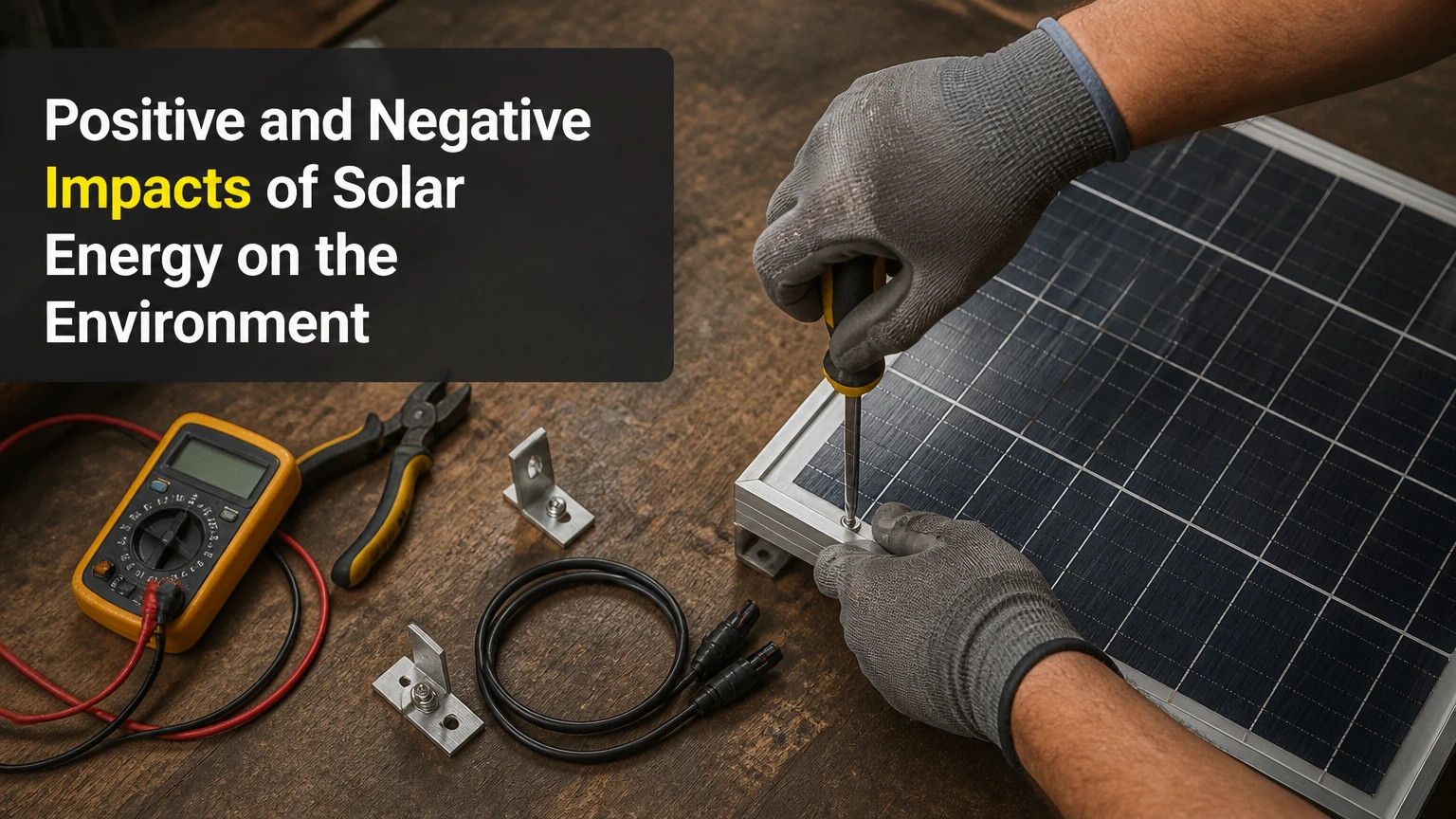
Solar energy has major environmental benefits because it produces electricity without combustion, sharply reducing greenhouse-gas and air-pollution emissions during operation. Its environmental costs occur mainly before and after operation, through mining, manufacturing, land conversion, wildlife disturbance, water use, and panel disposal, so the final balance depends strongly on technology, location, and project design.
Key Facts at a Glance
- Solar photovoltaic electricity produces no sulfur dioxide or nitrogen oxides during operation because panels generate power without burning fuel.
- Lifecycle greenhouse-gas emissions from utility-scale solar are far lower than coal and natural gas, although manufacturing and construction create emissions.
- Rooftop solar usually adds little new land disturbance, while large ground-mounted projects can fragment habitat and compact soil.
- Solar photovoltaic systems typically operate for 25-35 years, with output declining gradually rather than stopping suddenly.
- Panel recycling is technically possible, but recovery economics, collection systems, and local regulations determine whether recycling occurs.
- Solar energy reduces water demand during electricity generation, but mining, manufacturing, cooling, panel washing, and CSP operation can require water.
What Is Solar Energy and How Does It Work?
Solar energy is usable heat or electricity produced from sunlight. Photovoltaic panels convert photons into direct-current electricity through semiconductor materials, while solar-thermal collectors absorb radiation to heat water or another fluid.
A rooftop photovoltaic system sends DC electricity to an inverter, which produces alternating current for household appliances. Excess power can charge a battery, flow into the grid, or be curtailed when generation exceeds demand. Concentrated solar power, or CSP, uses mirrors to heat a receiver and produce steam, while solar-thermal water heaters use sunlight directly and avoid electrical conversion losses.
| Solar technology | Typical efficiency or output feature | Typical operating life | Main environmental consideration |
|---|---|---|---|
| Monocrystalline silicon PV | 19-24% module efficiency | 25-35 years | Higher material and manufacturing energy per module |
| Polycrystalline silicon PV | 15-18% module efficiency | 20-30 years | More area required for the same output |
| Cadmium telluride thin film | 18-22% module efficiency | 25-30 years | Cadmium management and recycling requirements |
| CIGS thin film | 13-19% module efficiency | 20-30 years | Indium, gallium, selenium, and copper supply chains |
| Solar thermal | 40-70% useful heat capture, site dependent | 15-25 years | Heat-transfer fluid, water, and freeze protection |
| Concentrated solar power | 15-25% electricity conversion | 25-40 years | Large site, high solar resource, and possible cooling water |
What Are the Positive Impacts of Solar Energy on the Environment?
The main positive impact of solar energy is the replacement of fossil-fuel electricity with a low-carbon source that produces no combustion pollution at the point of generation. Solar power also reduces fuel extraction, cooling-water demand, and exposure to pollutants when projects are correctly sited.
The International Energy Agency described solar photovoltaics as “the new king of electricity markets” in its World Energy Outlook 2020, referring to the technology’s falling costs and rapid deployment. That market growth matters environmentally only when solar displaces higher-emission generation rather than merely adding capacity that is often curtailed.
Solar energy reduces greenhouse-gas emissions
Solar power reduces climate pollution because photovoltaic panels generate electricity without burning coal, oil, or gas. Manufacturing, transport, construction, maintenance, and decommissioning still create lifecycle emissions, but those impacts are distributed across decades of generation.
The Intergovernmental Panel on Climate Change reported median lifecycle emissions of approximately 48 grams of carbon-dioxide equivalent per kilowatt-hour for utility-scale solar, compared with about 820 grams for coal and 490 grams for natural gas in its lifecycle assessment database. Exact results vary with manufacturing electricity, sunlight, panel efficiency, and land-use change.
Solar’s carbon advantage is greatest where it displaces coal and gas during sunny periods. Its climate benefit becomes smaller when a project replaces existing low-carbon nuclear, hydroelectric, or wind generation, or when storage and transmission construction add substantial embodied emissions.
Solar power improves air quality
Solar electricity avoids sulfur dioxide, nitrogen oxides, mercury, and fine particulate matter associated with fossil-fuel combustion. The avoided emissions can reduce respiratory and cardiovascular risks near coal plants, gas turbines, mines, rail corridors, and fuel-handling facilities.
The U.S. Environmental Protection Agency identifies particulate matter, nitrogen dioxide, sulfur dioxide, and ozone-forming pollutants as major contributors to health damage from air pollution. Solar panels do not eliminate regional air pollution by themselves, but replacing fossil generation removes the combustion source rather than shifting pollution to a different smokestack.
The benefit is location-specific. A solar farm connected to a coal-heavy grid generally avoids more pollution than one connected to a grid already dominated by hydroelectricity or wind.
Solar electricity uses little water during operation
Photovoltaic panels require no cooling water to generate electricity. That difference matters in arid regions because coal, gas, biomass, and nuclear plants often use water for steam-cycle cooling, while PV systems generally need only occasional panel cleaning.
The U.S. Department of Energy notes that water consumption varies by power technology and cooling system, with thermal power plants requiring water for cooling and solar PV generally using far less water during operation. Solar-thermal plants can require more water, particularly when using wet cooling, although dry cooling reduces consumption at the cost of lower efficiency and higher capital expense.
Operational water savings do not mean zero lifecycle water use. Quartz extraction, silicon purification, metal processing, semiconductor manufacturing, dust control, and panel washing can all consume water.
Solar projects can use disturbed land
Solar arrays can be built on rooftops, parking canopies, landfills, brownfields, abandoned mines, and already-developed industrial sites. These locations can produce electricity without converting intact habitat or productive farmland.
Agrivoltaic systems raise panels above crops or grazing land, allowing simultaneous energy production and agriculture under suitable climates and operating designs. Shade can reduce evaporation and heat stress for some crops, but panels can also reduce light and complicate farm machinery access.
The strongest land strategy follows a hierarchy: use buildings and already-disturbed land first, avoid high-value habitat and flood-prone areas, then design remaining sites for soil recovery and ecological connectivity.
What Are the Negative Impacts of Solar Energy?
Solar energy’s negative environmental impacts arise primarily from material extraction, industrial processing, land occupation, wildlife interactions, infrastructure, and end-of-life waste. Solar power is cleaner than fossil electricity on a lifecycle basis, but “clean” does not mean impact-free.
Mining and manufacturing require materials
Solar panels require glass, aluminum, steel, silicon, copper, silver, polymers, and semiconductor compounds. Mining and refining these materials can disturb land, consume energy, generate tailings, and release pollutants if poorly controlled.
Crystalline-silicon PV dominates the global market and requires high-temperature purification and wafer production. Thin-film technologies use smaller quantities of semiconductor material, but some formulations contain cadmium, tellurium, indium, gallium, or selenium, which require careful supply-chain and end-of-life management.
The presence of a hazardous element does not automatically mean normal panel operation creates hazardous exposure. Encapsulation, glass construction, manufacturing controls, and regulated disposal limit risk, while broken modules and informal recycling require more attention.
Utility-scale solar can alter land and habitat
Large solar farms require arrays, roads, substations, fencing, drainage controls, and transmission connections. Construction can remove vegetation, compact soil, increase erosion, interrupt animal movement, and divide habitat into smaller patches.
The U.S. National Renewable Energy Laboratory reports that land-use estimates vary widely according to terrain, spacing, tracking equipment, roads, and whether figures describe direct infrastructure or total project area. Fixed-tilt and tracking projects therefore cannot be compared using one universal acres-per-megawatt value.
A project can have a smaller direct footprint but a larger ecological effect if fencing blocks migration or if roads cut through breeding habitat. Conversely, native vegetation under and between arrays can improve soil cover compared with intensively tilled land.
Solar facilities can affect birds, insects, and other wildlife
Solar facilities affect wildlife through habitat loss, fencing, glare, collision risk, altered vegetation, and construction noise. CSP towers create an additional hazard because concentrated sunlight can injure or kill flying insects and birds that pass through the receiver’s intense flux field.
Research on photovoltaic facilities has documented insect attraction and possible bird-collision pathways, although the scale varies by panel design, habitat, lighting, reflective surfaces, and facility layout. Transmission lines and access roads can create impacts beyond the panel footprint.
Mitigation includes preconstruction surveys, wildlife corridors, permeable fencing, low-glare modules, seasonal construction limits, bird diverters on lines, and post-construction monitoring. Monitoring matters because developers cannot reliably predict every species response from desktop mapping alone.
Solar farms can affect soil and local hydrology
Grading, piling, trenching, and heavy vehicles can compact soil and alter runoff. Rainwater may flow differently around rows, roads, and inverter pads, particularly on sloped sites or where vegetation is removed.
Deep grading is not inevitable. Driven piles, limited grading, erosion-control blankets, native ground cover, and decommissioning bonds can reduce long-term disturbance. The restoration standard should be written into permits before construction rather than negotiated after closure.
A counterintuitive point is that panels can either worsen or improve local soil conditions. Bare gravel and frequent mowing increase runoff and habitat loss, while well-managed perennial vegetation can reduce erosion, support pollinators, and improve infiltration.
Panel waste will increase as early systems retire
Solar panels do not become unusable at the end of their rated life. Most modules continue producing electricity after 25-35 years, but output declines, repairs become less economical, and newer modules may provide more power in the same area.
The International Renewable Energy Agency and the International Energy Agency Photovoltaic Power Systems Programme estimated that global PV waste could reach 60-78 million tonnes by 2050 under different deployment and lifetime assumptions. Those figures describe a future waste stream, not current annual disposal.
Glass and aluminum are recoverable at high rates, but separating polymers, silicon, silver, and semiconductor materials can be expensive. Reuse, refurbishment, manufacturer take-back programs, design for disassembly, and dedicated recycling contracts reduce landfill dependence.
Which Solar Technology Has the Lowest Environmental Impact?
Rooftop crystalline-silicon PV generally has the lowest additional land impact because it uses existing structures, while ground-mounted PV can achieve low lifecycle emissions with greater habitat-management requirements. Solar thermal can be environmentally preferable for hot-water demand, and CSP is most suitable where dispatchable solar power justifies its land and water needs.
| Technology or deployment | Land demand | Operational water | Key material issue | Best environmental application |
|---|---|---|---|---|
| Rooftop silicon PV | Existing roof, approximately 0 new land acres | Very low | Silicon, aluminum, glass, silver | Homes, warehouses, schools |
| Parking-canopy PV | Existing paved area | Very low | Steel foundations and wiring | Urban parking lots |
| Utility-scale PV | Typical total area roughly 4-10 acres/MW, site dependent | Low | Steel, glass, silicon, copper | Brownfields or low-conflict land |
| Agrivoltaic PV | Shared agricultural land | Low to moderate | Structure and access design | Grazing or shade-tolerant crops |
| Solar thermal | Roof or compact ground loop | Low to moderate | Copper, fluid, storage tank | Domestic hot water |
| CSP with wet cooling | Large contiguous site | Moderate to high | Mirrors, steel, heat-transfer system | High-direct-normal-irradiance regions |
Rooftop solar versus utility-scale solar
Rooftop solar usually minimizes habitat conversion and transmission construction, but individual roofs may have shading, structural, fire-access, or replacement constraints. Utility-scale projects generally deliver lower-cost electricity and easier maintenance, yet they require larger connected sites and new grid infrastructure.
Rooftop arrays are not automatically superior in every lifecycle category. A roof with poor orientation, heavy shade, or a short remaining life can produce less electricity per kilogram of installed material than a well-sited ground array.
The practical winner is site-specific: choose rooftops and parking structures where they have strong solar exposure, and choose previously disturbed ground where distributed generation cannot meet demand.
Solar versus coal and natural gas
Solar has lower lifecycle greenhouse-gas emissions than coal and natural gas, but solar produces variable output and requires grid flexibility, storage, transmission, demand management, or complementary generation. Fossil plants provide controllable output, but they emit pollutants and require continuous fuel extraction and combustion.
| Impact category | Solar PV | Natural gas | Coal | Decision implication |
|---|---|---|---|---|
| Operational CO2 | 0 g/kWh at generation | High | Very high | Solar avoids combustion emissions |
| Lifecycle carbon | About 48 g CO2e/kWh median IPCC value | About 490 g CO2e/kWh median | About 820 g CO2e/kWh median | Solar remains lower carbon |
| SO2 and mercury | Near zero during operation | Low to moderate | High | Coal replacement brings major air gains |
| Cooling water | Very low for PV | Low to high by cooling design | Moderate to high | PV suits water-stressed regions |
| Fuel extraction | No ongoing fuel | Gas wells and pipelines | Mines and rail transport | Solar reduces recurring extraction |
| Dispatchability | Variable, daylight-dependent | Dispatchable | Dispatchable | Storage and grid planning matter |
How Can Solar Energy’s Environmental Impacts Be Reduced?
Solar developers and owners can reduce environmental damage by selecting disturbed land, limiting grading, protecting habitat corridors, managing vegetation, using less water, and planning recycling before panels arrive. The most effective measures occur during site selection because post-construction restoration cannot fully undo habitat conversion.
- Prioritize rooftops, parking canopies, landfills, and brownfields. Complete habitat and agricultural assessments before selecting greenfield sites.
- Preserve soil structure. Use pile-driven foundations, narrow trenching, defined vehicle routes, and erosion controls instead of broad grading.
- Maintain native vegetation. Replace gravel-heavy designs with regionally appropriate ground cover where fire, maintenance, and stormwater rules allow.
- Protect wildlife movement. Use corridor setbacks, wildlife-friendly fencing, seasonal construction windows, and transmission-line markers.
- Reduce water demand. Use dry cooling for CSP where feasible, clean PV panels only when yield losses justify the water, and use reclaimed water when regulations permit.
- Specify responsible materials. Require supplier disclosure, occupational controls, traceability for high-risk minerals, and compliance with hazardous-material regulations.
- Fund end-of-life management. Record module serial numbers, require a decommissioning bond, and sign a recycler or take-back agreement before commissioning.
An expert rule of thumb is to compare environmental impact per kilowatt-hour, not per acre or per panel. A higher-efficiency module may reduce land, racking, cabling, and maintenance requirements, while a lower-impact material can still perform poorly if the site has shade or low solar irradiance.
What Important Trade-Offs Are Often Missed?
The environmental result of solar energy depends on what it replaces, where it is built, and how long it operates. A rooftop system replacing coal generation in a sunny region has a different outcome from a greenfield plant replacing existing wind power in sensitive habitat.
Manufacturing location changes the carbon footprint
Panels made with carbon-intensive electricity generally begin with higher embodied emissions than panels manufactured with lower-carbon electricity. Longer shipping distances matter, but manufacturing energy often matters more than shipping for the total lifecycle result.
Panel efficiency also changes the balance. Higher efficiency can reduce area, support structures, wiring, and labor per unit of electricity, although the manufacturing process may require more refined material or energy per module.
Storage adds benefits and impacts
Batteries can shift midday solar electricity into evening demand, reduce curtailment, and improve resilience. Battery production adds mining, processing, manufacturing energy, fire-safety requirements, and eventual recycling needs.
Storage is not always required for solar to reduce emissions. Grid-connected PV can displace fossil generation immediately during daylight, while demand response, regional interconnection, hydroelectric flexibility, and thermal storage can provide alternatives to lithium batteries.
Solar is not equally suitable everywhere
Solar performs poorly where roofs are shaded, winter demand is high, or grid connections are constrained. Solar thermal hot-water systems may outperform PV for a direct heat load, while heat pumps can deliver more useful heat per unit of electricity than electric resistance heating.
Solar power is also a poor justification for clearing intact forest, wetlands, protected habitat, or highly productive farmland when rooftops and disturbed land remain available. The renewable label does not override local ecological value.
What Does the Evidence Say About Solar’s Overall Environmental Balance?
For electricity generation, solar usually has a strongly positive environmental balance when it replaces coal or gas and avoids high-value habitat. The balance becomes less favorable when projects cause major land-use change, rely on water-intensive CSP cooling in arid regions, or lack credible end-of-life management.
| Project condition | Likely environmental balance | Main reason | Preferred response |
|---|---|---|---|
| Urban rooftop, unshaded roof | Very favorable | Existing structure and low operational impacts | Install after roof inspection |
| Warehouse or parking canopy | Favorable | Avoids new land conversion | Pair with stormwater design |
| Brownfield solar farm | Favorable with controls | Uses disturbed land | Test soil and cap contamination |
| Native desert habitat | Mixed to unfavorable | Habitat fragmentation and water scarcity | Relocate or redesign site |
| Agricultural agrivoltaics | Mixed, site dependent | Shared land but altered farming operations | Test crop and equipment compatibility |
| CSP in arid region with wet cooling | Mixed | High water demand despite low carbon | Evaluate dry cooling or PV |
| Coal-heavy grid with storage | Very favorable | Large avoided emissions and pollution | Build transmission and recycling plan |
The most defensible conclusion is comparative rather than absolute: solar energy is not impact-free, but its lifecycle climate, air-quality, and operational water advantages usually outweigh its environmental costs when siting, materials, wildlife protection, and recycling are managed responsibly.
Frequently Asked Questions
Does solar energy cause pollution?
Solar panels produce no combustion pollution while generating electricity, but manufacturing and mining create emissions, wastewater, dust, and industrial waste. Lifecycle pollution is generally much lower than coal generation because solar avoids ongoing fuel combustion, sulfur dioxide, nitrogen oxides, mercury, and ash disposal.
Do solar panels contain toxic materials?
Some panels contain regulated materials, including small quantities of lead in solder and cadmium compounds in certain thin-film modules. Encapsulation limits routine exposure during normal use, while manufacturing, breakage, and disposal require compliance with applicable hazardous-waste and worker-protection rules.
Are solar farms bad for farmland?
Solar farms can compete with farmland when they occupy productive agricultural soil, but agrivoltaic projects can combine panels with grazing or compatible crops. The outcome depends on soil quality, panel spacing, drainage, machinery access, lease terms, and whether decommissioning restores the land.
Can solar panels be recycled?
Solar panels can be recycled, especially for glass, aluminum, steel, and copper. Recovering silicon, silver, polymers, and thin-film compounds is more complex and may cost more than recovering bulk materials, so take-back agreements and recycling rules strongly influence actual outcomes.
Does solar power work during a blackout?
A standard grid-connected solar system normally shuts down during a blackout to protect utility workers from back-fed electricity. Solar can provide outage power only when the system includes approved islanding controls, a compatible inverter, and usually a battery or other grid-forming equipment.
What is the biggest environmental disadvantage of solar energy?
For rooftop systems, manufacturing and end-of-life material management are usually the main concerns. For utility-scale projects, land conversion, habitat fragmentation, water use, and transmission infrastructure can become the largest disadvantages, particularly on intact habitat or in water-stressed regions.
Conclusion
The positive and negative impacts of solar energy on the environment are unequal but context-dependent. Solar energy usually delivers much lower lifecycle greenhouse-gas emissions, air pollution, and operational water use than coal and gas, while its main costs involve mining, manufacturing, land disturbance, wildlife, and panel waste. The best projects use rooftops or disturbed land, protect biodiversity, limit grading and water consumption, and fund recycling before construction begins.