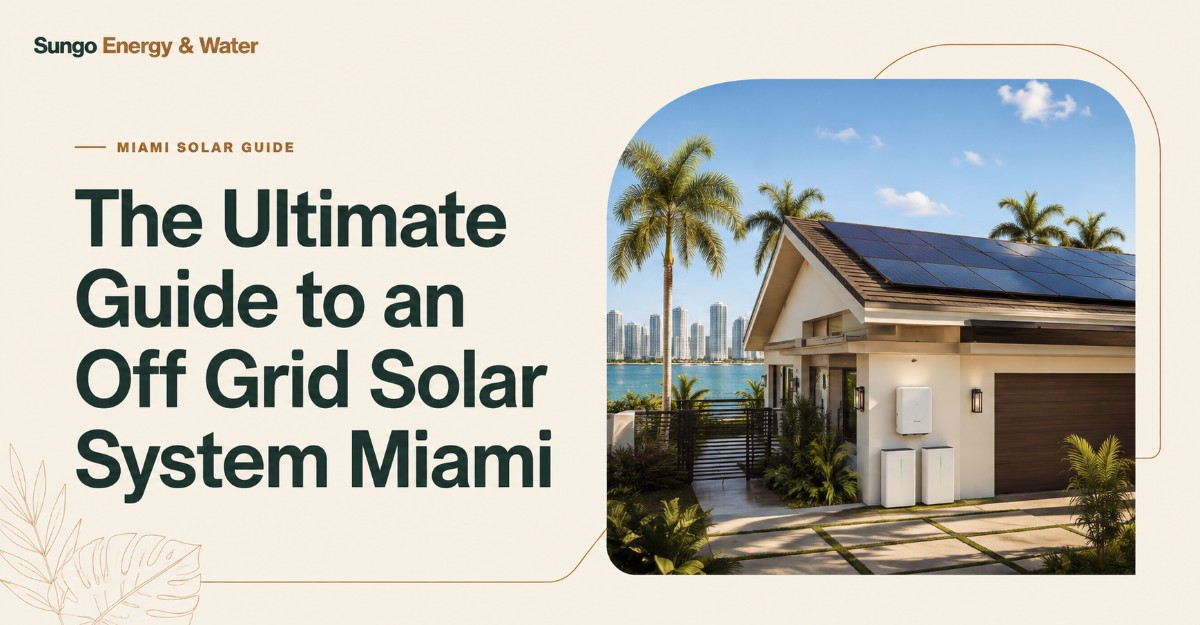
An off grid solar system miami setup is a standalone residential power plant that generates and stores its own electricity entirely independent of the utility grid. Homeowners use high-efficiency photovoltaic panels, charge controllers, and large-capacity battery banks to balance heavy tropical cooling demands with intermittent Florida sunshine.
Are Off-Grid Homes Legal in Miami-Dade County?
You cannot legally sever your physical connection to Florida Power & Light (FPL) if you live in a primary urban or suburban residence in Miami-Dade County. Local building codes operate under the International Property Maintenance Code (IPMC). The IPMC classifies any primary dwelling without an active utility grid hookup as unsanitary and unfit for human habitation.
Homeowners achieve independence through a regulatory workaround called a Zero-Export configuration. Installers physically wire the home to run entirely on solar arrays and battery banks. The system uses FPL strictly as a dormant emergency backup line. You never export power back to the grid for net metering. The off-grid inverter simply blocks any power draw from the street unless your batteries reach a critically low voltage during a multi-day storm. This satisfies municipal code requirements while eliminating your variable monthly energy usage bill.
How Does the Energy Flow Actually Work?
An independent energy system requires a tightly managed electrical loop to convert raw sunlight into usable household current. The process relies on five distinct sequential stages.
- Generation: High-efficiency photovoltaic (PV) panels capture ultraviolet light. The silicon cells agitate electrons to produce Direct Current (DC) electricity.
- Regulation: A charge controller receives the raw DC voltage. It steps the voltage down to match the battery bank requirements, preventing catastrophic overcharging and thermal runaway.
- Storage: Deep-cycle batteries retain the excess DC power generated during peak afternoon sun. This reserve handles nighttime consumption and consecutive days of heavy cloud cover.
- Conversion: The off-grid inverter draws DC energy from the battery bank. It transforms this energy into 120/240-volt Alternating Current (AC) electricity to power standard home appliances.
- Secondary Backup: An automated transfer switch engages an external generator or the dormant utility line if tropical depressions block the sun for several days. The backup source powers the home while simultaneously recharging the depleted battery bank.
Which System Architecture Works Best in South Florida?
System architecture determines how efficiently your equipment handles heavy daytime air conditioning loads versus nighttime battery charging. You must choose between AC-coupled and DC-coupled layouts based on your primary consumption hours.
A DC-coupled architecture feeds solar energy directly into the battery bank before any AC conversion takes place. This makes it highly efficient for storing power for nighttime use. An AC-coupled architecture converts solar energy to AC immediately at the roof level. This setup is highly efficient for powering heavy midday loads directly from the sun, but it requires a second conversion step to store excess energy in batteries.
| Architecture Type | Best Used For | Typical Efficiency Loss | Integration Difficulty |
| DC-Coupled | Remote cabins, nightly loads | 3% to 5% | Complex (requires specialized MPPT charge controllers) |
| AC-Coupled | Heavy midday AC usage | 10% to 15% | Simple (pairs with standard grid-tied microinverters) |
| Hybrid All-in-One | Suburban Zero-Export homes | 5% to 8% | Moderate (relies on heavy wall-mounted central units) |
| Microgrid Forming | Segmented critical load panels | 10% to 12% | High (requires proprietary load shed controllers) |
What Are the Key Component Requirements for Miami?
The extreme heat, high humidity, and corrosive coastal air of South Florida destroy standard solar equipment rapidly. You must select components engineered specifically for tropical environments.
Inverter Selection
You need heavy-duty industrial string inverters with dedicated off-grid capabilities. Brands like Sol-Ark, EG4, and Victron Energy dominate this space. These units manage simultaneous inputs from solar panels, battery banks, generators, and the utility grid. Modern microinverters installed under each panel (such as the Enphase IQ8 series) can also form an independent microgrid, but they require a proprietary smart switch to manage the disconnect from FPL.
Battery Chemistry Options
Lithium Iron Phosphate (LiFePO4) represents the only viable chemistry for long-term residential use in unconditioned Florida garages. Traditional Lead-Acid (AGM) batteries degrade exponentially when ambient temperatures exceed 85 degrees Fahrenheit.
| Battery Chemistry | Cycle Life Expectancy | Depth of Discharge (DoD) | Temperature Tolerance Limit |
| LiFePO4 (Lithium Iron Phosphate) | 6,000 to 8,000 cycles | 95% to 100% | Excellent (up to 120°F without severe degradation) |
| Lithium Nickel Manganese (NMC) | 3,000 to 5,000 cycles | 80% to 90% | Moderate (requires active liquid cooling) |
| Lead-Acid (Sealed AGM) | 500 to 1,000 cycles | 50% (Strict limit) | Poor (degrades rapidly above 85°F) |
| Saltwater (Aqueous Hybrid) | 3,000 to 4,000 cycles | 100% | Good (bulky footprint prevents garage installation) |
How Do You Size an Off Grid Solar System Miami Residents Rely On?
System sizing dictates whether you maintain power during a week of summer thunderstorms or experience total blackouts. You cannot rely on national averages. Miami receives 5.2 peak sun hours per day, but afternoon cloud cover and extreme humidity throttle panel efficiency significantly.
Your system requires three days of autonomy. You must install enough battery storage to run the home for 72 completely sunless hours. The standard sizing formula requires multiplying your daily kilowatt-hour (kWh) consumption by a 1.25 system loss buffer, then dividing that number by 5.2 sun hours.
The air conditioning factor remains the largest variable in your calculation. A standard 3-ton central AC unit requires 3,500 watts to run continuously. However, the compressor demands a massive 15,000-watt electrical surge (known as Locked Rotor Amps) just to start spinning. Your central inverter must feature a surge capacity rating capable of handling this spike. If your inverter falls short, you must install a dedicated soft-start capacitor on the outside AC unit to step the surge demand down by 60 percent.
What Is the Step-by-Step Implementation Process?
Transforming a residential property into an independent power plant requires strict adherence to local building codes. Mismanagement of any phase will result in failed inspections and thousands of dollars in rework.
Step 1: Execute the Comprehensive Load Audit
Calculate your exact energy consumption down to the individual appliance level. You must log the starting wattage and the continuous running wattage of every motor in the house (refrigerator, well pump, air conditioner). You will know this step is complete when you have a spreadsheet identifying your total daily kWh demand and your absolute peak instantaneous wattage demand.
Step 2: Complete the Structural Engineering Design
Miami properties must adhere strictly to the High-Velocity Hurricane Zone (HVHZ) building codes. You must hire a structural engineer to design roof racking capable of withstanding 170 to 180 mph wind loads. Aluminum rails must be fastened directly to the underlying roof rafters using heavy-duty lag bolts.
Step 3: Secure Expedited Municipal Permitting
Submit your engineered plans to your local municipal building department. Under Florida House Bill 683, local governments must review and approve residential rooftop solar permit applications within five business days. Failure to meet this deadline results in automatic approval for the installer.
Step 4: Perform the Physical Installation
Crews mount the structural arrays, followed by the solar modules themselves. Electricians wire the rapid-shutdown devices, run the conduit through the attic space, and mount the heavy inverters and battery enclosures in the garage. Heavy gauge copper wiring connects the new system to your existing main breaker panel.
Step 5: Pass Inspections and Commission the System
A municipal inspector verifies that all electrical grounding and structural rail spacing matches the permitted plans. Once the inspector signs off, the installer boots up the inverter, configures the Zero-Export software limits, and initiates the closed-loop power generation sequence.
How Much Does an Off-Grid System Cost in Miami?
Achieving absolute energy independence requires a massive upfront capital investment. Because off-grid configurations require three times the battery capacity of a standard grid-tied home, equipment costs escalate rapidly.
Florida law explicitly exempts certified solar panels, inverters, and battery storage components from the 6% state sales tax. You can also claim the 30% Federal Investment Tax Credit (ITC) on the total invoice price, which drastically reduces your final out-of-pocket burden.
| Component Category | Estimated Price Range (USD) | Equipment Specifications | Lifespan Expectancy |
| Solar Panel Array | $3,000 to $5,500 | Tier-1 N-Type or TopCon modules (10kW to 15kW) | 25 to 30 years |
| HVHZ Racking | $2,500 to $4,000 | Heavy-duty engineered hurricane mounts | 30+ years |
| Inverter System | $4,500 to $8,000 | Dual 12k or single 15k surge-rated hybrid units | 10 to 15 years |
| LiFePO4 Batteries | $10,000 to $22,000 | 30kWh to 45kWh total storage capacity | 10 to 15 years |
| Professional Labor & Soft Costs | $12,000 to $18,000 | Engineering, permitting, electrical labor, overhead | N/A |
| Total Turnkey Cost | $32,000 to $57,500 | Varies based on luxury cooling loads | N/A |
What Are the Typical Insurance and Maintenance Demands?
Homeowners insurance carriers in Florida maintain strict underwriting guidelines regarding rooftop solar. Citizens Property Insurance (the state-backed insurer of last resort) requires your roof to be less than 10 years old before allowing panel installation. Many private carriers will drop your coverage if they discover an unpermitted off-grid electrical panel modifications. You must secure written approval from your insurance underwriter before mounting hardware.
Maintenance in Miami revolves entirely around mitigating moisture and salt. Ocean salt spray accumulates on panel glass, creating a hazy film that reduces power generation by up to 15 percent over six months. You must wash the array twice a year using deionized water. High humidity also accelerates corrosion on the copper wire terminations inside the inverter cabinet. You should hire an electrician annually to perform a thermal scan on the battery terminals to identify loose, overheating connections before they fail.
Common Mistakes and How to Fix Them
Tropical environments exploit minor design flaws rapidly. Installers and homeowners frequently make sizing and placement errors that compromise the entire power plant.
Underestimating the air conditioning surge represents the most common failure mode. A homeowner will purchase a 5,000-watt inverter for a house with a central AC unit. The inverter instantly trips into safe mode the moment the thermostat clicks on, plunging the house into darkness. You fix this by sizing the inverter to the Locked Rotor Amps rating on the AC compressor data plate.
Neglecting shading from tropical foliage causes severe daily production losses. Palm trees or fast-growing oak trees casting even a small, partial afternoon shadow across a traditional string array can slash system production by up to 50 percent. You mitigate this by installing microinverters or DC power optimizers on the back of every individual panel, which isolates the shading loss to the specific covered module.
| System Symptom | Most Likely Cause | Immediate Action Required |
| Inverter Shuts Down Mid-Afternoon | Thermal throttling from high ambient heat. | Check and clean inverter ventilation fan filters in the garage. |
| Batteries Never Reach 100% Charge | Excessive overnight baseline loads (pool pumps). | Shift heavy electrical loads strictly to peak sun hours (11 AM to 2 PM). |
| Fails to Switch to Backup During Storm | Automatic Transfer Switch (ATS) misconfiguration. | Verify the manual bypass switch is clear and check the inverter error codes. |
| Voltage Drop on Heavy Appliance Startup | Insufficient copper wire gauge between battery and inverter. | Upgrade the battery cables to 4/0 AWG and shorten the physical cable run. |
The Bottom Line
Building a true off grid solar system miami local codes permit requires significant capital and precise engineering. You cannot legally sever the utility wire to a suburban home. You must instead rely on a Zero-Export system architecture utilizing LiFePO4 batteries and surge-heavy hybrid inverters to achieve functional independence. Size your battery bank for three days of tropical storm autonomy, ensure your racking meets strict HVHZ wind loads, and you will secure uninterrupted power regardless of utility grid failures.
Frequently Asked Questions
Can I run a central air conditioner on an off-grid system?
Yes, you can run a central air conditioner entirely on solar and batteries. You must install an inverter with a peak surge capacity exceeding 15,000 watts to handle the compressor startup, and you need a battery bank exceeding 30kWh to maintain cooling through the night.
Does Florida offer a state tax credit for solar batteries?
Florida does not offer a dedicated state income tax credit for solar equipment. The state explicitly exempts all solar panels, inverters, and battery storage components from the 6% state sales and use tax, lowering your upfront equipment purchase costs at the point of sale.
How do hurricanes affect rooftop solar panels?
Solar panels engineered for Miami must pass High-Velocity Hurricane Zone (HVHZ) testing. Installers bolt the aluminum racking directly into the heavy wooden roof trusses. The panels themselves withstand impacts from wind-borne debris and resist uplift forces up to 180 mph when installed correctly.
Will my Homeowners Association (HOA) block my off-grid installation?
Florida law prevents HOAs from banning solar panel installations on residential properties. The HOA can dictate the placement of the panels (such as requesting them on the rear-facing roof), but only if that placement does not significantly reduce the system’s electrical production capabilities.
What happens to excess solar power when my batteries are full?
In a standard grid-tied setup, excess power flows back to the utility company for net-metering credits. In a strictly off-grid or Zero-Export configuration, the charge controller simply throttles the solar panels down. The excess potential sunlight goes unharvested and is essentially wasted.