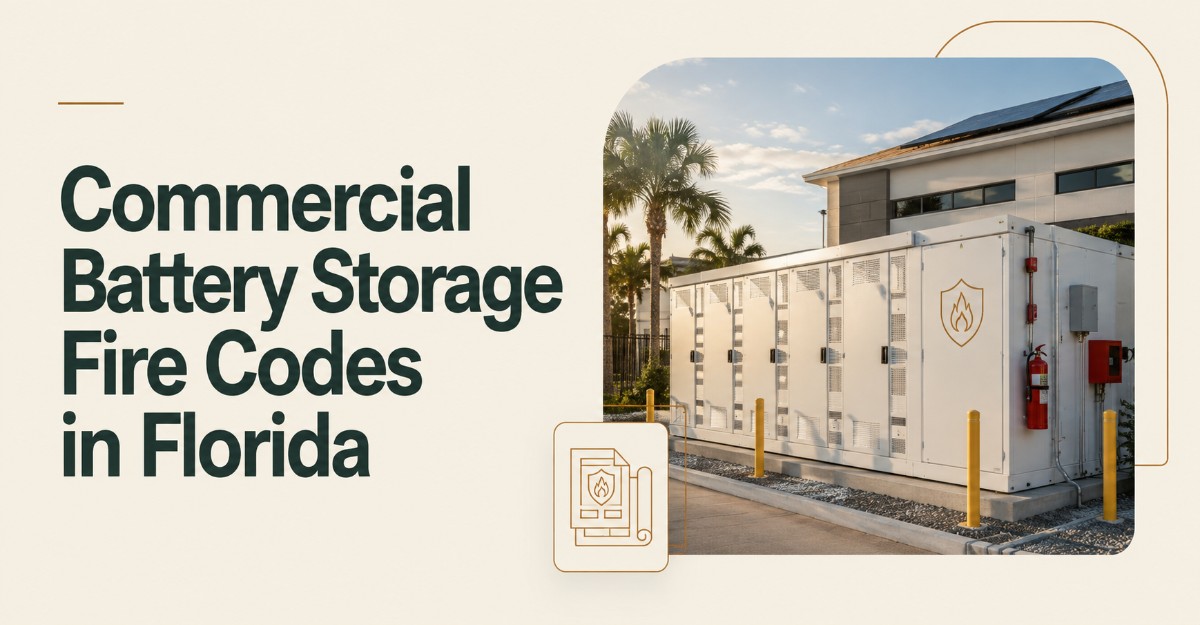
Commercial battery storage fire codes in Florida are set primarily by the Florida Fire Prevention Code (FFPC), 8th Edition, which adopts NFPA 1 (Fire Code) and NFPA 101, and references NFPA 855 for stationary energy storage systems. Any commercial lithium-ion system above 20 kWh of stored energy triggers these requirements, enforced locally by your Authority Having Jurisdiction (AHJ).
- Governing code: Florida uses the FFPC 8th Edition (NFPA 1 + NFPA 101), which references NFPA 855, not the IFC used in most other states.
- Threshold: Fire code requirements apply to commercial lithium-ion BESS above 20 kWh of stored energy.
- Spacing: NFPA 855 caps individual ESS units at 50 kWh and requires 3 ft (914 mm) separation between units and from walls.
- Barriers and water: 2-hour fire-rated barriers apply near exposures; sprinkler design density is 0.3 gpm/ft² per NFPA 13.
- Explosion control: Required per NFPA 69/68 where off-gas can reach 25% of the lower flammable limit (LFL).
- Approvals: Every project needs a Hazard Mitigation Analysis (HMA) and local AHJ (fire marshal plus building official) sign-off.
Which commercial battery storage fire codes apply in Florida?
Commercial BESS in Florida answers to a stack of codes led by the Florida Fire Prevention Code (FFPC), 8th Edition. The FFPC adopts NFPA 1, Fire Code (2021) and NFPA 101, Life Safety Code (2021). NFPA 1, Chapter 52, is the provision that pulls in NFPA 855, the Standard for the Installation of Stationary Energy Storage Systems.
Three more layers complete the picture. The Florida Building Code, 8th Edition (2023) governs structural, electrical, and flood-resistant construction. Equipment must be listed to UL 9540. Interconnection follows the National Electrical Code (NFPA 70), Articles 705 and 706. Local AHJs may add amendments on top of all of this.
Does Florida use NFPA 855 or the IFC?
Florida does not adopt the International Fire Code (IFC). This is the single most common error in national BESS guidance, including Google’s AI Overview, which cites IFC Section 320. Florida’s fire authority flows through NFPA 1 and NFPA 855 instead. The technical requirements overlap heavily (the 20 kWh threshold, 50 kWh unit cap, and 3 ft spacing appear in both frameworks), but the enforceable citations differ. When you submit to a Florida AHJ, reference NFPA 855 sections, not IFC 320, or you invite a plan-review rejection.
Which NFPA 855 edition does Florida enforce?
The FFPC 8th Edition references NFPA 855 through NFPA 1 (2021), which points to the 2020 edition of NFPA 855. Later editions (2023 and the 2026 release) add refinements, but they are not automatically enforceable in Florida until a future FFPC adoption cycle brings them in, or a local AHJ requires them by amendment. Confirm the edition your jurisdiction enforces before locking a design, because separation and testing details shifted between editions.
What capacity threshold triggers fire code compliance?
Commercial lithium-ion battery systems above 20 kWh of aggregate stored energy trigger full NFPA 855 fire code compliance in Florida. Below 20 kWh, a system falls under lighter, residential-style provisions. The 20 kWh line is not about ownership or being labeled “commercial.” It is about stored energy and the occupancy the system sits in.
Most commercial projects run from 100 kWh to several megawatt-hours, so they land far above the threshold. That means the complete requirement set applies: a Hazard Mitigation Analysis, unit spacing, fire barriers, gas detection, ventilation, explosion control, and suppression. There is no partial-compliance tier once you cross 20 kWh.
How does thermal runaway drive the fire code requirements?
Fire codes for BESS exist because lithium-ion cells can enter thermal runaway, a self-sustaining exothermic reaction triggered by an internal short circuit, overcharge, mechanical damage, or external heat. A single failing cell vents flammable and toxic gases (hydrogen, carbon monoxide, and hydrocarbons) and can cascade to neighboring cells within seconds.
NFPA 855 is engineered to contain a single-module event. It mandates spacing, fire barriers, gas detection, exhaust ventilation, and suppression so that one cell failure does not propagate across the array or reach the surrounding building. The codes shift the safety burden away from firefighter intervention and onto the engineered architecture of the system. That design philosophy explains nearly every number in the tables below.
Core fire code requirements and key numbers
The core NFPA 855 requirements enforced in Florida center on stored-energy limits, physical separation, explosion control, and water supply. The table below lists the values a plan reviewer will check first.
| Requirement | Value | Standard |
|---|---|---|
| Compliance threshold | 20 kWh aggregate stored energy | NFPA 855 / NFPA 1 Ch. 52 |
| Maximum stored energy per unit | 50 kWh | NFPA 855 |
| Separation between units and walls | 3 ft (914 mm) | NFPA 855 |
| Fire barrier near exposures | 2-hour fire-resistance rating | NFPA 855 / FBC |
| Explosion control trigger | 25% of the LFL | NFPA 69 / NFPA 68 |
| Automatic sprinkler design density | 0.3 gpm/ft² over design area | NFPA 13 |
| Large-scale fire test | UL 9540A report required | UL 9540A |
| Equipment listing | UL 9540 system listing | UL 9540 |
Separation, barriers, and setbacks
NFPA 855 requires 3 ft between individual ESS units and from walls, plus additional clearance to exposures such as lot lines, occupied buildings, and stored combustibles. The exposure distance is not a single fixed number across every edition and jurisdiction. It is set by the AHJ and can be reduced with UL 9540A large-scale fire test data or a 2-hour fire-rated barrier. Do not assume a flat “20 ft” figure; confirm the enforced value with your reviewer before finalizing the site plan.
Explosion control, ventilation, and suppression
Explosion control is required wherever off-gas from a battery failure can accumulate to 25% of the lower flammable limit. Two paths satisfy it: deflagration venting under NFPA 68, or gas prevention through mechanical exhaust and detection under NFPA 69. Standard building HVAC does not qualify. Suppression follows NFPA 13 at 0.3 gpm/ft², though some UL 9540A-tested systems justify alternative agents or a defend-in-place approach where cell-to-cell propagation was shown not to occur.
What is a Hazard Mitigation Analysis (HMA)?
A Hazard Mitigation Analysis (HMA) is a required engineering study under NFPA 855 that evaluates the failure modes of a specific BESS and documents how the design contains them. In Florida it is typically prepared or stamped by a licensed Fire Protection Engineer (FPE) or professional engineer.
The HMA addresses thermal runaway propagation between cells and modules, off-gas composition and volume, deflagration risk, fire service access and remote shutdown, and fire-flow water supply calculations. It is the analytical backbone the AHJ reviews before issuing a permit. A weak HMA, or one that relies on generic manufacturer boilerplate rather than the installed configuration, is the most frequent cause of Florida plan-review delays.
The Florida BESS compliance process, step by step
Getting a commercial BESS approved in Florida follows a predictable five-phase sequence. The factor that most determines success is engaging the AHJ before, not after, you finalize the design.
UL 9540 + UL 9540A data
Design + HMA (FPE)
AHJ plan review
Barriers, detection, suppression
EOP + responder walkthrough
- Verify the product. Confirm the full assembly is listed to UL 9540 and has a completed UL 9540A large-scale fire test report. Refuse any system without an unredacted 9540A report.
- Engineer and analyze. A Florida-registered FPE prepares the HMA and stamps the design, including off-gas behavior and water-supply math.
- Submit to the AHJ. Provide the HMA, electrical single-line diagrams matching NEC Articles 705 and 706, the civil site plan, and flood-elevation data to the fire marshal and building department.
- Construct the infrastructure. Build structural pads, 2-hour barriers where required, gas detection, exhaust or deflagration venting, and the suppression system.
- Commission and integrate. Finalize an Emergency Operations Plan and run an on-site walkthrough with local fire crews covering remote shutdown, gas indicators, and standpipe connections.
How do battery chemistries change the requirements?
Battery chemistry shifts the code burden but never removes it. Lithium iron phosphate (LFP) has a higher thermal runaway onset, roughly 250-270°C, and lower propagation energy, which usually simplifies the HMA. Nickel manganese cobalt (NMC) packs more energy per kilogram but runs away nearer 210°C and off-gasses more, so it demands faster suppression. Flow batteries use non-flammable aqueous electrolytes and avoid classic cell runaway, yet they are not exempt from NFPA 855, contrary to a common claim. They still require liquid containment, ventilation (hydrogen management in some designs), and full AHJ review.
| Chemistry | Runaway onset (typical) | Code implication | Typical suppression |
|---|---|---|---|
| LFP (lithium iron phosphate) | ~250-270°C | Simplest HMA path | Sprinklers plus gas detection |
| NMC (nickel manganese cobalt) | ~210°C | Aggressive suppression, more off-gas | Water mist or clean agent |
| Flow (vanadium / iron) | No cell runaway | Containment and venting, not exempt | Liquid containment basins |
Indoor vs outdoor commercial BESS in Florida
Outdoor prefabricated enclosures are usually the lower-cost compliance path in Florida because the factory UL listing carries most of the fire-rating burden and there is no building to evacuate. Indoor rooms buy climate control and weather protection but demand full smoke control, gas monitoring, and dedicated sprinkler zones.
| Configuration | Advantage | Disadvantage | Code implication |
|---|---|---|---|
| Outdoor prefab container | Lower indoor risk, factory-listed | Larger footprint, storm-surge exposed | Reduced spacing allowed with 2-hour shell and 9540A data |
| Indoor dedicated room | Climate-controlled, weather-protected | Costly retrofit, complex ventilation | Full smoke control, gas monitoring, dedicated sprinklers |
For most Florida commercial sites with land available, outdoor siting wins on cost and evacuation risk. Indoor siting earns its premium only where roof space, aesthetics, or extreme coastal exposure forces it.
Florida-specific factors: flood zones, hurricanes, and local AHJs
Florida adds coastal and wind requirements that generic BESS guidance ignores. Any facility in a Special Flood Hazard Area must be sited under the Florida Building Code flood provisions, with equipment elevated above the base flood elevation (BFE). Submersion of lithium cells causes short circuits and corrosion that can lead to fire, so raising ground-mount platforms above the BFE is both a code and a safety measure.
Wind loads matter too. In the High Velocity Hurricane Zone (HVHZ) covering Miami-Dade and Broward counties, enclosures and anchoring face stricter structural review. Salt-air corrosion shortens the life of enclosures and electrical connections statewide.
Two more points get overlooked. The State Fire Marshal draws authority from Chapter 633, Florida Statutes, and has advanced draft Uniform Firesafety Standards for Energy Storage Systems under the Florida Administrative Code (Rule Chapter 69A), which may tighten requirements over time. Separately, grid interconnection runs through your utility (FPL, Duke Energy, or TECO) and the Florida Public Service Commission, on a track parallel to fire permitting. Start both early.
How much does compliance cost and how long does it take?
Fire code compliance for a typical 100 kWh to 500 kWh Florida commercial BESS adds roughly $28,000 to $77,000 in engineering, monitoring, suppression, and permitting, and 4 to 6 months of runway before interconnection. The figures below are typical practitioner ranges and scale with system size and AHJ complexity.
Total added compliance cost: $28,000 – $77,000
Total runway before interconnection: 4 – 6 months
| Line item | Typical cost | Typical timeline |
|---|---|---|
| FPE and Hazard Mitigation Analysis | $8,000 – $20,000 | 4 – 6 weeks |
| Gas detection and thermal monitoring | $5,000 – $15,000 | With build |
| Suppression (clean agent or water mist) | $12,000 – $35,000 | With build |
| Permitting and AHJ review | $2,500 – $7,000 | 8 – 12 weeks |
| Physical install and testing | Varies | 3 – 4 weeks |
Common compliance mistakes
The failures below cause the most Florida plan-review rejections and field problems. Each has a straightforward fix.
- Citing the IFC instead of NFPA 855. Florida enforces NFPA-based codes; IFC 320 references get flagged. Reference NFPA 855 sections in every submittal.
- Siting outdoor ground-mount below the BFE. Coastal floodwater shorts lithium packs. Elevate platforms above the base flood elevation and add remote grid isolation.
- Treating HVAC as explosion control. Standard ducts do not vent deflagration gases. Design explicit exhaust or deflagration paths that discharge to open air.
- Relying on ABC extinguishers. Portable dry chemical units cannot arrest an active lithium runaway. Install direct-to-module cooling or suppression plumbing.
- Buying without a full UL 9540A report. The AHJ will request it to verify non-propagation. Never accept a redacted or missing report.
- Skipping the AHJ pre-application meeting. Local water supply and access rules vary. A pre-submittal meeting prevents costly redesigns.
The bottom line
Commercial battery storage fire codes in Florida reduce to one path: FFPC, 8th Edition, to NFPA 1, Chapter 52, to NFPA 855, enforced by your local AHJ and layered with Florida Building Code flood and wind rules. Get the UL 9540 and UL 9540A data first, have a Florida FPE prepare the HMA, meet the fire marshal before you submit, and design for the 20 kWh threshold, 50 kWh unit cap, 3 ft spacing, 2-hour barriers, and 25% LFL explosion trigger. Do that and permitting becomes a schedule item, not a surprise.
Frequently asked questions
Are residential battery systems covered by these codes? Residential systems below 20 kWh fall under lighter NFPA 855 provisions and simpler permitting. Above 20 kWh, or in multi-family and commercial occupancies, the full commercial requirement set applies regardless of the building type. The stored-energy total, not the home-versus-business label, decides.
Do I need a fire sprinkler for an outdoor container BESS? Not always. NFPA 855 allows outdoor listed enclosures with UL 9540A test data showing non-propagation to use alternative protection instead of a full 0.3 gpm/ft² sprinkler system. Indoor rooms almost always require sprinklers. Your AHJ makes the final call based on the 9540A results.
Who is the AHJ for a BESS project in Florida? The AHJ is typically the local fire marshal working alongside the county or city building official. Both review the submittal. In some jurisdictions the State Fire Marshal’s office is involved. Identify your specific reviewers before designing, since local amendments to the FFPC vary widely across Florida.
Does UL 9540A testing let me reduce spacing? Yes. UL 9540A large-scale fire test data showing that a failure does not propagate cell-to-cell or unit-to-unit can justify reducing separation below the default distances or replacing a fire barrier. This is why an unredacted 9540A report is non-negotiable for commercial projects.
What happens if my project is in a flood zone? In a Special Flood Hazard Area, the Florida Building Code flood provisions require equipment elevated above the base flood elevation. You will also need remote grid-isolation switches and a coordinated emergency plan. Coastal saltwater intrusion into lithium packs is a fire risk, so elevation is both a code requirement and a safety safeguard.