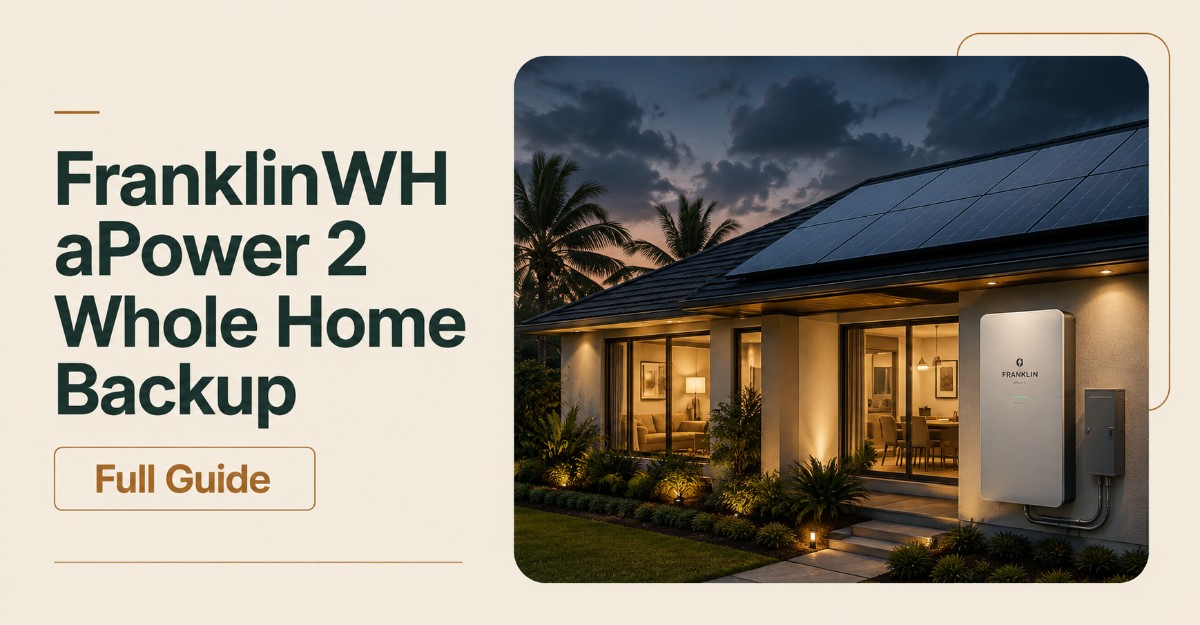
The FranklinWH aPower 2 is an AC-coupled home battery that delivers 15 kWh of usable storage and 10 kW of continuous output, enough to power an entire house, including a 5-ton central air conditioner, during a grid outage. Paired with the aGate controller, one unit forms an automated whole-home microgrid.
What Is the FranklinWH aPower 2?
The FranklinWH aPower 2 is a premium residential lithium iron phosphate (LFP) battery built for whole-home backup rather than single-circuit coverage. One unit stores 15 kWh of usable energy and pushes 10 kW of continuous power, which is roughly double the output of an older Tesla Powerwall 2 or an Enphase IQ Battery 5P.
FranklinWH pairs every battery with the aGate, a smart service panel that mounts beside your main electrical panel. The aGate handles transfer switching, load management, solar routing, and generator control, so the aPower 2 is the storage while the aGate is the brain. The system is AC-coupled, meaning it works with any solar inverter brand and also runs fine in homes with no solar at all. Stacked to its limit, fifteen units on one aGate reach 225 kWh, enough for extended off-grid living or a small farm.
How Does the aPower 2 Whole Home Backup Work?
The aPower 2 whole home backup works as an automated microgrid: the aGate constantly monitors grid voltage, and when it detects a failure it isolates your house within milliseconds using a motorized transfer switch, then the battery’s inverter supplies AC power from its LFP cells. No manual intervention is needed.
During the switch, the aGate opens the connection to the utility to prevent islanding, which is the dangerous back-feeding of power onto lines a lineworker may be repairing. The changeover is fast enough that most homes see no more than a brief flicker. If a well pump or compressor starts, the battery releases up to 15 kW of surge for 10 seconds to cover the motor-startup spike, then settles back to its 10 kW continuous ceiling.
What happens the moment the grid goes down?
When the grid fails, the aGate runs a fixed sequence in under a second. First it confirms the outage, then it fires the internal transfer switch to island the home, then the aPower 2 inverter energizes the panel. If the battery drops below a threshold you set, the aGate sheds pre-mapped heavy loads such as EV chargers or a hot tub, keeping refrigerators, medical devices, and lights alive. This load-shedding logic is the difference between four comfortable hours and one wasteful one.
How does it save money during normal operation?
While the grid is healthy, the aPower 2 shifts your bill rather than backing it up. Surplus solar bypasses the house and recharges the battery at up to an 8 kW charge rate. During peak time-of-use windows, the aGate stops drawing utility power and runs the home from stored energy, so you buy less electricity at the most expensive hours. In a strong solar market this arbitrage can offset a meaningful share of the equipment cost over the warranty term.
FranklinWH aPower 2 Specifications
The specifications below reflect FranklinWH’s published aPower 2 datasheet. The single most consequential number is the 10 kW continuous rating, because that, not capacity, decides whether one battery can start heavy motor loads.
| Specification | Value |
|---|---|
| Usable capacity | 15 kWh per unit, plus 1.1 kWh black-start reserve |
| Continuous output | 10 kW, AC-coupled |
| Peak surge | 15 kW for up to 10 seconds |
| Battery chemistry | Lithium iron phosphate (LFP) |
| Maximum solar charge rate | 8 kW |
| Scalability | Up to 15 units per aGate (225 kWh) |
| Round-trip efficiency | About 89% |
| Weather rating | IP67, submersible to 1 m for 30 minutes |
| Operating temperature | Minus 20°C to 55°C (minus 4°F to 131°F), fanless |
| Unit weight | About 400 lb (181 kg) |
| Warranty | 15 years or 60 MWh throughput at 70% capacity |
Two figures deserve a practitioner’s flag. The fanless convection design keeps noise under 30 dBA, quieter than a refrigerator, but the roughly 89% round-trip efficiency means AC coupling loses about 11% of solar energy across the DC-to-AC-to-DC path. On a 10 kWh charge, that is roughly 1.1 kWh you never get back.
aPower 2 vs aPower S: Which One Should You Install?
Choose the aPower 2 for retrofits and no-solar homes, and choose the aPower S for brand-new solar-plus-storage builds. The aPower 2 is AC-coupled only, so it leans on your existing solar inverter, while the aPower S adds direct DC inputs that accept up to 20 kW of raw solar straight into the battery.
| Feature | aPower 2 | aPower S |
|---|---|---|
| Coupling | AC only | Hybrid AC and DC |
| Best fit | Existing solar or no solar | New solar install |
| Direct DC solar input | None, external inverter | Up to 20 kW |
| Usable capacity | 15 kWh | 15 kWh |
| Continuous output | 10 kW | 10 kW |
| Efficiency edge | Lower (extra conversion) | Higher (DC path) |
Both batteries run on the same aGate, and both can add the aHub module for auxiliary smart circuits, vehicle-to-load, and generator ports. On a standard 200 A meter-main home, the Meter-Main Adapter (a meter-collar option) can cut installation labor versus a full sub-panel build.
Can a Single aPower 2 Really Run Your Whole Home?
Yes on power, but capacity is the honest limit. One aPower 2 has the 10 kW muscle to start and run a 5-ton central air conditioner, yet its 15 kWh tank drains in about 3 to 4 hours if that AC runs hard and continuously. Power decides what turns on; capacity decides how long it stays on.
Here is realistic math. A refrigerator, Wi-Fi, lights, and phone charging draw roughly 5 to 6 kWh per day, so one unit covers essentials for about 2.5 to 3 days with no solar. Add a modern 3-ton AC pulling about 3.5 kW at a 50% summer duty cycle and you burn close to 42 kWh per day, far past a single battery. That gap is why FranklinWH lets you stack units and pair a generator. For most homes wanting full comfort through a multi-day outage, two aPower 2 units (30 kWh) is the practical floor, and solar recharge extends everything.
How Much Does the FranklinWH aPower 2 Cost?
A single aPower 2 whole-home setup typically runs $17,500 to $18,500 installed before incentives, breaking down to roughly $11,000 for the battery, $3,500 for the aGate, and the balance in labor and materials. That works out to about $1,177 per usable kWh, which sits above budget-tier batteries.
| Cost item | Typical figure |
|---|---|
| aPower 2 battery (equipment) | About $11,000 |
| aGate controller (equipment) | About $3,500 |
| One-battery system, installed | $17,500 to $18,500 |
| Two-battery system, installed | About $35,300 |
| Install labor time | 5 to 7 hours, two techs |
| Interconnection and permits | 4 to 8 weeks |
One point the AI Overview skips: federal incentives changed in 2025. The 30% Residential Clean Energy Credit under Section 25D historically covered standalone battery storage of 3 kWh or more, but under 2025 federal tax legislation that homeowner credit was set to end for systems placed in service after December 31, 2025. Because incentive rules shift quickly, confirm current federal, state, and utility programs with a tax professional before you budget, since a lost 30% credit changes the payback math substantially.
aPower 2 vs Tesla Powerwall 3 vs Enphase IQ 5P
The aPower 2 wins on capacity per unit and warranty length, but the claim that it doubles “competitor” output is only half true in 2026. The Tesla Powerwall 3 actually delivers 11.5 kW continuous, more than the aPower 2’s 10 kW, though the modular Enphase IQ Battery 5P is far smaller at 3.84 kW.
| Spec | aPower 2 | Powerwall 3 | Enphase IQ 5P |
|---|---|---|---|
| Usable capacity | 15 kWh | 13.5 kWh | 5 kWh |
| Continuous output | 10 kW | 11.5 kW | 3.84 kW |
| Coupling | AC | DC, built-in inverter | AC |
| Warranty | 15 years | 10 years | 15 years |
| Max stack | 15 units, 225 kWh | 4 units, 54 kWh | Highly modular |
| Installed, one unit | $17,500 to $18,500 | $14,000 to $16,000 | $7,000 to $9,000 |
Verdict by need. The aPower 2 leads for large homes that want the most storage and the longest warranty from a single box, and for anyone pairing a standby generator, which FranklinWH orchestrates natively. The Powerwall 3 wins on price and integrated solar for new PV builds. The IQ 5P suits small essentials-only backups where 5 kWh increments and a low entry price matter more than raw power.
Common Installation and Operating Mistakes
Most aPower 2 disappointment traces back to a handful of avoidable errors, not the hardware. These are the ones installers see repeatedly.
- Undersizing capacity for the load. One 15 kWh unit has the power to run central AC but not the runtime to do so all night. Size capacity to your outage length, not just your peak wattage.
- Skipping smart-circuit mapping. If you never assign heavy loads like EV chargers or a hot tub to the aGate’s shed relays, they drain your reserve in the first hour instead of being dropped automatically.
- Mounting in direct sun in hot climates. The chassis tolerates 131°F ambient, yet direct radiation on the metal can trigger thermal throttling that quietly cuts charge and discharge rates.
- Ignoring the black-start reserve during a dead-battery outage. The aPower 2 holds an isolated 1.1 kWh reserve; clear debris off panels or start the generator so the aGate can use it to re-engage the inverters.
- Assuming remote monitoring equals backup. If Wi-Fi drops and the app shows “communication disconnect,” the system still backs up your home offline on local logic. Power-cycle the router to restore reporting.
Who Should Buy the aPower 2?
The aPower 2 is the right pick for high-demand homes and the wrong pick for lights-and-fridge budgets. Match the system to your goal below before committing, because the cost-per-kWh premium only pays off when you actually use the power headroom.
Frequently Asked Questions
How many aPower 2 batteries do I need for whole-home backup? One unit covers essentials plus intermittent AC for a large home, and it will run a 5-ton compressor. For continuous heavy cooling or a multi-day outage without much solar, plan on two units (30 kWh). Beyond that, stack up to fifteen on a single aGate.
Is the FranklinWH aPower 2 safe indoors or outside? The aPower 2 uses lithium iron phosphate cells, the most thermally stable common lithium chemistry, and carries an IP67 rating for full outdoor mounting in rain and dust. It runs fanless below 30 dBA, so wall placement in a garage or exterior wall both work.
Can the aPower 2 work with a backup generator? Yes. The aGate natively integrates diesel, propane, or natural-gas standby generators and can start one to recharge the batteries during a prolonged outage. That generator-plus-solar orchestration is a core reason long-outage households choose FranklinWH over battery-only rivals.
What is the aPower 2 warranty and how long do the cells last? FranklinWH warrants the aPower 2 for 15 years or 60 MWh of throughput, whichever comes first, guaranteeing at least 70% capacity at that point. LFP chemistry typically sustains several thousand full cycles, which comfortably outlasts the 10-year terms common on competing packs.
Does the aPower 2 qualify for the federal tax credit? Battery storage historically qualified for the 30% Residential Clean Energy Credit, but 2025 federal legislation set that homeowner credit to expire for systems placed in service after December 31, 2025. Verify current federal, state, and utility incentives with a tax professional before purchasing.
The Bottom Line
The FranklinWH aPower 2 whole home backup is the strongest single-battery choice for large homes that want to run heavy HVAC through an outage, backed by a 15-year warranty and true generator integration. It costs more per kWh and loses about 11% to AC conversion, so budget, essentials-only buyers are better served elsewhere. Match unit count to your outage length, map your shed loads, and the system delivers genuine grid independence.