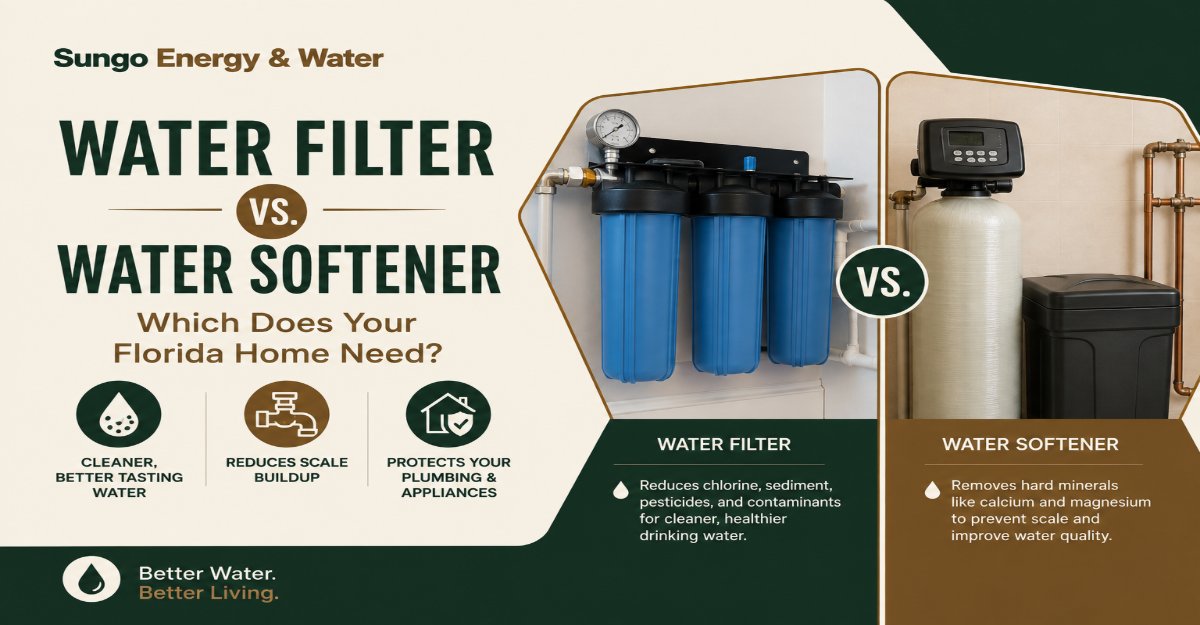
For most Florida homes, a water filter and water softener are not competing solutions. A softener wins when calcium and magnesium cause scale, while a filter wins when chlorine, sediment, odor or a tested contaminant is the problem. Homes with both conditions need filtration first and softening second.
Quick Verdict
Municipal home with scale and chlorine: Install both.
Scale without odor: Choose a salt-based softener.
Chlorine taste without scale: Choose carbon filtration.
Private well with sulfur or iron: Treat iron and sulfur first.
Drinking-water concerns: Use certified point-of-use filtration or RO.
Condo with limited space: Prioritize under-sink filtration.
Master Comparison Table
Ratings use a 1–5 scale, where 5 means the system is highly effective for that specific criterion. Costs are broad planning ranges from the supplied brief and must be confirmed through local quotes.
| Criterion | Salt-Based Softener | Whole-House Carbon Filter | Under-Sink RO | Salt-Free Conditioner | Iron/Sulfur Filter |
|---|---|---|---|---|---|
| Removes hardness minerals | 5/5 | 0/5 | 4/5 at one faucet | 0/5 | 0/5 |
| Prevents whole-house scale | 5/5 | 0/5 | 0/5 | 2–4/5, chemistry-dependent | 0/5 |
| Reduces chlorine taste or odor | 0/5 | 4–5/5 with suitable media | 4–5/5 at one faucet | 0/5 | 0–1/5 |
| Treats iron or sulfur | 1–2/5 at low levels only | 1–2/5 | 2–4/5 at one faucet | 0/5 | 5/5 when properly sized |
| Treats health-related contaminants | Claim-specific | Claim-specific | Claim-specific | 0/5 | Claim-specific |
| Typical application | Whole house | Whole house | Drinking and cooking tap | Whole house | Whole house on wells |
| Estimated hardware range | $800–$2,500 | $600–$2,000 | $200–$1,000+ | $800–$2,500 | $1,200–$3,500+ |
| Estimated installation | $500–$1,500 | $400–$1,000 | $150–$600 | $500–$1,500 | $700–$2,000+ |
| Consumables | Salt | Media or cartridges | Filters and membrane | Usually media replacement | Media and service parts |
| Wastewater | Regeneration discharge | Backwash on some tanks | Reject water | Usually none | Backwash water |
| Space requirement | Two tanks in many systems | One large tank or cartridges | Under-sink cabinet | One tank | One or more tanks |
| Best certification reference | NSF/ANSI 44 | NSF/ANSI 42 or 53 | NSF/ANSI 58 | Performance claim varies | Contaminant-specific claim |
NSF/ANSI 44 covers residential cation-exchange softeners. NSF/ANSI 42 generally addresses aesthetic effects such as taste and odor, NSF/ANSI 53 addresses specified health-effect reductions, and NSF/ANSI 58 applies to point-of-use reverse-osmosis systems. Certification must include the exact reduction claim needed, not merely the NSF logo. (NSF)
What Each System Actually Removes
A salt-based water softener is engineered around hardness ions, principally calcium and magnesium. Its resin exchanges those ions for sodium or potassium and periodically regenerates with brine. EPA identifies cation exchange as an effective technology for removing hardness ions, while NSF/ANSI 44 provides the principal residential-softener standard. (US EPA)
A whole-house filter is a broader product category. Its performance depends entirely on its media:
- Sediment cartridges trap particles larger than their rated pore size.
- Activated carbon commonly reduces chlorine, taste and odor.
- Catalytic carbon may be selected for chloramine reduction.
- Specialized media may target substances such as iron, manganese or hydrogen sulfide.
- A filter only removes a contaminant when its design, capacity and operating conditions support that claim.
Reverse osmosis uses membrane separation at one drinking-water outlet in most residential installations. It can reduce many dissolved substances, but the reduction rate varies by contaminant, membrane, pressure, temperature and system condition. NSF/ANSI 58 certification is more meaningful than an unsupported “removes 99%” advertisement. (NSF)
A salt-free conditioner does not remove calcium and magnesium. Technologies such as template-assisted crystallization attempt to change mineral behavior so that scale is less likely to adhere to surfaces. Hardness remains measurable in the treated water.
Criterion winner: A salt-based softener is the clear winner for whole-house hardness removal, while a properly certified filter wins for the particular contaminant named in its reduction claim.
Florida Water Hardness and Scale
Water hardness is generally caused by calcium and magnesium compounds. USGS classifies water above 180 mg/L as calcium carbonate as very hard. That concentration is approximately 10.5 grains per gallon, using 17.1 mg/L per grain. (USGS)
Florida’s geology can contribute calcium, magnesium and bicarbonate to groundwater. USGS identifies calcium, magnesium and sodium among the common cations in the Upper Floridan aquifer, but this does not mean every Florida tap has the same hardness. Municipalities may use different aquifers, surface water, desalination, lime softening or blended supplies. (USGS)
Look for these hardness symptoms:
- White crust around faucets and showerheads
- Scale inside kettles or coffee makers
- Recurring spots on glassware
- Soap that lathers poorly
- Water-heater sediment
- Mineral deposits on shower doors
Do not diagnose hardness from dry skin alone. Skin symptoms can have many causes, and a softener should not be presented as medical treatment.
When hardness justifies a softener
A practical decision framework is:
| Hardness Result | Classification | Treatment Decision |
|---|---|---|
| 0–3.5 GPG | Soft to moderately hard | Softener usually unnecessary |
| 3.6–7 GPG | Moderately hard | Consider symptoms and appliance impact |
| 7.1–10.5 GPG | Hard | Softener often worthwhile where scale is visible |
| Above 10.5 GPG | Very hard | Salt-based softening is usually the most complete scale solution |
These bands translate the USGS milligram-per-liter classifications into approximate grains per gallon. Household tolerance and plumbing temperature still matter because heated surfaces accumulate scale faster. (USGS)
Criterion winner: A salt-based softener wins whenever laboratory or utility data confirms significant hardness and the homeowner wants calcium and magnesium removed rather than merely conditioned.
Chlorine, Chloramine, Taste and Odor
Municipal utilities disinfect water to control microbial risk. The disinfectant may be free chlorine, chloramine or a treatment sequence that changes seasonally. Florida utilities are required to monitor disinfectant residuals and disinfection byproducts, but the treatment method is not identical across the state. (FDEP)
A softener does not meaningfully solve a chlorine taste or swimming-pool odor. Granular activated carbon is commonly used for free chlorine, while chloramine may require catalytic carbon, greater media volume or longer contact time.
That distinction affects sizing. A small cartridge marketed as a “whole-house filter” may provide inadequate contact time at the 8–15 gallons per minute used by a busy household. A larger backwashing tank can hold more carbon and support higher service flow, although performance still depends on the manufacturer’s specifications.
Carbon should normally be installed before a softener where disinfectant reduction is part of the plan. Removing chlorine or chloramine upstream can reduce oxidative stress on the softener resin. The final layout must still follow each manufacturer’s installation instructions.
Criterion winner: A properly sized carbon system wins for municipal disinfectant taste and odor; a water softener provides almost no value for this criterion.
Iron, Sulfur and Private-Well Problems
Private-well owners are responsible for water testing and treatment. Florida DEP provides private-well sampling programs in certain contamination areas and describes point-of-use RO as an option when ingestion risks involve inorganic substances such as nitrate, arsenic or lead. (FDEP)
Three well-water symptoms require different diagnoses:
| Symptom | Possible Cause | Appropriate Test | Common Treatment |
|---|---|---|---|
| Orange or brown stains | Iron | Dissolved and total iron | Oxidation plus filtration |
| Black stains | Manganese | Manganese concentration | Specialized oxidation media |
| Rotten-egg odor | Hydrogen sulfide or bacteria | H₂S and bacteriological testing | Aeration, oxidation or disinfection |
| Blue-green stains | Low pH or copper corrosion | pH, alkalinity and copper | Neutralization and corrosion review |
| Cloudiness or grit | Sediment | Turbidity and particle analysis | Sediment filtration |
A softener can handle limited dissolved iron under certain manufacturer conditions, but high iron loads can foul resin, stain fixtures and increase regeneration frequency. Installing the softener first is therefore a poor default when substantial iron or sulfur is present.
The usual well-water sequence is:
- Pressure tank and raw-water sampling point
- Oxidation, aeration or disinfection where required
- Iron, sulfur or sediment filtration
- Water softener if hardness remains high
- UV treatment where microbiological testing and system design justify it
- Certified drinking-water filtration or RO at the kitchen
The exact order can change with pH, tannins, bacteria, arsenic, nitrate, salinity and the treatment chemistry selected.
Criterion winner: A contaminant-specific oxidation or filtration system wins for iron and sulfur; a softener should be added only after those problems are controlled and hardness is confirmed.
Drinking-Water Safety and Purity
Neither “filter” nor “softener” automatically means safer drinking water.
A conventional water softener is not a general-purpose purifier. It removes calcium and magnesium and may reduce certain positively charged substances when specifically engineered and certified to do so. It does not reliably eliminate bacteria, nitrate, PFAS, pesticides or every dissolved metal.
A carbon filter is also not universal. NSF/ANSI 42 certification may verify aesthetic claims such as chlorine, taste or odor reduction. Health-related reduction claims are generally evaluated under standards such as NSF/ANSI 53. Buyers should read the certified contaminant list and rated capacity rather than relying on words such as “premium,” “medical-grade” or “advanced.” (NSF International)
An NSF/ANSI 58-certified RO system is often the strongest residential choice for high-purity drinking and cooking water. However:
- It normally treats one faucet, not the entire house.
- It produces reject water.
- It requires adequate pressure.
- Its membrane and prefilters require scheduled replacement.
- Reduction claims still vary by certified model.
- It does not replace well disinfection when microbial contamination exists.
Criterion winner: A certified point-of-use RO system wins for broad drinking-water treatment, but a contaminant-specific certified filter may be less wasteful and less expensive when only one substance requires reduction.
Flow Rate and Water Pressure
Whole-house equipment must handle peak demand, not merely average daily consumption.
A home can briefly demand more than 10 gallons per minute when showers, washing machines, toilets and outdoor faucets operate together. Undersized carbon tanks, sediment cartridges or iron filters can create a noticeable pressure drop.
Compare three numbers before purchase:
- Service flow rate: The continuous flow the system can treat effectively.
- Peak flow rate: The short-duration maximum it can pass.
- Pressure drop: The reduction in pressure at the stated flow and media condition.
Softener sizing also requires hardness load:
Daily hardness load = people × gallons per person × hardness in GPG
For four people using 60 gallons each per day at 12 GPG:
4 × 60 × 12 = 2,880 grains per day
A system regenerating at a practical working capacity of 30,000 grains would theoretically run about ten days before reserve capacity and iron compensation. Selecting equipment from the advertised maximum grain figure alone can cause inefficient salt use.
Filters require different calculations. Carbon performance depends on media volume and contact time. Sediment cartridges depend on micron rating, surface area and dirt-holding capacity. Iron filters depend on contaminant concentration, pH, oxygen demand and backwash rate.
Criterion winner: Neither technology wins automatically; the correctly sized system wins, while undersizing either a softener or filter can reduce pressure and treatment performance.
Installation Order and Plumbing Requirements
For a municipal-water home needing sediment removal, carbon filtration, softening and kitchen RO, the usual sequence is:
Main shutoff → sediment prefilter if needed → carbon filter → softener → household plumbing → under-sink RO
The carbon-before-softener arrangement protects the resin from disinfectant exposure. The point-of-use RO remains last because it polishes water used for drinking and cooking.
For private wells, the sequence must be designed around the raw-water analysis:
Well pressure equipment → oxidation or disinfection → iron/sulfur filtration → softener → UV if specified → household plumbing → kitchen RO
Installation also requires checking:
- Available floor space
- Drain access
- Electrical outlet location
- Main pipe diameter
- Bypass-valve clearance
- Backwash flow capacity
- Septic or sewer discharge rules
- Outdoor freeze and weather exposure
- Condo association or landlord restrictions
A salt-free conditioner may require less drainage infrastructure because many units do not regenerate. That can make conditioning practical where a conventional softener cannot be installed, although the water remains chemically hard.
Criterion winner: Carbon followed by softening is the most defensible municipal-water layout, while well-water order must be determined by a complete water analysis.
Purchase Price and Ten-Year Cost
The source brief estimates the following broad costs:
| System | Hardware | Installation | Typical Recurring Expense |
|---|---|---|---|
| Salt-based softener | $800–$2,500 | $500–$1,500 | Salt, cleaning and service |
| Whole-house carbon | $600–$2,000 | $400–$1,000 | $100–$300 yearly in media or filters |
| Under-sink RO | $200–$1,000+ | $150–$600 | Prefilters, postfilter and membrane |
| Combined carbon and softener | $1,400–$4,500 | $900–$2,500 | Salt plus filter maintenance |
| Well treatment train | $2,500–$8,000+ | Varies | Media, backwash and professional service |
These are planning ranges from the supplied material and should not be treated as Florida contractor quotes. Plumbing modifications, well chemistry, equipment capacity and permit requirements can move the installed price substantially.
A ten-year comparison should include:
Ten-year cost = equipment + installation + consumables + water + electricity + repairs
The cheapest initial system can become the expensive choice when:
- A cartridge clogs every month.
- A softener regenerates too frequently.
- Iron destroys softener resin.
- An undersized carbon tank requires early media replacement.
- Proprietary replacement filters cost several times more than standard cartridges.
- The equipment cannot be serviced by another local dealer.
Ask whether the control valve, cartridges and replacement media are proprietary. Switching costs become significant when one dealer controls all parts, programming and service.
Criterion winner: A single correctly targeted system wins on cost; installing both is justified only when testing confirms both hardness and filtration problems.
Maintenance, Salt and Wastewater
Salt-based softener maintenance
A conventional softener requires:
- Periodic salt loading
- Brine-tank inspection
- Salt-bridge checks
- Injector or control-valve cleaning
- Resin cleaning when iron is present
- Regeneration and drain-line monitoring
A salt bridge forms when a hardened layer develops above an empty space in the brine tank. The tank may appear full even though water cannot dissolve enough salt. The bridge should be broken carefully without damaging the tank.
Continuous draining can indicate a stuck regeneration cycle, seal failure, control problem or restricted valve. The system should be placed in bypass if necessary while the fault is diagnosed.
Carbon-filter maintenance
Cartridge systems need replacement when their rated capacity is reached or pressure loss becomes excessive. Tank-style carbon systems may require backwashing and eventual media replacement.
New carbon media can release harmless black fines. The system should be flushed according to the manufacturer’s instructions before normal use.
RO maintenance
RO systems usually require more individual service items:
- Sediment prefilter
- Carbon prefilter
- Membrane
- Post-carbon filter
- Storage-tank pressure check
- Sanitization
- Leak inspection
Environmental trade-offs
A softener consumes salt and discharges regeneration water containing displaced hardness minerals and chloride. RO sends a portion of incoming water to the drain. Backwashing filters also use water.
Salt-free conditioning generally produces less treatment wastewater, but that advantage comes with a performance trade-off: calcium and magnesium remain in the supply.
Criterion winner: Salt-free conditioning has the lowest routine wastewater burden, while carbon filtration generally requires less frequent attention than a conventional softener or multistage RO system.
Certification and Marketing Claims
The most important purchase question is not “Is it certified?” It is:
Certified by whom, to which standard, for which reduction claim, at what capacity and flow rate?
Use this checklist:
| Product Type | Standard to Look For | What to Verify |
|---|---|---|
| Cation-exchange softener | NSF/ANSI 44 | Hardness capacity, salt efficiency and flow |
| Carbon drinking-water filter | NSF/ANSI 42 or 53 | Exact aesthetic or health claim |
| Reverse osmosis | NSF/ANSI 58 | Exact contaminant reductions and recovery data |
| UV system | NSF/ANSI 55 | Class A or Class B designation |
| Plumbing components | NSF/ANSI/CAN 61 or 372 | Material safety and lead content, where applicable |
NSF maintains certified-product listings that allow consumers to confirm the manufacturer, model and individual reduction claims. (NSF International)
Avoid interpreting these statements as equivalent:
- “Uses NSF-certified components”
- “Tested to NSF standards”
- “Designed according to NSF principles”
- “The complete model is certified”
Only the last statement necessarily indicates that the complete listed system has been independently certified, and even then the certified claims must be checked.
Criterion winner: Neither system category wins; the product with complete third-party certification for the required performance claim is the safer purchase.
Which Should You Choose?
Municipal Home With Scale and Chlorine
Recommendation: Install a whole-house carbon filter followed by a salt-based softener.
Choose this combination when testing confirms hard water and the utility uses chlorine or chloramine that creates objectionable taste, odor or shower exposure.
The carbon system addresses the disinfectant. The softener addresses calcium and magnesium. An under-sink RO unit can be added when the household also wants high-purity drinking water, but RO is not required merely because the home has hard water.
Do not automatically buy a three-system package. Read the utility’s current consumer confidence report and test hardness at the home first.
Municipal Home With Chlorine but Little Scale
Recommendation: Install carbon filtration without a softener.
A softener adds cost, salt use and regeneration discharge without solving the main complaint. Select carbon media based on whether the utility uses chlorine or chloramine, and size the system for the home’s peak flow.
A certified under-sink carbon block may be enough when the concern is limited to drinking-water taste. Whole-house equipment is justified when showers, laundry and every faucet require treatment.
Home With Severe Scale but Acceptable Taste
Recommendation: Choose a salt-based softener.
A carbon filter will not remove the calcium and magnesium responsible for crusted fixtures, spotty glass and water-heater scale. Salt-free conditioning may reduce scale adhesion, but it will not deliver zero-hardness water or the same soap-lathering effect.
A softener should be sized from measured hardness, household water use and any iron concentration.
Private-Well Home With Rotten-Egg Odor
Recommendation: Test first, then install oxidation or aeration treatment before any softener.
Rotten-egg odor can involve hydrogen sulfide, sulfur bacteria, water-heater reactions or other conditions. A softener is not the default sulfur treatment.
After sulfur control, add a softener only if hardness remains high. Add UV or point-of-use purification only when microbiological or chemical testing supports it.
Private-Well Home With Orange Stains and Hardness
Recommendation: Install iron treatment first and a softener second.
Heavy iron can foul resin and shorten softener performance. Oxidation and filtration should remove the iron load before softened water enters the house.
The treatment design must account for total iron, dissolved iron, manganese, pH, sulfur, tannins and required backwash flow. Generic package systems are risky when the chemistry is incomplete.
Condo, Townhouse or Rental
Recommendation: Prioritize point-of-use filtration.
An under-sink carbon filter or compact RO unit treats drinking and cooking water without requiring access to the building’s main plumbing. A shower filter may reduce chlorine exposure when permitted, although it will not soften water.
Before installing RO, measure the cabinet, confirm drain access and obtain approval for plumbing modifications. A countertop purifier may be more practical in a rental.
Salt-Restricted or Drain-Constrained Home
Recommendation: Use salt-free conditioning only with realistic expectations.
Salt-free treatment can be suitable when the goal is reducing scale adhesion and a regeneration drain is unavailable. It is not a direct substitute for ion-exchange softening.
Hardness test strips will continue to show calcium and magnesium after treatment. Soap behavior, mineral spotting and the feel of the water may remain closer to untreated hard water.
Where the Recommended Systems Disappoint
A softener does not make contaminated water safe
A softener is excellent at hardness removal, but it is often marketed as a complete water-quality solution. It does not replace contaminant testing, disinfection or certified drinking-water filtration.
A carbon filter cannot fix mineral scale
A homeowner can spend thousands of dollars on premium carbon equipment and still see white crust the next morning. Carbon and hardness treatment solve different chemical problems.
RO wastes water and treats limited flow
RO is powerful at the kitchen sink but inefficient as a whole-house default. It produces reject water, requires maintenance and normally supplies a relatively slow dedicated faucet or storage tank.
Salt-free conditioning is frequently oversold
Salt-free systems can be useful scale-control tools, but descriptions such as “salt-free softener” blur an important distinction. If calcium and magnesium remain in the water, the system has not softened it through mineral removal.
Whole-house treatment can remove desirable residual disinfectant
Removing chlorine at the point where water enters the house means the building’s internal plumbing no longer carries the same disinfectant residual. Proper system sanitation, maintenance and avoidance of stagnant plumbing become more important.
Testing can cost less than correcting the wrong system
The market rewards large bundled installations. Homeowners should instead pay for the smallest treatment train that solves measured conditions. A current utility report and targeted laboratory test can prevent a multi-thousand-dollar purchasing mistake.
Common Installation Mistakes
Treating symptoms instead of water chemistry
White deposits suggest hardness, but odor, staining and taste require separate testing. One visual symptom cannot identify every contaminant.
Installing undersized equipment
A system that performs well at three gallons per minute may fail during two simultaneous showers. Service flow and pressure drop matter as much as tank size.
Placing a softener before major iron treatment
High iron loading can foul resin, increase salt consumption and create staining. Significant iron or sulfur treatment generally belongs upstream.
Using the wrong carbon for the disinfectant
Free chlorine and chloramine do not behave identically. Confirm the utility disinfectant and select a system with an appropriate verified claim.
Buying from the maximum capacity number
Softener “grain capacity” may be advertised at an inefficient salt setting. Compare usable programmed capacity, salt dose per regeneration and verified efficiency.
Ignoring drain and backwash requirements
A large filter may need a high backwash flow. A softener needs a reliable air-gapped drain. Confirm that the plumbing and well pump can support the required cycle.
Water Filter vs. Water Softener FAQs
Can one system filter and soften water?
Combination cabinets and multi-tank packages can provide both functions, but they still use separate treatment mechanisms. Carbon handles selected chemicals, while ion-exchange resin handles hardness. A combined label does not eliminate the need to verify media quantity, flow rate, softener capacity and certified reduction claims.
Does a water filter remove calcium and magnesium?
Most sediment and carbon filters allow dissolved calcium and magnesium to pass through. Reverse osmosis can reduce them at one faucet, but whole-house hardness is normally treated with ion exchange. A filter should not be expected to stop scale unless its technology specifically addresses hardness or scale formation.
Is softened water safe to drink?
Softened water is commonly used throughout homes, but ion exchange adds sodium or potassium in proportion to the hardness removed. People following medically prescribed sodium restrictions should discuss their drinking-water setup with a healthcare professional. A separate unsoftened tap or under-sink RO system is a common design choice.
Does reverse osmosis replace a water softener?
An under-sink RO system can reduce hardness minerals in drinking water, but it cannot protect the home’s water heater, showerheads, dishwasher and plumbing. Hard homes still need whole-house softening or scale control when appliance and fixture protection is the objective.
Can a carbon filter remove PFAS?
Some carbon systems can reduce particular PFAS compounds, but “contains activated carbon” is not sufficient proof. Performance depends on media type, bed depth, flow, contaminant concentration and replacement timing. Select a model with an independent certification or validated claim for the specific PFAS reduction required.
Should Florida homeowners test municipal water?
Start with the utility’s current consumer confidence report, then test at the home when symptoms, old plumbing or a treatment purchase justify it. A home test is especially useful for hardness, iron, pH, total dissolved solids and contaminants that may enter after water leaves the treatment plant.
Final Verdict
A water softener is the right choice for measured calcium and magnesium hardness. A water filter is the right choice for a named contaminant, disinfectant, particle, taste or odor that the filter is designed and verified to reduce.
Most Florida municipal homes do not automatically need every available system. Homes with both hard water and objectionable chlorine should use carbon filtration first and salt-based softening second. Private-well homes should test for bacteria, nitrate, iron, manganese, sulfur, pH and hardness before selecting any equipment.
The best system is not the package with the most tanks. It is the smallest certified treatment train that solves the home’s measured water problems at its actual peak flow rate.