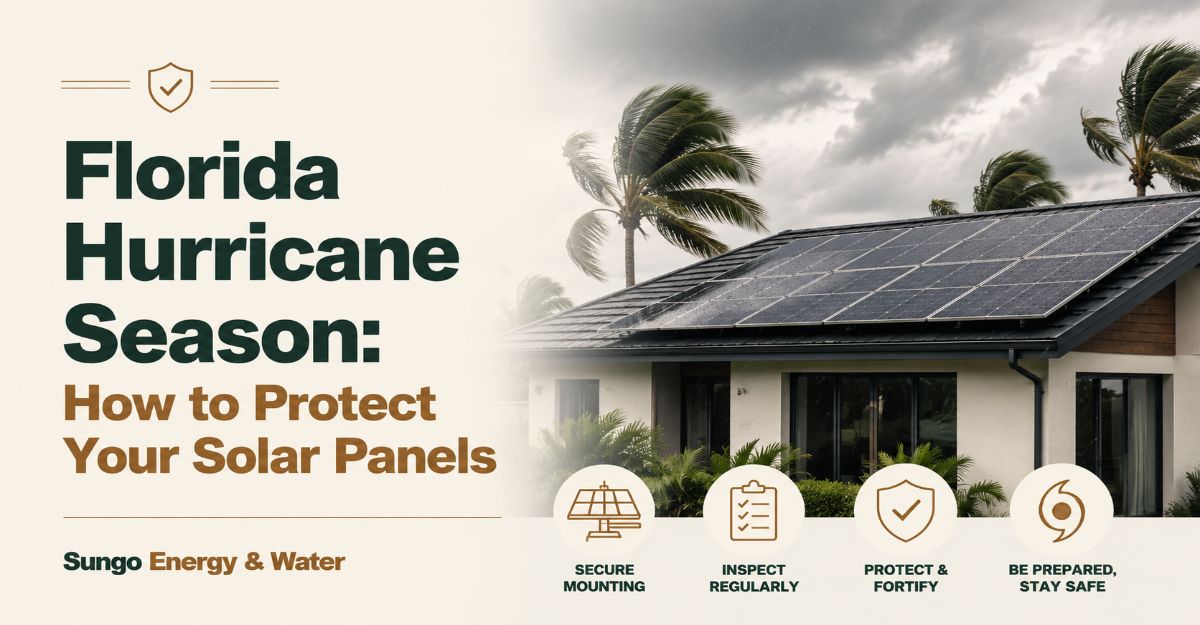
Protecting solar panels during Florida hurricane season requires more than covering the modules or switching off an inverter. The safest strategy combines code-compliant structural design, annual roof and array inspections, controlled vegetation, documented system condition, properly configured battery storage, and a cautious post-storm assessment before restarting damaged equipment.
Key Facts at a Glance
- Florida’s official Atlantic hurricane season runs from June 1 through November 30, although tropical systems can develop outside those dates.
- Solar panels should not be removed by homeowners before a hurricane.
- Wind resistance depends on the complete load path from the module clamps to the roof structure, not only on the panel’s advertised wind rating.
- Standard grid-tied solar normally shuts down during a utility outage because of anti-islanding protection.
- Solar panels alone do not provide backup electricity; outage operation requires compatible isolation equipment and usually battery storage.
- Flooded, cracked, displaced, or electrically faulted solar equipment should remain off until inspected by a qualified professional.
Before You Start
A complete hurricane-readiness review should begin before a named storm threatens Florida. Ground-level checks may take less than an hour, but structural, electrical, roof, or battery inspections must be performed by appropriately qualified contractors.
| Planning item | Practical requirement |
|---|---|
| Best preparation period | Before June, then again when a storm threatens |
| Homeowner difficulty | Low for documentation and ground observations |
| Professional difficulty | High for roof, racking, electrical, and engineering work |
| Essential records | Permit, engineering drawings, equipment list, warranties, photos |
| Useful supplies | Phone or camera, flashlight, waterproof document storage |
| Professional support | Solar contractor, electrician, roofer, arborist, insurer |
| Primary success factor | A verified structural load path and undamaged roof |
Do not climb onto a roof, loosen clamps, remove panels, open an inverter, or touch storm-damaged conductors. Wet surfaces, concealed roof damage, energized DC wiring, and unstable modules can make apparently minor inspections dangerous.
Why Are Hurricanes Dangerous to Solar Panels?
Hurricanes threaten solar systems through wind pressure, debris impact, roof movement, water intrusion, flooding, corrosion, and electrical disturbances. A module may remain intact while its attachment, wiring, flashing, roof deck, inverter, or battery sustains damage.
How does wind create uplift?
High-speed airflow creates changing positive and negative pressures around the roof and solar array. The strongest local pressures often occur near roof edges and corners, where airflow separates, becomes turbulent, and can pull upward on modules and racking.
The protective load path normally includes:
- Module frame and glass
- Mid-clamps and end-clamps
- Rails or rail-free mounting components
- Roof attachments and flashing
- Rafters, trusses, purlins, or other structural members
- Roof deck and building frame
A system is only as strong as its weakest connection. A high-rated module cannot compensate for inadequate attachment spacing, damaged roof framing, incorrect fasteners, loose clamps, or deteriorated sheathing.
Federal guidance recognizes that rooftop solar arrays require specific wind-load assessment rather than being treated as ordinary rooftop equipment. Current severe-weather guidance also emphasizes design, installation quality, operations, maintenance, and recovery as parts of the same resilience strategy.
Why does roof location matter?
Panels near roof corners, ridges, eaves, and perimeter zones may face higher localized pressure than panels in protected interior zones. Attachment spacing and array layout therefore cannot be copied safely from one house to another.
A proper design considers the building height, roof shape, roof slope, exposure category, surrounding terrain, panel dimensions, panel height above the roof, array position, building risk category, structural substrate, and local design wind speed.
Can flying debris break solar panels?
Flying roof tiles, branches, signs, outdoor furniture, and construction materials can fracture module glass or damage frames and wiring. Tempered solar glass is designed to resist specified mechanical loads and impact tests, but it is not indestructible.
Damage is not always visible. Silicon cells can develop microcracks while the outer glass appears mostly intact, potentially causing reduced output, hot spots, insulation faults, or progressive failure.
Can Solar Panels Withstand a Florida Hurricane?
Properly engineered and installed solar arrays can withstand severe wind events, but no contractor can guarantee that every system will survive every hurricane without damage. Performance depends on the site-specific design, installation quality, roof condition, debris exposure, maintenance history, and actual storm forces.
The U.S. Department of Energy reports that resilient systems are achievable when lessons from storm-damaged arrays are incorporated into design and maintenance. Field experience also shows that failures often originate in attachments, connectors, wire management, foundations, or installation details rather than in the module glass alone.
What wind speed should a Florida system meet?
There is no single “Florida solar panel wind rating” that applies to every property. Required design values depend on the property location, building characteristics, risk category, adopted code, and engineering calculations.
The 8th Edition Florida Building Code became effective on December 31, 2023 and references ASCE 7-22 for minimum design loads. Florida’s official product-approval system also identifies products evaluated under the applicable code edition.
A homeowner should request the following documents instead of relying on a verbal claim such as “rated for 180 mph”:
- Site-specific structural calculations
- Design wind criteria used for the property
- Roof-zone attachment layout
- Attachment spacing and allowable loads
- Fastener type and structural substrate
- Module clamp zones
- Racking installation manual
- Florida Product Approval information when applicable
- Permit and inspection records
- Engineer-sealed documents when required
A wind-speed number alone does not describe actual system capacity. Design wind speed, pressure coefficients, safety factors, roof zones, exposure, allowable loads, and ultimate loads must be interpreted together.
Step 1: Inspect the Roof and Array Before the Season
Inspect the system from the ground before hurricane season and arrange a professional assessment when the roof, racking, or electrical equipment shows deterioration. The goal is to identify weakness while repairs can still be completed safely.
Look for:
- Panels that no longer align evenly
- Visibly lifted or displaced modules
- Missing or distorted clamps
- Sagging rails
- Loose conduit
- Hanging or poorly supported wires
- Cracked roof tiles near attachments
- Missing shingles
- Rust staining or corrosion
- Damaged animal guards
- Water stains in the attic
- Previous roof leaks beneath the array
- Error codes or unexplained production losses
Should homeowners tighten solar-panel bolts?
Homeowners should not retorque solar clamps or roof attachments unless they are qualified and specifically authorized to perform that work. Clamp torque is manufacturer-specific, and overtightening can deform module frames, damage hardware, crush roofing materials, or invalidate installation requirements.
A contractor checking fasteners should use the current racking manual, verify the correct component type, inspect for thread or metal damage, and document any corrective work. “Tighten everything” is not a safe maintenance standard.
Why does roof age matter?
A strong solar mounting system cannot make a deteriorated roof deck or damaged truss stronger. Soft decking, corroded metal, broken tile, failed flashing, rotten wood, or previous water intrusion can weaken the structural path below an apparently secure array.
When a roof is near replacement age, reroofing before solar installation is often more economical than removing and reinstalling the array several years later. Existing systems should be reviewed by both a roofer and solar contractor when leaks or structural deterioration are suspected.
Step 2: Control Trees and Loose Debris
Remove dead limbs and manage overhanging vegetation before a storm enters the short-term forecast. Tree work becomes more dangerous, more expensive, and less available once watches or warnings are issued.
Prioritize:
- Dead or cracked branches above the roof
- Diseased trees that could fall toward the array
- Palm fronds or limbs contacting panels
- Vegetation obstructing access to electrical equipment
- Branches rubbing conduit or wiring
Do not use a universal distance such as 10 or 15 feet as a substitute for an arborist’s assessment. Tree species, height, condition, lean, soil saturation, and likely fall path matter more than one clearance number.
Secure or move outdoor furniture, ladders, decorations, tools, temporary signs, waste containers, and construction materials. Debris originating from the property can damage the owner’s roof as easily as debris from a neighboring property.
Step 3: Verify the Structural and Electrical Records
Collect the solar system’s technical records before hurricane season. Records help contractors identify replacement components, help insurers establish pre-loss condition, and help future owners verify how the array was designed.
Keep digital and waterproof copies of:
- Signed installation contract
- Final permit
- Approved plans
- Structural calculations
- Electrical one-line diagram
- Final inspection record
- Interconnection approval
- Module, inverter, battery, and racking model numbers
- Equipment serial numbers
- Product warranties
- Workmanship warranty
- Roof warranty
- Installer and manufacturer contact information
- Monitoring login and ownership credentials
- Previous service reports
This documentation is especially important when the original installer has closed, merged, or stopped servicing the area.
Step 4: Prepare the Battery and Backup Loads
A solar battery should be charged according to the manufacturer’s storm or backup settings before a likely outage. The correct setting may be called Storm Watch, Backup Reserve, Backup Only, Full Backup, or another product-specific name.
Check the system app and confirm:
- Battery state of charge
- Backup reserve percentage
- Grid-charging permissions
- Severe-weather mode
- Critical-load panel status
- Communication connectivity
- Active warnings
- Generator integration settings, when applicable
Some systems automatically respond to severe-weather alerts, while others require manual configuration. Grid charging may also depend on equipment settings, utility rules, tariff conditions, or installer configuration.
How long will a battery last?
Battery runtime depends on usable battery capacity and household load, not only on the battery’s nameplate capacity. A 13.5 kWh battery cannot deliver 13.5 kW continuously for an entire day; kilowatt-hours measure stored energy, while kilowatts measure instantaneous power.
Use this simplified estimate:
Approximate runtime = usable battery energy ÷ average supported load
For example, 12 kWh of usable energy supporting an average 1 kW load provides roughly 12 hours before accounting for conversion losses, reserve limits, temperature, battery condition, and changing appliance demand.
During an extended outage, prioritize:
- Refrigeration
- Medical equipment
- Selected lighting
- Internet and communications
- Fans
- Security equipment
- Limited cooking loads
- A properly designed air-conditioning circuit, when supported
Electric resistance water heaters, pool pumps, clothes dryers, ovens, multiple air conditioners, and electric vehicle charging can deplete storage rapidly.
Will solar panels work when the grid fails?
Standard grid-tied solar usually stops supplying the home during a utility outage because anti-islanding protection prevents the system from energizing utility lines. Solar panels may still be exposed to sunlight and produce DC voltage internally, but the ordinary grid-tied inverter does not provide usable household power.
Backup operation requires equipment designed to isolate the home from the grid and establish a stable local electrical source. Depending on the architecture, that may include a battery, hybrid inverter, system controller, transfer equipment, backed-up loads panel, or approved microgrid controls.
Solar plus storage can improve resilience, but battery capacity remains finite and consecutive cloudy days can reduce daily recharging. Distributed solar and storage can support critical loads during disturbances when designed for islanded operation.
Step 5: Document the Pre-Storm Condition
Take clear, time-stamped photographs and save recent production records before the storm. Documentation should establish the condition of the roof, array, equipment, and surrounding property before damage occurs.
Photograph:
- Entire roof from each accessible ground angle
- Each visible array section
- Roof edges, ridges, tiles, and shingles
- Inverter and disconnects
- Battery and surrounding wall or floor
- Main electrical panel
- Visible conduit and junction boxes
- Equipment labels and serial numbers
- Nearby trees
- Attic areas beneath the array
- Existing stains, cracks, or prior damage
Download or screenshot at least 30 days of energy-production and battery data. A post-storm reduction may otherwise be difficult to distinguish from normal seasonal variation, shading, equipment clipping, or an older fault.
Do not climb onto the roof merely to obtain better insurance photographs.
Step 6: Follow the Approved Shutdown Procedure
A solar system should be shut down before a hurricane only when the manufacturer, installer, emergency authority, or site-specific plan recommends it. There is no universal shutdown sequence for every string inverter, microinverter, optimizer, battery, generator, transfer switch, or rapid-shutdown system.
The sequence in one manual may differ from another. Turning devices off in the wrong order can interrupt backup functions, trigger faults, leave batteries unavailable, or expose the user to equipment that remains energized internally.
Use this decision process:
- Read the system shutdown label and owner’s manual.
- Check the inverter and battery manufacturer’s storm guidance.
- Contact the installer when instructions conflict.
- Keep backup equipment operating when evacuation or emergency plans require it.
- Do not open electrical enclosures.
- Do not disconnect conductors.
- Do not assume that switching off an AC breaker removes DC voltage from the roof.
Should panels be covered or removed?
Solar panels should not be covered or removed by homeowners before a hurricane. Covers can become windborne debris, trap water, impose unexpected loads, damage glass, and create unsafe attachment points.
Removing modules changes the engineered array, exposes wiring and roof penetrations, creates fall and electrical hazards, and may affect warranties. A properly designed system is intended to remain installed.
Step 7: Inspect Safely After the Storm
Remain at ground level and assume damaged solar equipment may be electrically hazardous. Sunlight can energize PV conductors even when utility service is unavailable and the inverter appears off.
Do not approach the system when you see:
- A panel hanging from the roof
- Broken or missing modules
- Exposed conductors
- Sparking, smoke, or burning odor
- Floodwater near the inverter, battery, panel, or disconnect
- A damaged battery enclosure
- Bulging, heat, hissing, or unusual battery odor
- Collapsed roof sections
- Metal racking touching fallen utility lines
- Conduit pulled away from equipment
- A persistent ground-fault or isolation-fault warning
Call emergency services when there is fire, smoke, a damaged utility line, structural collapse, or immediate danger. Contact the solar contractor, electrician, roofer, insurer, or battery manufacturer for non-emergency damage.
What should be checked from inside the attic?
From a safe attic access point, look for water staining, active dripping, displaced insulation, visible daylight, cracked framing, or wet electrical components. Do not enter an attic with structural movement, standing water, damaged wiring, or unsafe access.
A roof leak after a hurricane does not automatically prove that a solar attachment failed. Wind-driven rain can enter through damaged shingles, tiles, vents, flashing, ridges, walls, or unrelated roof penetrations. The roofer and solar contractor may need to inspect the same area jointly.
Step 8: Restart Only After the System Is Cleared
Restart the solar system only when utility service is stable, no physical damage is visible, equipment has not been flooded, and the manufacturer’s restart procedure permits operation. Follow the system’s posted instructions rather than simply reversing a generic shutdown list.
After startup, review:
- Inverter operating status
- Battery warnings
- Grid voltage or frequency alerts
- Ground-fault messages
- Production compared with similar weather
- Offline microinverters or optimizers
- Abnormal noise
- Unusual heat
- Communication failures
A breaker that trips again after one reset indicates a fault requiring diagnosis. Repeated resetting can re-energize damaged equipment and should not be used as troubleshooting.
Which Solar Systems Handle Hurricanes Best?
The best hurricane-resilient system is the one engineered for the specific site, installed correctly, maintained properly, and paired with a sound roof. Inverter topology alone does not determine structural survival.
| System type | Main advantage | Main hurricane concern | Best protection priority |
|---|---|---|---|
| Flush roof mount | Lower profile than elevated tilt systems | Roof attachments and perimeter pressure | Verify roof zones, flashing, clamps, and structural members |
| Tilted roof array | May improve orientation or production | Greater aerodynamic exposure | Site-specific wind engineering and robust bracing |
| Ground mount | Easy inspection and no roof penetration | Direct debris, overturning, foundation, and flood exposure | Engineered posts, foundations, drainage, and wire protection |
| Ballasted flat-roof array | Fewer roof penetrations | Sliding, overturning, roof loading, and drainage | Wind calculations, attachment strategy, deflectors, and roof capacity |
| String inverter | Centralized service point | One inverter fault can stop a large array section | Surge protection, dry equipment location, spare-part planning |
| Microinverters | Module-level conversion and monitoring | Roof-level electronics remain exposed | Secure wire management and compatible replacement planning |
| Solar plus battery | Backup power when properly configured | Flooding, thermal damage, capacity limits | Safe equipment location and realistic load management |
Do microinverters make a system hurricane-proof?
Microinverters do not make an array hurricane-proof. They can reduce some single-point production failures because each module has separate power electronics, but all modules still share structural, roof, wiring, communication, and grid-interconnection risks.
Microinverters also do not automatically supply power during an outage. The system needs compatible grid-isolation and backup equipment.
Are flush mounts always safer than tilted arrays?
Flush mounts generally present a lower profile, but they are not automatically safer. Module-to-roof spacing, roof-edge location, attachment design, roof shape, array geometry, and local pressure coefficients affect the actual wind load.
The Department of Energy advises evaluating rooftop compatibility, structural strength, age, and wind exposure. It also recommends mechanical attachments rather than relying entirely on ballast in high-wind situations.
How Should Tile, Shingle, and Metal Roofs Be Protected?
Each roof type creates different attachment, waterproofing, and inspection issues. The mounting method must be approved for the roofing material and connected to adequate structure below it.
Asphalt-shingle roofs
Inspect for lifted tabs, missing shingles, deteriorated seal strips, soft decking, failed flashing, and exposed fasteners. Solar attachments should use compatible flashing or approved waterproofing details rather than sealant as the only defense against leaks.
Concrete or clay tile roofs
Inspect for cracked, displaced, or improperly notched tiles around mounts. Replacement tiles should match the roof system, and attachments must transfer loads to the structure without relying on fragile tile.
A tile can look intact from the ground while being cracked beneath the array. Roof access and tile replacement should be handled by qualified workers familiar with solar-mounted tile roofs.
Standing-seam metal roofs
Inspect seam clamps, set screws, corrosion, seam deformation, panel movement, and roof-manufacturer requirements. Clamp-on systems avoid some penetrations but still require verified clamp capacity and correct installation.
Exposed-fastener metal roofs
Inspect aging washers, loose fasteners, corrosion, elongated holes, sealants, and panel condition. Roof fastener deterioration may exist independently of the solar attachments and can become a major leak or uplift risk.
How Does Coastal Corrosion Affect Solar Mounting?
Salt-rich coastal air can accelerate corrosion of fasteners, grounding components, connectors, electrical enclosures, and incompatible metals. Corrosion can reduce mechanical capacity or electrical continuity before the damage becomes obvious from the ground.
A coastal inspection should evaluate:
- Stainless-steel hardware grade and condition
- Aluminum and steel contact points
- Bonding jumpers and grounding components
- Cut rail ends
- Exposed threads
- Connector seals
- Enclosure gaskets
- Conduit fittings
- Rust staining
- Manufacturer-approved corrosion protection
Adding random coatings or replacing one fastener with a different metal can create galvanic corrosion or violate the mounting approval. Use compatible components specified by the manufacturer or engineer.
How Does Flooding Change the Safety Plan?
Flooding can make inverters, batteries, disconnects, junction boxes, conduits, service equipment, and ground-mounted wiring unsafe even when panels remain physically intact. Equipment that has been submerged or exposed beyond its environmental rating should not be energized merely because it has dried externally.
Flood-resilience planning may include:
- Locating batteries and inverters above expected flood levels
- Avoiding low wall positions where stormwater accumulates
- Elevating ground-mounted electrical equipment
- Protecting conduit entries
- Maintaining drainage around pads and foundations
- Preserving emergency access
- Separating equipment from vehicle-impact areas
- Following battery clearances and manufacturer instructions
Federal solar-resilience guidance treats flood mitigation as a separate design and recovery issue, not simply an extension of wind protection.
Are Solar Panels Covered by Florida Homeowners Insurance?
Solar coverage depends on the policy, ownership structure, installation type, cause of loss, exclusions, coverage limits, and deductible. Homeowners should not assume that every rooftop or ground-mounted system receives full replacement-cost coverage automatically.
Ask the insurer in writing:
- Is an owned rooftop system included in dwelling coverage?
- Is a ground-mounted system treated as another structure?
- Is leased or financed equipment handled differently?
- Does the system increase the required dwelling limit?
- Are windstorm, hurricane, hail, flood, and electrical surge treated differently?
- Is there a separate hurricane deductible?
- Are removal and reinstallation costs covered during roof repair?
- Is lost energy production covered?
- Are batteries covered under the same section?
- What documents are required for a claim?
Florida hurricane deductibles are policy-specific. A percentage sometimes quoted in general articles should not be treated as the homeowner’s actual deductible without reviewing the declarations page and endorsements.
Flood damage may also be excluded from a standard homeowners policy. Confirm the distinction between wind-driven rain, storm surge, surface flooding, roof failure, and equipment malfunction before hurricane season.
Common Mistakes and How to Fix Them
Mistake 1: Trusting a module wind rating
Why it fails: The module rating does not verify the roof attachment, racking, structural substrate, roof zones, or site-specific pressure.
Better approach: Request the permitted structural package and confirm that the installed layout matches it.
Mistake 2: Retorquing every fastener
Why it fails: Incorrect torque can damage frames, threads, roof materials, or approved connections.
Better approach: Have a qualified contractor inspect suspect components using the correct manufacturer documentation.
Mistake 3: Waiting for a named storm
Why it fails: Roofers, arborists, electricians, solar technicians, and replacement parts become difficult to obtain shortly before landfall.
Better approach: Complete maintenance before June and preserve a service contact list.
Mistake 4: Assuming solar works during every outage
Why it fails: Ordinary grid-tied inverters shut down when the grid fails.
Better approach: Verify whether the property has true islanding capability, which circuits are backed up, and how much usable battery energy is available.
Mistake 5: Restarting flooded equipment
Why it fails: Internal contamination, corrosion, insulation breakdown, and hidden battery damage may remain after external surfaces dry.
Better approach: Keep affected equipment isolated and obtain a qualified inspection.
Mistake 6: Resetting a recurring fault
Why it fails: Ground faults, insulation faults, arc faults, and breaker trips can indicate damaged conductors or water intrusion.
Better approach: Record the error, leave the system off when instructed, and arrange professional diagnosis.
What Do Common Post-Storm Errors Mean?
| Symptom | Possible cause | Safe response |
|---|---|---|
| Inverter remains off after grid restoration | Tripped breaker, disconnect position, grid delay, surge damage, internal fault | Check the user-accessible display and manual; do not open equipment |
| Ground-fault or isolation-fault warning | Wet connector, damaged cable, cracked module, insulation failure | Keep the system off and call a qualified technician |
| One panel or device is offline | Communication failure, damaged microinverter, optimizer, connector, or module | Compare monitoring data and schedule module-level diagnosis |
| Production is lower than before | Debris, shading, hidden module damage, disconnected string, inverter issue | Compare similar-weather data and obtain electrical testing |
| Battery drains rapidly | Excessive loads, low solar recharge, reserve settings, battery fault | Reduce noncritical loads and review system alerts |
| Battery will not charge | Grid restriction, communication failure, temperature limit, internal fault | Follow manufacturer guidance and request service |
| Breaker trips repeatedly | Short circuit, ground fault, water intrusion, damaged equipment | Do not continue resetting the breaker |
Infrared imaging, insulation-resistance testing, current-voltage testing, module-level monitoring, drone imaging, and electroluminescence testing can identify different failure types. No single test detects every form of hurricane damage.
Which Protection Plan Fits Your Property?
Coastal or high-exposure property
Prioritize site-specific engineering, corrosion-resistant compatible hardware, roof-zone attachment details, secure wire management, elevated electrical equipment where flooding is possible, and documented annual inspections.
Properties in Florida’s High-Velocity Hurricane Zone require attention to the code provisions and approvals applicable to that jurisdiction. Do not replace a jurisdiction-specific review with a generic advertised wind rating.
Suburban roof-mounted system
Prioritize roof condition, tree risk, permitted attachment spacing, attic leak checks, monitoring records, and insurance coverage. A battery can improve outage resilience, but it does not improve the module’s structural attachment.
Rural ground-mounted system
Prioritize foundation design, overturning resistance, erosion, drainage, exposed wiring, vegetation control, livestock or vehicle impact, and debris exposure. Ground mounting avoids roof penetrations but may place the array in a more exposed wind field.
Older roof with a newer solar array
Arrange a joint roof and solar assessment. A solar contractor may evaluate the array while a roofer evaluates the roofing material, deck, flashing, and remaining service life.
Battery system in a flood-prone area
Verify the equipment’s elevation, drainage path, wall or pad condition, enclosure rating, emergency access, and manufacturer requirements. Relocating battery equipment must be engineered and permitted rather than improvised immediately before a storm.
Expert Rules of Thumb
- Verify the load path, not the marketing number. A hurricane rating has limited value without the roof-zone layout, attachment capacity, structural substrate, and permitted plans.
- Treat the roof and solar array as one assembly. Roof deterioration can undermine a perfectly good racking system, while poor solar flashing can undermine a sound roof.
- Use monitoring data as evidence, not proof of safety. Normal power output does not rule out cracked tiles, loosened attachments, damaged flashing, or structural movement.
- Plan battery use around energy, power, and weather. A battery may start a load successfully but still lack enough stored energy to operate that load throughout a long outage.
- Do not use a successful past storm as certification. Wind direction, gusts, debris, rainfall, roof aging, and attachment condition change from one hurricane to another.
Honest Limitations of Hurricane Hardening
Hurricane preparation cannot eliminate every risk. Site-specific engineering cannot stop an unrelated roof from collapsing, prevent every debris strike, guarantee utility restoration, or provide unlimited battery power during several cloudy days.
Solar-plus-storage is also not automatically equivalent to a whole-home generator. Some systems support only selected circuits, some cannot start large air-conditioning compressors, and all batteries have finite energy and power limits.
The practical objective is risk reduction: prevent avoidable failures, identify hidden weaknesses, protect occupants and responders, preserve claim evidence, and restore operation without energizing damaged equipment.
Frequently Asked Questions
Should I switch off my solar panels before a hurricane?
Switch off the system only when the manufacturer, installer, emergency authority, or system-specific plan recommends it. Solar architectures use different disconnects, batteries, controllers, and restart procedures. Follow the posted shutdown instructions and never assume that turning off an AC breaker makes rooftop DC wiring safe.
Can I put plywood over solar panels?
Plywood should not be placed over installed solar panels. It can damage the glass, create point loads, trap water, interfere with drainage, and become dangerous debris. Do not drill into modules, frames, rails, or roofing to attach temporary storm covers.
Can a hurricane tear solar panels off a roof?
A hurricane can detach modules or racking when wind loads exceed the system’s capacity or when attachments, clamps, framing, roof decking, or installation details fail. Proper site-specific engineering and installation reduce the risk but cannot guarantee survival in every combination of wind, debris, and structural damage.
How soon should solar panels be inspected after a storm?
Perform a ground-level observation after authorities declare the area safe. Arrange prompt professional inspection when panels shifted, debris struck the array, the roof leaked, equipment flooded, electrical errors appeared, or production changed unexpectedly. Do not delay when conductors, batteries, structural components, or fire hazards are involved.
Does homeowners insurance pay to remove solar panels for roof repair?
Coverage varies by policy. Some policies may cover necessary removal and reinstallation when the underlying roof damage is covered, while others impose limits, exclusions, or separate conditions. Ask the insurer specifically about detach-and-reset labor before a loss and retain the installation contract and equipment records.
Can solar panels charge a battery during a hurricane outage?
A compatible solar-plus-storage system may recharge its battery during daylight while isolated from the grid. Actual charging depends on sunlight, array condition, battery state, inverter limits, household load, and system controls. Heavy cloud cover and high household demand may leave little surplus energy for charging.
The Bottom Line
Florida Hurricane Season: How to Protect Your Solar Panels is primarily a structural, electrical, roof, documentation, and recovery problem. Homeowners should verify code-compliant engineering, inspect the roof and array before June, control debris hazards, prepare battery settings, document pre-storm condition, follow system-specific shutdown instructions, and avoid restarting equipment that is cracked, flooded, displaced, or electrically faulted.
The most resilient solar system is not necessarily the one with the strongest advertised panel. It is the system with a complete engineered load path, a healthy roof, correctly installed components, realistic backup expectations, accessible records, appropriate insurance, and a safe post-storm inspection plan.