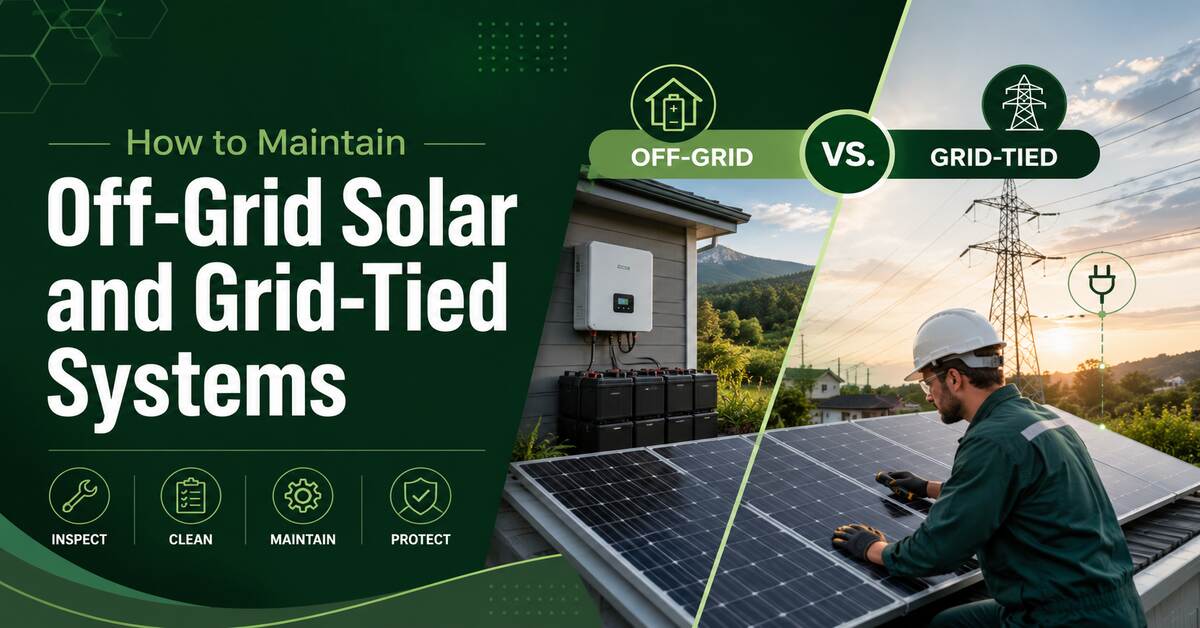
Maintaining an off-grid solar system centers on battery health, generator upkeep, and frequent inspection, demanding roughly 4–6 hours per quarter; maintaining a grid-tied system is largely panel cleaning and app monitoring, often under 2 hours per year. The two share the same panels and inverters but diverge entirely on storage, which is where nearly all real solar maintenance lives.
Key Facts at a Glance
- Off-grid systems require 4–6 hours of maintenance per quarter; grid-tied systems typically need 1–2 hours per year.
- Battery care is the single largest maintenance task in off-grid solar and is absent from most grid-tied systems.
- Flooded lead-acid batteries need monthly watering and periodic equalization; AGM, gel, and lithium (LiFePO₄) batteries must never be equalized.
- Grid-tied inverters shut down automatically during a blackout under UL 1741 / IEEE 1547 anti-islanding rules, so they cannot power a home when the grid is down.
- Solar panel soiling can cut output by 5–25%, and cleaning frequency ranges from twice yearly in rainy climates to monthly in dusty or agricultural areas.
- A megger (insulation-resistance) test should read well above 1 MΩ per string; lower values signal wire-jacket degradation.
Before You Start: Tools, Time, and Safety
Solar maintenance is moderate-difficulty work with one non-negotiable prerequisite: DC circuits carry lethal voltage even in bright shade, and unlike AC they cannot simply be “switched off” at a panel. Treat every array as live.
You will need: a digital multimeter (ideally with a DC clamp), a torque screwdriver or wrench rated in inch-pounds, a soft-bristle brush or squeegee with an extension pole, distilled water (for flooded batteries only), a hydrometer, insulated gloves, safety glasses, and a phone with the inverter’s monitoring app installed.
Safety sequence before touching wiring: open the DC disconnect, then the AC disconnect, then wait five minutes for capacitors in the inverter to discharge, and verify zero volts with your meter before proceeding. Never bridge battery terminals with a tool. For lead-acid banks, ventilate the enclosure charging releases hydrogen, which is explosive.
Time and cost budget: DIY routine maintenance costs near $0 in materials annually. A professional annual inspection runs $150–$300 for grid-tied and $300–$600 for off-grid with batteries. The real long-term cost is battery replacement, not upkeep.
Two Systems, Two Maintenance Realities
Off-grid and grid-tied systems look similar on the roof but impose opposite maintenance workloads. A grid-tied system uses the utility as an infinite virtual battery, so it has no storage to babysit; a grid-tied owner’s job is essentially cleaning glass and watching an app. An off-grid system stores every watt-hour in a physical battery bank and usually a backup generator, and both age, drift, and fail if neglected.
| Maintenance dimension | Off-grid | Grid-tied |
|---|---|---|
| Battery upkeep | Central task, monthly–quarterly | None (unless hybrid) |
| Generator upkeep | Oil, filters, load-test | None |
| Panel cleaning | Same as grid-tied | Same as off-grid |
| Inverter attention | Higher (battery-coupled) | Low (fault resets, firmware) |
| Typical yearly labor | 16–24 hours | 1–2 hours |
| Consequence of neglect | No power at night | Slightly lower savings |
The practical takeaway: if you own grid-tied solar and haven’t thought about maintenance, you’re probably fine. If you own off-grid solar and haven’t thought about it, your batteries are quietly dying.
What Is the Solar Maintenance Calendar?
The solar maintenance calendar is a four-tier schedule monthly, quarterly, bi-annual, and annual that escalates from quick visual checks to instrumented electrical testing. Following it in order catches 90% of failures before they cause an outage or permanent damage.
Monthly Tasks: Look, Listen, Log
Monthly maintenance is a five-minute visual and data check that requires no tools and no shutdown. Walk the array and read the monitoring app.
Inspect panels for leaves, bird droppings, pollen, or dust drifts, especially along the lower edge where soiling concentrates. Confirm the inverter display shows normal operation with no active fault codes and no unusual fan noise. On off-grid systems, log the battery State of Charge (SOC) and confirm it reaches 100% on sunny days a bank that never tops out is showing early capacity loss.
Success checkpoint: the app’s daily production curve looks like a smooth bell, and off-grid SOC hits full by afternoon. Common mistake: ignoring a small daily shortfall a battery that peaks at 95% this month peaks at 80% by summer if left uncorrected.
Quarterly Tasks: Clean, Clear, and Water
Quarterly maintenance is where hands-on work begins: cleaning arrays, trimming shade, and for flooded lead-acid banks checking electrolyte. Budget 1–2 hours for grid-tied and 4–6 hours for off-grid.
Wash panels with ambient-temperature water and a soft squeegee in early morning or evening, never at midday cold water on hot glass can thermally shock and crack a cell. Skip abrasive pads, detergents, and pressure washers, all of which strip anti-reflective coatings or force water past frame seals. Trim any branch throwing a new shadow, since even one shaded cell in a string inverter system drags down the whole string. Inspect inverter and battery enclosures for wasp nests, rodent nests, and dust-clogged cooling fans.
For flooded lead-acid batteries only, check electrolyte levels and top up with distilled water after a full charge, keeping plates covered by about a quarter inch. Success checkpoint: post-clean production rises measurably in the app. Common mistake: watering flooded batteries before charging the electrolyte expands as it charges and will overflow acid.
How Often Should You Clean Solar Panels?
Clean solar panels twice a year in rainy or temperate climates and every one to two months in dusty, desert, coastal, or agricultural environments where soiling accumulates fast. Rain handles light dust but leaves behind bird droppings, pollen crust, and mineral spots, which create permanent “hot spots” that damage cells if left for months.
The economic trigger is simple: if production drops more than about 5% after ruling out weather, it’s time to clean. In high-soiling regions, that can mean monthly. Flat-mounted arrays (tilt under 5°) self-clean poorly and need cleaning roughly twice as often as steeply tilted racks.
Bi-Annual Tasks: Connections and Battery Voltages
Every six months, move from surface cleaning to electrical inspection: check wiring integrity and test individual battery voltages. This tier catches loose connections and weak cells before they cascade.
Inspect outdoor conduit and wire runs for UV cracking, sagging, and rodent chew marks chewed insulation is a leading cause of ground faults and fires. Using a multimeter, measure the resting voltage of each battery in a bank; in a healthy lead-acid string the cells should read within about 0.2V of each other, and any outlier is failing. For flooded banks, use a hydrometer to compare specific gravity across cells; a spread greater than 0.030 points signals stratification.
Success checkpoint: all cell voltages and specific gravities cluster tightly. Common mistake: replacing a single weak battery in an old bank new and old cells drag each other down, so you replace the whole string or nothing.
Annual Tasks: Torque, Thermal, and Megger
The annual service is instrumented, professional-grade work: thermal imaging, torque verification, and insulation-resistance testing. This is the tier most owners should hire out.
Scan every combiner box, breaker, terminal, and panel junction with an infrared camera; any point running 10–20°C hotter than its neighbors is a resistive hotspot, usually a loose or corroded connection. Re-torque structural bolts and electrical lugs to the manufacturer’s inch-pound spec under-torqued lugs arc, over-torqued ones crack. Finally, run a megger (insulation-resistance) test on each string; readings should sit well above 1 MΩ, and a value trending toward zero means moisture or degraded wire jackets.
Success checkpoint: no thermal anomalies and megger readings above 1 MΩ. Common mistake: skipping torque checks thermal cycling loosens connections every year, and a loose DC lug is the classic cause of rooftop solar fires.
How Do You Maintain Solar Batteries by Chemistry?
Battery maintenance depends entirely on chemistry, and applying the wrong routine destroys the battery this is the most consequential correction to make against generic maintenance advice. The three families behave completely differently.
Flooded lead-acid (FLA): the highest-maintenance chemistry. Check water monthly, equalize periodically, and keep depth of discharge under 50%. Equalization is a deliberate, controlled overcharge (around 15.5V on a 12V nominal bank, for 2–4 hours per the manufacturer) that remixes stratified acid and reverses sulfation. Run it every one to three months on heavily cycled banks.
AGM and gel (sealed lead-acid): water-free, but you must never equalize them the high voltage boils off electrolyte they can’t replace, permanently drying the battery. Keep them cool and avoid deep discharge.
Lithium iron phosphate (LiFePO₄): essentially maintenance-free. No watering, no equalization, no acid. The Battery Management System (BMS) handles cell balancing internally. Your only jobs are keeping the pack in a reasonable temperature range and updating BMS firmware when the manufacturer releases it. Charging lithium below freezing is the main hazard many BMS units block it, but not all.
Expert correction: Google’s AI Overview lists “neglecting equalization” as a critical mistake but doesn’t say equalization applies only to flooded lead-acid. Equalizing an AGM, gel, or lithium bank is not neglect it’s active destruction. Always confirm chemistry before running any equalization cycle.
Do Grid-Tied Systems Need Battery Maintenance?
Pure grid-tied systems need zero battery maintenance because they store nothing surplus power flows to the utility through a net meter, and the grid supplies power at night. This is the entire reason grid-tied maintenance measures in hours per year rather than hours per quarter.
The exception is a hybrid system, where a grid-tied inverter is paired with a backup battery for outages. That battery reintroduces the full storage-maintenance burden, though usually a lithium pack, so the added work is firmware updates and an occasional programmed self-test rather than watering acid. A grid-tied owner’s non-panel “maintenance” is really administrative: watching for utility net-metering policy changes that can quietly cut the value of exported power.
What Maintenance Does an Off-Grid Generator Need?
An off-grid backup generator needs oil and filter changes on a run-hour schedule, monthly load-testing, and fuel management it’s an engine, and neglected engines don’t start during the winter storm you bought them for. Skipping generator upkeep is the most common way off-grid owners get caught without power.
Change oil every 50–200 run hours depending on the model, replace air and fuel filters annually, and exercise the generator monthly for 20–30 minutes under real load, not just idling. For diesel and gasoline units, use fuel stabilizer and rotate fuel; stale fuel gums carburetors and clogs injectors. On autostart generators, verify the auto-start actually triggers by simulating a low-battery condition quarterly.
Solar Troubleshooting Matrix
When something goes wrong, match the symptom to its probable cause before touching hardware. This matrix covers the failures that account for most service calls.
| Symptom | Probable cause | Corrective action |
|---|---|---|
| Rapid battery drain | Parasitic loads or cell sulfation | Turn off non-essential breakers; for FLA, run a controlled equalization |
| Inverter “Grid Fault” code | Utility voltage or frequency out of bounds | Measure AC at the main breaker; if outside your region’s trip window, call the utility |
| Plunging energy yield | Shading, soiling, or blown bypass diodes | Clean panels; check per-panel VOC with a clamp meter |
| Inverter overload shutdown | Undersized inverter vs motor surge | Stagger large loads; size inverter for surge current, not just running watts |
| Batteries never reach 100% | Aging cells or undersized array | Test individual voltages; check charge-controller settings |
| Ground fault interrupt trips | Chewed or moisture-degraded wiring | Run a megger test per string; inspect conduit |
| Corroded terminals / white powder | Loose lug + moisture | Clean, apply anti-oxidant, re-torque to spec |
Note that the exact grid-fault voltage window is region-specific the AI Overview cites a 211V–264V band, which reflects one wide trip setting on a US 240V split-phase service, but your allowable range depends on local utility rules and inverter configuration. Verify against your inverter’s spec sheet, not a generic number.
When Should You Call a Professional?
Call a professional for anything involving opening the AC service panel, high-voltage DC troubleshooting, roof work without fall protection, or a megger and thermal-imaging inspection. DIY covers cleaning, visual inspection, battery watering, SOC logging, and app monitoring the tasks that carry no electrocution or fall risk.
One warranty caution the AI Overview omits entirely: many manufacturers void panel or inverter warranties if unqualified work damages the equipment, and some require documented professional inspections to keep the warranty valid. Before doing invasive work yourself, read the warranty terms. Photographing your DIY maintenance and keeping receipts protects you either way.
What Does Solar Maintenance Cost Each Year?
Grid-tied maintenance costs effectively nothing beyond an optional $150–$300 annual inspection, while off-grid maintenance costs $300–$600 per year in professional service plus the amortized cost of battery replacement, which dominates the total. The batteries, not the labor, are the real number.
| Cost factor | Off-grid | Grid-tied |
|---|---|---|
| DIY routine materials | ~$50/yr (distilled water, cleaning) | ~$0–$20/yr |
| Professional inspection | $300–$600/yr | $150–$300/yr (optional) |
| Battery replacement | Lead-acid every 5–7 yrs; lithium every 10–15 yrs | N/A (hybrid only) |
| Inverter replacement | Every 10–15 yrs | Every 10–15 yrs (string); microinverters ~25 yrs |
| Annual labor (DIY) | 16–24 hours | 1–2 hours |
Spread over its life, a lead-acid bank replaced every six years is the biggest recurring off-grid expense — which is exactly why battery maintenance discipline (avoiding deep discharge, equalizing FLA correctly, keeping cells cool) pays for itself by pushing replacement further out.
Maintenance Plans by Owner Type
Maintenance intensity should match your system and tolerance for hands-on work. These three profiles map the AI Overview’s implementation examples onto concrete routines.
The Remote Off-Grid Homesteader
Runs a large AC-coupled array with a lithium (LiFePO₄) bank and an autostart diesel generator. Maintenance is high-frequency and proactive: use remote telemetry to watch cell temperatures and generator fuel weekly, exercise the generator monthly under load, and run the full quarterly and annual protocols without skipping. The failure mode here is a dead generator during a multi-day storm, so generator readiness gets priority.
The Suburban Grid-Tied Homeowner
Runs a roof-mounted array with microinverters and no battery. Maintenance is genuinely set-and-forget: check the monitoring app monthly for flagged panels, clean twice a year (or let rain do it in wet climates), and book a professional inspection every few years. Microinverters mean one failed unit costs only that panel’s output and is flagged individually in the app.
The Urban Hybrid Realist
Runs a grid-tied string inverter with a small lithium backup for medical devices, internet, and refrigeration during outages. Maintenance is low but not zero: program the hybrid inverter’s quarterly battery self-test, keep firmware current, and confirm after every utility outage that the battery actually carried the critical loads as intended.
How Do You Winterize an Off-Grid Solar System?
Winterizing an off-grid system means clearing snow, protecting batteries from cold-induced capacity loss, and prepping the generator for cold starts. Lead-acid capacity can drop 20–50% at freezing temperatures, so a bank sized for summer may fall short in January.
Brush snow off panels with a soft foam roof rake even a thin layer blocks nearly all production, and snow slides off dark warm glass once cleared. Move or insulate battery enclosures to keep cells above freezing, and never charge lithium below 0°C unless the BMS explicitly allows it. Add fuel stabilizer to the generator, confirm cold-start batteries are healthy, and increase your SOC monitoring frequency, since short winter days plus higher heating loads shrink your energy margin.
Frequently Asked Questions
Can you equalize a lithium (LiFePO₄) battery? No. Equalization is a controlled overcharge designed for flooded lead-acid batteries. Applying it to lithium can trigger the Battery Management System’s protection or damage cells, and lithium chemistry doesn’t stratify, so there’s nothing to correct. Lithium banks self-balance through the BMS and need no equalization at all.
How long do solar inverters last? String inverters typically last 10–15 years, microinverters up to 25 years, and off-grid battery-based inverters around 7–12 years due to heavier thermal cycling. Keeping the inverter cool, dust-free, and firmware-updated pushes lifespan toward the top of the range. Plan financially for at least one inverter replacement over a system’s life.
Does rain replace cleaning solar panels? Rain rinses light dust but does not remove bird droppings, pollen crust, pollen, or mineral deposits, which form permanent hot spots. In wet climates, rain plus twice-yearly cleaning is enough; in dusty, coastal, or agricultural areas, panels need active cleaning every one to two months regardless of rainfall. Judge by production drop, not by weather.
Why does my grid-tied inverter shut off during a blackout? Grid-tied inverters are required by UL 1741 and IEEE 1547 anti-islanding standards to stop feeding power the instant the grid goes down, protecting utility line workers from back-fed electricity. This is normal safety behavior, not a fault. Only a hybrid or off-grid system with battery storage can power your home during an outage.
What is a megger test and why does it matter? A megger test measures insulation resistance across a solar string’s wiring, revealing moisture intrusion or degraded wire jackets before they cause a ground fault or fire. Healthy readings sit well above 1 MΩ; values trending toward zero indicate failing insulation. It’s part of annual professional maintenance because problems it catches are invisible on a normal visual inspection.
How do you extend solar battery lifespan? Keep depth of discharge shallow (under 50% for lead-acid, 80–90% for lithium), maintain moderate temperatures, avoid mixing old and new cells, and match the maintenance routine to the chemistry watering and equalizing flooded banks, doing neither to sealed or lithium ones. Consistent full charges and avoiding chronic under-charging prevent the sulfation that kills lead-acid banks early.
The Bottom Line
Maintaining off-grid solar and grid-tied systems is fundamentally two different jobs sharing one set of panels. Grid-tied maintenance is a light annual rhythm of cleaning glass and watching an app, because the utility carries the storage burden. Off-grid maintenance is a demanding quarterly discipline built around battery chemistry, generator readiness, and instrumented testing and the owners who follow the tiered calendar, respect the chemistry rules, and never equalize a sealed battery are the ones whose lights stay on and whose batteries last twice as long.