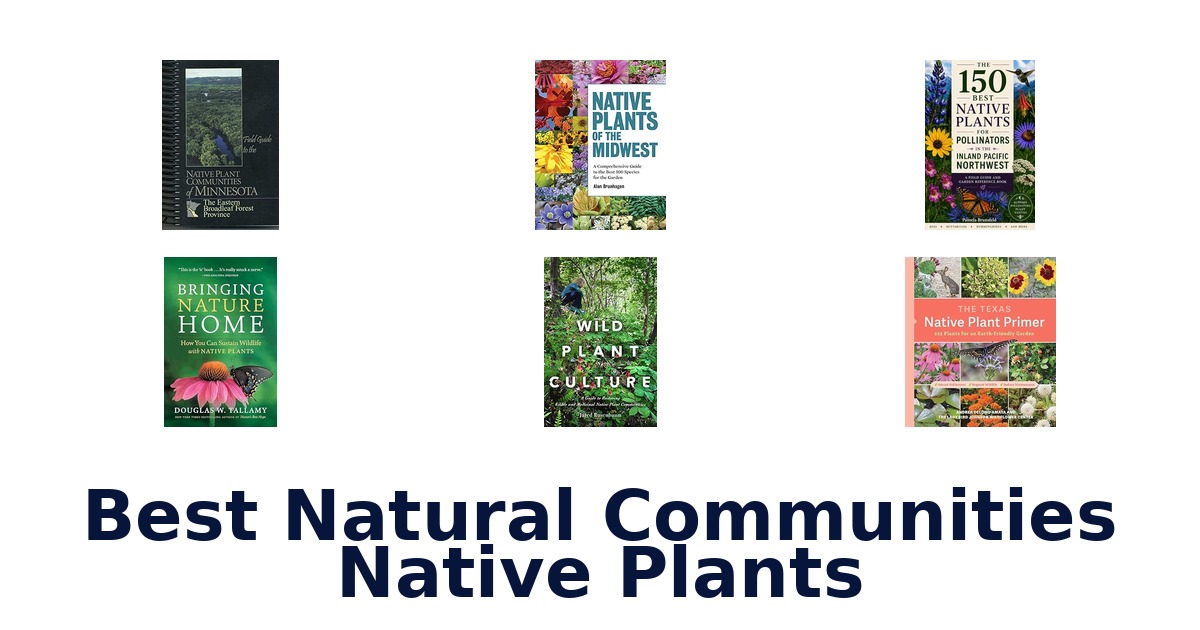
A strong choice for natural communities and native plants explains how species work together or helps you identify plants suited to a specific region. The books here range from community-based garden design and resilient landscape planning to restoration, field identification, and regional species references. For a broad design approach, start with Designing California Native Gardens or Planting in a Post-Wild World; for practical regional selections, narrow the list by geography, including Minnesota, Florida, the Inland Pacific Northwest, the Midwest, the Southeast, and Texas.
Some titles focus on ecological relationships rather than a particular region, while others offer localized plant lists or community field-guide coverage. Match the book’s scope to your goal: designing a garden, restoring edible and medicinal plants, supporting wildlife, or learning about native species where you live.
Designing California Native Gardens is the strongest overall match because its subtitle explicitly presents a plant community approach to artful, ecological gardens. That focus closely fits a search for natural communities and native plants, rather than simply a list of species. Planting in a Post-Wild World is a useful alternative for readers focused on designing plant communities for resilient landscapes, while Wild Plant Culture suits restoration with edible and medicinal native plants.
Choose a regional guide when local identification or region-specific plant selections matter most.
Our Top Picks
 Best Overall
Designing California Native Gardens
Its subtitle directly promises a plant community approach to artful, ecological gardens, closely matching the search for natural communities and native plants.
View on Amazon Resilient Landscape Design
It explicitly focuses on designing plant communities for resilient landscapes, making it a close fit for readers seeking community-oriented planting guidance.
View on Amazon Best for Restoration
Its subtitle centers on restoring edible and medicinal native plant communities, a specific and practical community-restoration focus.
View on Amazon- Best Field Guide Minnesota Plant Communities Field Guide
Compare Native Plant Community Guides
| # | Product | Buy |
|---|---|---|
| 1 | 1. Designing California Native GardensBest Overall | View on Amazon |
| 2 | 2. Planting in a Post-Wild WorldResilient Landscape Design | View on Amazon |
| 3 | 3. Wild Plant CultureBest for Restoration | View on Amazon |
| 4 |  4. Minnesota Plant Communities Field GuideBest Field Guide | View on Amazon |
| 5 |  5. Bringing Nature HomeBackyard wildlife-minded native planting | View on Amazon |
| 6 |  6. Native Plants of the MidwestMidwest gardeners seeking breadth | View on Amazon |
| 7 |  7. Native Plants of the SoutheastSoutheast native garden planning | View on Amazon |
| 8 |  8. Inland Pacific Northwest Pollinator PlantsInland Northwest pollinator gardeners | View on Amazon |
| 9 |  9. Texas Native Plant PrimerTexas earth-friendly garden choices | View on Amazon |
| 10 |  10. Florida Native Landscape PlantsFlorida landscape plant selectors | View on Amazon |
Detailed Reviews: Best Natural Communities Native Plants
#1 · Best Overall
1. Designing California Native Gardens
Best for: California plant-community garden planners.
Why it ranks #1: Its subtitle directly promises a plant community approach to artful, ecological gardens, closely matching the search for natural communities and native plants.
Its plant-community approach is the defining feature: this book connects California native gardens with ecological communities, giving garden planners a framework for considering plants together rather than only as individual selections. The title also pairs ecology with artful garden-making, so it speaks to readers who want both ideas in view.
The California focus helps keep the subject centered on gardens in that region, while the plant-community approach gives the book its organizing lens. Its emphasis on artful, ecological gardens makes it relevant to readers balancing garden appearance with ecological framing. Those two elements point to a resource for planning around communities of native plants, rather than a general guide to every region or a single-species catalog. The title identifies Glenn Keator and Alrie Middlebrook as authors.
- Focuses on California native gardens
- Uses a plant-community approach
- Connects ecological gardens with artful design
- Authored by Glenn Keator and Alrie Middlebrook
- Its stated focus is California, limiting its relevance to gardeners seeking a multi-region guide.
Skip it if you need a broad regional species reference; Native Plants of the Midwest covers 500 Midwest species for gardens.
California gardeners interested in ecological, artful planting will find the plant-community premise directly relevant. Choose it for that regional design lens, while readers seeking species-by-species coverage across another region should use a region-specific reference.
Listed on Amazon as: Designing California Native Gardens: The Plant Community Approach to Artful, Ecological Gardens
View on Amazon#2 · Resilient Landscape Design
2. Planting in a Post-Wild World
Best for: Resilient landscape community designers.
Why it ranks #2: It explicitly focuses on designing plant communities for resilient landscapes, making it a close fit for readers seeking community-oriented planting guidance.
Its focus on designing plant communities for resilient landscapes makes this book a conceptual choice for readers planning beyond individual plant selections. The post-wild framing connects community design with landscape resilience, making it relevant to gardeners and designers interested in how planting is organized.
The title’s emphasis on plant communities shifts attention toward how plants are grouped, while its resilient-landscape framing ties that approach to a broader design aim. Together, these ideas make the book relevant to readers thinking about landscape structure rather than simply compiling a species list. It is a hardcover by Thomas Rainer and Claudia West. The supplied facts do not identify a region, species count, or specific planting prescriptions.
- Centers plant-community design
- Connects design with resilient landscapes
- Uses a post-wild framing
- Hardcover by Thomas Rainer and Claudia West
- The supplied title gives no regional boundary or species count for selecting local plants.
Skip it if you need a Midwest species catalog for garden choices; Native Plants of the Midwest covers 500 species for gardens.
Readers interested in plant-community design and resilient landscapes are the strongest match. Those choosing plants for a specific region may need a locally focused species reference alongside this broader design-oriented title.
Listed on Amazon as: Planting in a Post-Wild World: Designing Plant Communities for Resilient Landscapes
View on Amazon#3 · Best for Restoration
3. Wild Plant Culture
Best for: Edible and medicinal restoration readers.
Why it ranks #3: Its subtitle centers on restoring edible and medicinal native plant communities, a specific and practical community-restoration focus.
The combination of edible and medicinal native plants with restoring plant communities sets this book apart for readers interested in useful plants as part of ecological restoration. Its subtitle also frames the subject through culture, while the supplied description emphasizes reciprocity and a renewed relationship with the natural world.
Rosenbaum’s stated subject connects restoring native plant communities with edible and medicinal plants, making it relevant to readers who want those uses considered alongside restoration. The description’s emphasis on reciprocity and broken relationships with the natural world adds an ethical and ecological frame to that practical topic. Together, these themes suit readers exploring how people relate to useful native plants; the supplied facts do not identify a region-specific species list or step-by-step restoration method.
- Addresses restoration of native plant communities
- Includes edible plants in its stated scope
- Includes medicinal plants in its stated scope
- Frames the subject around reciprocity with nature
- The supplied description does not identify a region-specific plant list or step-by-step restoration plan.
Skip it if you need a regional garden species catalog; The Texas Native Plant Primer presents 225 plants for an earth-friendly garden.
Readers drawn to edible and medicinal native plants within a restoration and reciprocity framework are the clearest fit. If your priority is a regional planting list or procedural instructions, the stated scope may not answer that need.
Listed on Amazon as: Wild Plant Culture: A Guide to Restoring Edible and Medicinal Native Plant Communities
View on Amazon#4 · Best Field Guide
4. Minnesota Plant Communities Field Guide
Best for: Minnesota field identification reference.
Why it ranks #4: This spiral-bound field guide specifically covers native plant communities in Minnesota’s Eastern Broadleaf Forest Province.
Its sharply defined scope—the Eastern Broadleaf Forest Province of Minnesota—makes this field guide relevant to readers researching native plant communities in that specific area. The spiral-bound format identifies it as a hands-on reference, while the title keeps its focus on communities rather than garden species alone.
The geographic boundary helps readers keep their research centered on Minnesota’s Eastern Broadleaf Forest Province, instead of treating native plants as interchangeable across regions. Its subject is plant communities, which makes it useful for someone trying to understand the community context of native vegetation. The spiral-bound format distinguishes it from the hardcover garden guides in this roundup, although the supplied facts do not specify particular identification keys, illustrations, or field techniques.
- Covers Minnesota’s Eastern Broadleaf Forest Province
- Focuses on native plant communities
- Presented as a field guide
- Spiral-bound format
- Its coverage is limited to one Minnesota province, not a broad home-garden species range.
Skip it if you need a homeowner garden selection guide; Florida's Best Native Landscape Plants covers 200 species for Florida landscapes.
This is a focused choice for readers whose interest is Minnesota’s Eastern Broadleaf Forest Province and its native communities. Gardeners outside that area or seeking homeowner-oriented species selections should choose a geographically and practically better-matched guide.
Listed on Amazon as: Field guide to Native Plant Communities of Minnesota: The Eastern Broadleaf Forest Province
View on Amazon#5
5. Bringing Nature Home
Best for: Backyard wildlife-minded native planting.
Why it ranks #5: It explains sustaining wildlife with native plants and offers a backyard-focused ecological rationale, though its title does not specifically center plant communities.
The book’s central proposition is that every backyard can help sustain wildlife with native plants, turning home landscapes into part of a broader response to extinction. Its updated and expanded edition presents that wildlife-centered perspective for readers considering how planting choices relate to ecological change.
Tallamy frames native planting as a way to sustain wildlife and presents every backyard in America as part of a blueprint for halting the extinction crisis. The supplied description also explains that organisms adapted over eons to their physical environments and surrounding organisms, while today’s rapid changes leave plants and animals operating under old rules. Together, these points make the book a fit for readers seeking an ecological rationale for native planting, rather than a regional species list.
- Links native plants with sustaining wildlife
- Frames backyards as part of a wider conservation response
- Discusses adaptation to physical environments and other organisms
- Updated and expanded edition
- Its stated emphasis is wildlife and ecological context, not a region-specific plant selection guide.
Skip it if you need a regional garden species catalog; Native Plants of the Southeast lists 460 species for Southeastern gardens.
Choose this for a wildlife-centered account of why native plants matter in home landscapes, especially if the ecological context is your priority. For choosing plants by region, pair that interest with a geographically specific garden reference.
Listed on Amazon as: Bringing Nature Home: How You Can Sustain Wildlife with Native Plants, Updated and Expanded
View on Amazon#6
6. Native Plants of the Midwest
Best for: Midwest gardeners seeking breadth.
Why it ranks #6: Its comprehensive guide covers 500 garden species in the Midwest, useful for regional plant selection but less directly focused on natural communities.
Its 500-species coverage gives this comprehensive guide a broad starting point for Midwest gardeners comparing native plants for gardens. The title identifies both a regional audience and garden use, making it a fit for readers who want a sizable species reference rather than a narrowly themed guide.
The Midwest focus gives the species coverage a regional frame, while the 500-species count signals substantial breadth for garden reference. Those features support browsing a wide range of native choices without confusing the book with a pollinator-only or single-province field guide. It is a hardcover by Alan Branhagen. The supplied facts do not name particular species, plant-care directions, or a specific garden-design method, so its stated strength is scope.
- Covers 500 native species
- Focuses on the Midwest
- Frames the species for garden use
- Hardcover format
- Its stated regional focus is the Midwest, not a guide to other regions.
Skip it if you garden in the Southeast and need region-specific garden coverage; Native Plants of the Southeast covers 460 species.
Midwest gardeners wanting a wide-ranging native garden reference are the natural audience. Its regional scope is the key boundary, so readers planning landscapes elsewhere should choose a guide centered on their own region.
Listed on Amazon as: Native Plants of the Midwest: A Comprehensive Guide to the Best 500 Species for the Garden
View on Amazon#7
7. Native Plants of the Southeast
Best for: Southeast native garden planning.
Why it ranks #7: It covers 460 garden species for the Southeast, providing broad regional choices rather than an explicit plant-community approach.
Coverage of 460 species for Southeastern gardens gives this guide a defined regional and practical focus. Its comprehensive framing, paired with authorship by Larry Mellichamp and photography by Will Stuart, makes it relevant to readers seeking a substantial native-plant garden reference for the Southeast.
The Southeast-specific coverage helps readers focus their plant research on the region named in the title, while the 460-species scope offers breadth within that boundary. Its garden orientation distinguishes it from references centered on plant communities or pollinators alone. The book is a hardcover, and Will Stuart is credited as photographer alongside author Larry Mellichamp. The supplied facts do not specify particular species, cultivation requirements, or design instructions.
- Covers 460 species
- Focused on Southeastern gardens
- Presented as a comprehensive guide
- Credits Will Stuart as photographer
- Its stated coverage is the Southeast, so it does not serve as a region-neutral garden guide.
Skip it if you need a Texas-specific earth-friendly garden list; The Texas Native Plant Primer covers 225 plants for Texas.
Southeastern gardeners seeking a broad native species reference are the clearest fit. The regional focus is useful when it matches the garden location, but readers elsewhere should choose a guide tailored to their own area.
Listed on Amazon as: Native Plants of the Southeast: A Comprehensive Guide to the Best 460 Species for the Garden
View on Amazon#8
8. Inland Pacific Northwest Pollinator Plants
Best for: Inland Northwest pollinator gardeners.
Why it ranks #8: Its field guide and garden reference covers 150 native plants for pollinators in the Inland Pacific Northwest, a narrower purpose than community design.
A focus on 150 native plants for pollinators in the Inland Pacific Northwest makes this field guide unusually specific in both purpose and region. Its combined field-guide and garden-reference identity suits readers connecting pollinator interest with native plant choices for that part of the Northwest.
The pollinator emphasis gives the plant selection a clear purpose, while the Inland Pacific Northwest scope helps keep regional relevance in view. With 150 plants named in the title, readers can evaluate it as a focused field guide and garden reference rather than an all-purpose native-plant encyclopedia. These features make it pertinent to pollinator-minded planting in the named area; the supplied facts do not detail specific plant profiles or cultivation instructions.
- Focuses on plants for pollinators
- Covers the Inland Pacific Northwest
- Names 150 native plants
- Combines field-guide and garden-reference roles
- Its stated region is the Inland Pacific Northwest, limiting usefulness for gardeners elsewhere.
Skip it if you garden in the Midwest and need a broad garden species guide; Native Plants of the Midwest covers 500 species.
Pollinator-focused gardeners and field-guide users in the Inland Pacific Northwest are the best match. The regional boundary matters: anyone choosing plants for a different climate or area should look to a guide focused on that region.
Listed on Amazon as: The 150 Best Native Plants for Pollinators in the Inland Pacific Northwest: A Field Guide and Garden Reference Book
View on Amazon#9
9. Texas Native Plant Primer
Best for: Texas earth-friendly garden choices.
Why it ranks #9: It presents 225 plants for an earth-friendly Texas garden, but the provided title does not specify natural community design or restoration.
Its 225 plants are framed specifically for an earth-friendly Texas garden, making this primer a clear regional choice for gardeners selecting native plants in the state. The title credits the Lady Bird Johnson Wildflower Center and Andrea DeLong-Amaya, identifying its authorship as well as its audience.
The Texas focus gives the plant selection a defined geographic context, while the 225-plant scope provides a concrete breadth for garden reference. Its earth-friendly framing makes it pertinent to readers seeking native choices for that kind of garden, rather than a guide for another state. The title identifies the Lady Bird Johnson Wildflower Center and Andrea DeLong-Amaya as authors. Supplied facts do not specify individual plant needs or detailed installation guidance.
- Covers 225 plants
- Focused on Texas
- Frames choices for an earth-friendly garden
- Credits the Lady Bird Johnson Wildflower Center and Andrea DeLong-Amaya
- Its stated plant coverage is Texas-specific, limiting its fit for gardeners in other regions.
Skip it if you need California ecological garden design; Designing California Native Gardens focuses on California plant communities and artful gardens.
Texas gardeners looking for native choices for an earth-friendly landscape are the intended audience. The state-specific focus is central to its usefulness, so gardeners elsewhere should prioritize a reference for their own region.
Listed on Amazon as: The Texas Native Plant Primer: 225 Plants for an Earth-Friendly Garden
View on Amazon#10
10. Florida Native Landscape Plants
Best for: Florida landscape plant selectors.
Why it ranks #10: It lists 200 readily available Florida species for homeowners and professionals, but focuses on landscape plants rather than native plant communities.
Its 200 readily available species give this Florida-focused guide a concrete selection scope for homeowners and professionals choosing native landscape plants. The title makes both the region and intended audiences explicit, helping readers quickly judge whether its coverage matches a Florida landscape project.
The Florida focus anchors the guide to a defined state, which helps readers avoid mistaking it for a national native-plant reference. Its 200-species scope offers a substantial set of landscape choices, and the title specifically addresses both homeowners and professionals. That combination makes it pertinent to people selecting plants for Florida landscapes, though the supplied facts do not specify individual species, design plans, or detailed growing requirements.
- Focused on Florida native landscape plants
- Covers 200 species
- Identifies homeowners as an audience
- Also addresses professionals
- Its stated geographic coverage is Florida, so it is not a multi-state planting reference.
Skip it if you garden in Texas and want a state-specific selection; The Texas Native Plant Primer covers 225 plants for an earth-friendly garden.
Florida homeowners and professionals seeking native landscape plant choices are the intended readers. Its state-specific scope is useful for that audience, but gardeners working elsewhere should select a guide centered on their own region.
Listed on Amazon as: Florida's Best Native Landscape Plants: 200 Readily Available Species for Homeowners and Professionals
View on AmazonAvoid treating a regional plant list as a community plan
A regional plant list does not by itself tell you which species belong together in a natural community. The titles here serve different purposes: Florida’s Best Native Landscape Plants offers 200 readily available species, while Native Plants of the Midwest covers 500 garden species and The Texas Native Plant Primer covers 225 plants. Those counts can help with browsing, but they should not be mistaken for a planting recipe or evidence that every listed species suits one site.
By contrast, Designing California Native Gardens explicitly takes a plant community approach, and Planting in a Post-Wild World frames its subject around designing communities for resilient landscapes. A practical trap is choosing a book for its large number of plants, then assuming the selection resolves site compatibility.
Use a regional plant reference for candidates and a community-focused design resource to think about how species function together.
Match regional coverage to where you are planting
The regional books are not interchangeable: each is tied to a particular place or ecological scope. The Minnesota field guide is specifically for the Eastern Broadleaf Forest Province, while the Inland Pacific Northwest guide focuses on pollinator plants. Other titles cover the Midwest, Southeast, Texas, Florida, or California.
A common mismatch is buying a book whose state or region sounds nearby without checking whether its stated coverage fits the planting site. The supplied descriptions do not establish that these books cover every neighboring climate, habitat, or ecoregion, so do not assume they transfer seamlessly.
If you need a general design framework rather than local species choices, the titles centered on plant communities can be more relevant starting points. If identification or local plant selection is the priority, select the regional guide whose named geography most closely matches your site.
How to Choose a Native Plant Community Book
Community design or species reference
Look first for whether you need guidance on relationships among plants or a catalog of species. Designing California Native Gardens explicitly takes a plant community approach, and Planting in a Post-Wild World focuses on designing plant communities for resilient landscapes. By comparison, Native Plants of the Midwest covers 500 garden species, Native Plants of the Southeast covers 460, and Florida’s Best Native Landscape Plants covers 200 readily available species.
Those are different tools, not a simple quality ladder. Choose community-focused titles when your main question is how to design a planting; choose a species reference when you want options to investigate for your region.
Wild Plant Culture is the more specific fit when restoration of edible and medicinal native communities is central.
Geographic fit
Choose a book whose stated region matches your planting area as closely as possible. The options range from a Minnesota guide limited to the Eastern Broadleaf Forest Province to regional guides for the Midwest, Southeast, Texas, Florida, and the Inland Pacific Northwest; Designing California Native Gardens names California in its title. The supplied descriptions do not confirm coverage beyond those named areas, so avoid assuming a nearby state or region is equivalent.
A gardener seeking local plant choices should favor the closest stated geographic match. Someone seeking broader design principles rather than location-specific species can instead prioritize Designing California Native Gardens or Planting in a Post-Wild World, whose titles foreground community design rather than a species count.
Specific ecological purpose
Decide whether the book should support wildlife, pollinators, restoration, or general garden planning. Bringing Nature Home focuses on sustaining wildlife with native plants and describes a backyard-oriented blueprint; the Inland Pacific Northwest field guide is specifically for 150 pollinator plants. Wild Plant Culture addresses restoring edible and medicinal native plant communities, while the regional garden references emphasize plant selections for their areas.
These purposes are not interchangeable: a pollinator-oriented reference may be less relevant if your goal is edible-plant restoration, and a broad garden species book may not foreground wildlife. Choose the most specific purpose that matches your project; select a broader community-design book when you are still shaping the overall planting approach.
Which Native Plant Community Book Should You Choose?
For an explicit plant-community approach to ecological garden design, choose Designing California Native Gardens, the closest match to the search. Pick Planting in a Post-Wild World if your priority is designing communities for resilient landscapes, or Wild Plant Culture for restoring edible and medicinal native communities. For a location-specific field resource, Minnesota Plant Communities Field Guide is narrowly defined for Minnesota’s Eastern Broadleaf Forest Province.
Choose Bringing Nature Home to focus on sustaining wildlife with native plants. If you mainly need regional garden species, select Native Plants of the Midwest, Native Plants of the Southeast, Texas Native Plant Primer, or Florida Native Landscape Plants according to the named geography.
For pollinator planting in the Inland Pacific Northwest, choose Inland Pacific Northwest Pollinator Plants.
Frequently Asked Questions
How can I identify the native plant community in my own area?
Start with a guide focused on your region, then compare its community descriptions with your location. The Minnesota field guide is specifically for Minnesota’s Eastern Broadleaf Forest Province; the other regional titles cover Florida, the Midwest, the Southeast, Texas, or the Inland Pacific Northwest. Match the guide’s stated geography before relying on it for identification.
How do I choose plants that will thrive together in my site’s soil, light, and moisture?
Use your site conditions to narrow the choices, and favor a guide whose scope matches your region and planting goal. The titles identify regional selections or particular approaches, but the supplied information does not specify individual plants’ soil, light, or moisture needs. Check those requirements for each candidate before combining plants.
Should I prioritize native plants for wildlife, restoration, or garden design?
Choose according to your main purpose: Bringing Nature Home focuses on sustaining wildlife, Wild Plant Culture addresses restoration with edible and medicinal native plants, and Designing California Native Gardens takes a plant-community approach to ecological garden design. For resilient landscape design, Planting in a Post-Wild World is the stated alternative.
When should I choose a regional native plant guide?
Choose a regional guide when local identification or region-specific plant selections matter most. The listed options focus on Minnesota’s Eastern Broadleaf Forest Province, Florida, the Midwest, the Southeast, Texas, and the Inland Pacific Northwest. Confirm that your location falls within a guide’s named geography before treating it as the best fit.
Which guide fits a resilient landscape design approach?
Choose Planting in a Post-Wild World if your priority is designing plant communities for resilient landscapes. For an explicit plant-community approach to artful ecological garden design, Designing California Native Gardens is the closer match to that focus. The right choice depends on whether resilience or ecological garden design is your primary aim.
Final Words
For an explicit plant-community approach to ecological garden design, choose Designing California Native Gardens. If resilience is the priority, consider Planting in a Post-Wild World; for restoration with edible and medicinal native plants, choose Wild Plant Culture. When local identification or regional selections matter more, use the guide for your geography, such as Minnesota, Florida, the Midwest, the Southeast, Texas, or the Inland Pacific Northwest.