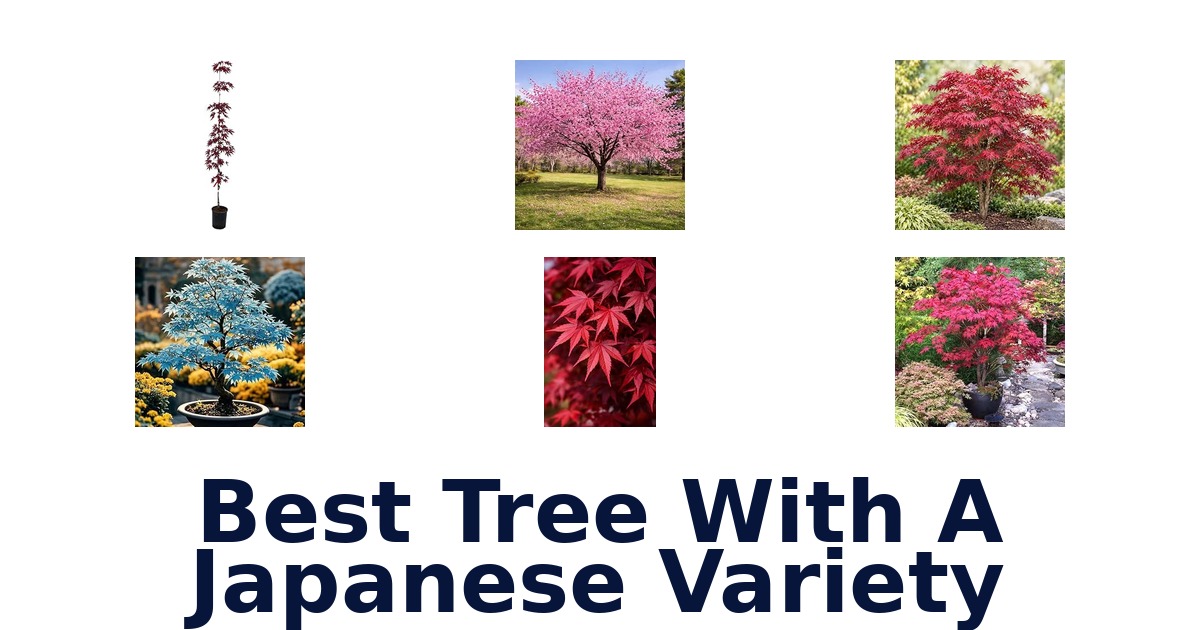
A strong choice for a Japanese-variety tree is a live, named Japanese maple if you want a defined ornamental cultivar; it suits gardeners seeking an established focal point rather than a seed-growing project. This roundup compares ten options, including rooted trees, a flowering cherry, and seed kits. The live maples range from a two-year-old Bloodgood to a 3–4-foot tree, while the seed listings offer a slower route that requires preparation and patience.
Consider the mature size, whether the listing names a specific cultivar, and whether you want a plant ready to transplant or seeds to raise yourself. Shipping restrictions also matter: one Japanese maple listing excludes California, Arizona, Alaska, and Hawaii.
These differences shape which product is a practical fit for your garden.
The best overall choice is Bloodgood Japanese Maple Tree. It is a named Acer palmatum ‘Bloodgood’ live plant, described as a 2-year tree with deep red foliage and suitability for landscapes, containers, or bonsai training. That makes it a more direct match for someone seeking a Japanese variety than generic seed kits or seedlings whose traits may vary.
If you want a larger listed plant, Brighter Blooms Bloodgood Japanese Maple is specified at 3–4 feet tall.
Our Top Picks
 Best Overall
This named Acer palmatum ‘Bloodgood’ is a 2-year live tree with deep red foliage and stated landscape, container, and bonsai uses.
View on Amazon Tallest Listed Tree
Brighter Blooms Bloodgood Maple
The 3–4-foot live Bloodgood is a named Japanese maple, and its care guidance specifies well-drained soil and 4 to 8 hours of sunlight.
View on Amazon Late-Budding Foliage
This live Japanese Red Maple is listed at 1–2 feet in a 1-gallon pot; its description notes later spring budding and longer leaf retention.
View on Amazon- Most Compact Pixie Dwarf Japanese Maple
- Largest Pot Japanese Red Maple
Compare Japanese Maple and Related Tree Options
| # | Product | Care Instructions | Material Feature | Material Features | Buy |
|---|---|---|---|---|---|
| 1 | 1. Bloodgood Japanese Maple TreeBest Overall | Plant in well-draining soil with partial sun…. | Live rooted plant, 2-year growth, nursery… | Live rooted plant, 2-year growth, nursery… | View on Amazon |
| 2 | 2. Brighter Blooms Bloodgood MapleTallest Listed Tree | Plant in well-draining, nutrient-rich soil. | Bloodgood Japanese Maple Tree | Bloodgood Japanese Maple Tree | View on Amazon |
| 3 | 3. Emperor One Japanese MapleLate-Budding Foliage | Plant in well-drained, acidic soil. Provide… | — | — | View on Amazon |
| 4 |  4. Pixie Dwarf Japanese MapleMost Compact | — | Organic | Organic | View on Amazon |
| 5 |  5. Japanese Red MapleLargest Pot | Plant in moist, organically rich, slightly… | — | — | View on Amazon |
| 6 |  6. Okame Cherry TreeSpring-blooming Okame cherry | — | — | — | View on Amazon |
| 7 |  7. Japanese Red Maple SeedsRed maple seed-growing project | Use species-appropriate seed preparation and… | Heirloom | Heirloom | View on Amazon |
| 8 |  8. Blue Japanese Maple SeedsRare blue maple seed project | — | GMO Free, Heirloom | GMO Free, Heirloom | View on Amazon |
| 9 |  9. CZ Grain Bonsai Seed KitMulti-variety bonsai starter | Germination and preparation requirements vary… | — | — | View on Amazon |
| 10 |  10. AVERGO Bonsai Tree KitFamily bonsai seed activity | — | Wood | Wood | View on Amazon |
Detailed Reviews: Best Tree With A Japanese Variety
#1 · Best Overall
1. Bloodgood Japanese Maple Tree
- Care Instructions: Plant in well-draining soil with partial sun….
- Material Feature: Live rooted plant, 2-year growth, nursery…
- Material Features: Live rooted plant, 2-year growth, nursery…
Best for: Ready-to-plant Bloodgood.
Why it ranks #1: This named Acer palmatum ‘Bloodgood’ is a 2-year live tree with deep red foliage and stated landscape, container, and bonsai uses.
A rooted, two-year-old Bloodgood Japanese Maple arrives ready to plant, giving buyers an established live tree rather than seeds or a young seedling. Deep red foliage is described from spring to fall, and the listing identifies landscape, container, and bonsai training uses.
The live rooted plant is supplied in a pot or grow bag, so it can be moved from delivery into a chosen landscape spot or container planting. Its listed USDA Zones 5–8 provide a climate-fit reference, while the Bloodgood’s deep red foliage offers seasonal color. The product is described as slow growing and compact, qualities that can support a more measured placement plan; it is also listed as suitable for bonsai training. Consider the eventual space and container needs before planting.
- Two-year-old live rooted tree
- Deep red foliage from spring to fall
- Listed for USDA Zones 5–8
- Suitable for landscapes, containers, and bonsai training
- Slow growth means it will take time to develop into a larger landscape tree.
Skip it if you want to start several species from seed; CZ Grain's 12-variety kit includes more than 300 seeds.
This fits buyers who want a rooted Bloodgood for a landscape accent, container, or bonsai project. Its slow-growing, compact character suits a planned position, but it is not the multi-variety seed-growing experience.
Full product details
| Brand | Japanese Maples and Evergreens |
|---|---|
| Color | Red |
| Item Weight | 1.7 pounds |
| Manufacturer | Japanese Maples and Evergreens |
| Material Feature | Live rooted plant, 2-year growth, nursery grown, shipped in pot or grow bag |
| Material Features | Live rooted plant, 2-year growth, nursery grown, shipped in pot or grow bag |
| Special Features | deep red leaves, cold hardy, low maintenance, slow growing, compact size, ornamental appeal, great for bonsai, deer resistant, easy to grow, container friendly, stunning fall color, seasonal interest, unique branching |
| Care Instructions | Plant in well-draining soil with partial sun. Water regularly until established, then reduce. Mulch base to retain moisture. Prune in late winter for shape. Avoid over-fertilizing to maintain compact growth. |
| Special Feature | deep red leaves, cold hardy, low maintenance, slow growing, compact size, ornamental appeal, great for bonsai, deer resistant, easy to grow, container friendly, stunning fall color, seasonal interest, unique branching See more |
| Style Name | Japanese |
Listed on Amazon as: Bloodgood Red Japanese Maple Tree – 2 Year Live Plant – Acer palmatum 'Bloodgood' by – Japanese Maples and Evergreens
View on Amazon#2 · Tallest Listed Tree
2. Brighter Blooms Bloodgood Maple
- Care Instructions: Plant in well-draining, nutrient-rich soil.
- Material Feature: Bloodgood Japanese Maple Tree
- Material Features: Bloodgood Japanese Maple Tree
Best for: Taller Bloodgood landscape tree.
Why it ranks #2: The 3–4-foot live Bloodgood is a named Japanese maple, and its care guidance specifies well-drained soil and 4 to 8 hours of sunlight.
At 3–4 ft tall, this Bloodgood Japanese Maple offers a larger starting tree than a seedling, with distinctive red foliage for outdoor decoration. The listing describes the variety as easy to care for and gives a practical planting guide based on the root ball and site sunlight.
The stated 3–4 ft size gives buyers a substantial starting point for a landscape planting, while Bloodgood’s red foliage supplies the ornamental focus. The care information recommends well-drained soil and full to partial sunlight, defined as four to eight hours daily, helping buyers assess the site before planting. Instructions say to dig a hole slightly larger than the root ball and just as deep, then backfill and water. This straightforward planting workflow suits gardeners ready to establish a live tree outdoors.
- 3–4 ft Bloodgood Japanese Maple
- Distinctive red foliage
- Listed as easy to care for
- Planting guidance covers sunlight, soil, and root-ball hole size
- Needs a site with well-drained soil and 4–8 hours of sunlight daily.
Skip it if you cannot provide four to eight hours of sunlight; the Okame Cherry from GINGERGLOW is another listed outdoor flowering tree.
This fits a gardener seeking a 3–4 ft Bloodgood with red foliage for an outdoor planting. Check that the site offers well-drained soil and the stated daily sunlight before choosing its location.
Full product details
| Brand | Brighter Blooms |
|---|---|
| Color | Red |
| Manufacturer | Brighter Blooms |
| Part Number | MAP-JAP |
| Manufacturer Warranty Description | If anything does happen to your plants during delivery, don't worry… we got you covered. Every plant is covered by our warranty. We guarantee your plants to be true to type and in healthy condition. Due to the nature of the trees and shrubs you are buying, a root system and trunk will quickly deve |
| Material Feature | Bloodgood Japanese Maple Tree |
| Material Features | Bloodgood Japanese Maple Tree |
| Model Number | Acer palmatum 'Bloodgood' |
| Special Features | Cold Hardy |
| Care Instructions | Plant in well-draining, nutrient-rich soil. |
| Special Feature | Cold Hardy |
Listed on Amazon as: Brighter Blooms Bloodgood Japanese Maple Tree, 3-4 ft.
View on Amazon#3 · Late-Budding Foliage
3. Emperor One Japanese Maple
- Care Instructions: Plant in well-drained, acidic soil. Provide…
Best for: Upright red maple accent.
Why it ranks #3: This live Japanese Red Maple is listed at 1–2 feet in a 1-gallon pot; its description notes later spring budding and longer leaf retention.
Its upright branching and red, finely serrated leaves give this Japanese Red Maple a defined ornamental profile, while the listed 1–2 ft height offers a smaller starting tree for a garden or landscape plan. The Emperor One variety is also described as holding its leaves longer than classic Bloodgood.
This tree is listed for USDA Zones 5–8, giving zone-matched gardeners a clear starting point for evaluating placement. Its care guidance calls for well-drained, acidic soil, partial shade, and consistently even moisture; those conditions help buyers plan a suitable planting site and watering routine. The upright habit and balanced branching provide structure, while occasional pruning can keep the form tidy. Note the stated shipping restriction: it cannot ship to California, Arizona, Alaska, or Hawaii.
- Emperor One Japanese Red Maple variety
- Upright habit with balanced branching
- Red foliage and finely serrated leaves
- Listed for USDA Zones 5–8
- Cannot ship to California, Arizona, Alaska, or Hawaii.
Skip it if you live in California, Arizona, Alaska, or Hawaii; the Japanese Red Maple from Simpson Nursery is another listed option.
This suits a gardener seeking an upright red-leaved Japanese maple and able to provide acidic, well-drained soil with partial shade. Check the listed shipping exclusions and USDA zone range before making it your landscape choice.
Full product details
| Brand | Generic |
|---|---|
| Color | Red, Gray |
| Item Weight | 5 pounds |
| Manufacturer | Simpson Nursery |
| Special Features | Attracts Pollinators |
| Care Instructions | Plant in well-drained, acidic soil. Provide partial shade to shield from intense sunlight. Water consistently, keeping the soil evenly moist. Mulch to conserve soil moisture and regulate temperature. Prune for shape and remove dead branches. The Japanese Red Maple thrives with moderate care, rewardi |
| Special Feature | Attracts Pollinators |
Listed on Amazon as: Emperor One Japanese Red Maple, Ornamental Value, Vibrant Red Foliage, Serrated Leaves, 1-2 ft Tree Height, 1 gal Nursery Pot (Due to Agricultural Laws, we Cannot Ship to CA, AZ, AK, or HI)
View on Amazon#4 · Most Compact
4. Pixie Dwarf Japanese Maple
- Material Feature: Organic
- Material Features: Organic
Best for: Small-space Pixie maple.
Why it ranks #4: The named Pixie cultivar is described as a dwarf with compact growth, about 4–5 feet tall and wide, and purple foliage with fiery red fall color.
Pixie’s dense branching, short internodes, and deep purple-red leaves give this dwarf Japanese maple a compact, richly colored profile. It is listed at 4–5 ft tall and wide, with fiery scarlet-red fall foliage, making it a candidate for gardens where a smaller maple is preferred.
The short internodes and dense branching support Pixie’s tight, compact growth habit, giving buyers a more closely structured form than a broadly spreading tree. Its purple-red foliage and scarlet-red fall color add seasonal contrast, while the listed 4–5 ft height and width provide a useful scale for planning a planting spot. The tree is described as suitable for full sun to part shade and USDA Zones 5–8. Account for its eventual width as well as its height.
- Dwarf Japanese maple with compact growth habit
- Dense branching and short internodes
- Purple-red leaves with scarlet-red fall color
- Listed for full sun to part shade and Zones 5–8
- Its listed 4–5 ft width still requires room to spread in a small planting bed.
Skip it if you want a taller, established Bloodgood tree; Brighter Blooms lists its Japanese maple at 3–4 ft on arrival.
Pixie suits a buyer seeking a compact Japanese maple with dense branching and vivid seasonal color for a Zone 5–8 site. Allow room for its listed 4–5 ft spread when choosing a garden position.
Full product details
| Brand | Japanese Maples and Evergreens |
|---|---|
| Color | Black-red,Purple,Red-black |
| Material Feature | Organic |
| Material Features | Organic |
| Model Number | Acer p 'Pixie' |
| Special Features | Low Maintenance |
| Special Feature | Low Maintenance |
Listed on Amazon as: Pixie Dwarf Japanese Maple 2 – Year Live Tree
View on Amazon#5 · Largest Pot
5. Japanese Red Maple
- Care Instructions: Plant in moist, organically rich, slightly…
Best for: Compact-yard seasonal maple.
Why it ranks #5: This live Japanese Red Maple comes in a 3-gallon nursery pot and is described as reaching 15–20 feet tall and wide at maturity.
Red leaves through most of summer, reddish fall color, and a compact, spreading habit give this Japanese Red Maple seasonal interest without requiring a tall, narrow profile. It is presented as a focal-point option for smaller gardens, with a stated mature height and width of 15–20 ft.
The 3-gallon nursery pot gives buyers a potted tree to place in a landscape plan, while the compact, spreading habit can work as a garden focal point where its eventual breadth is accounted for. Seasonal foliage shifts from red to greenish red in hot southern conditions, then to reddish fall color. Planting guidance specifies moist, organically rich, slightly acidic, well-drained soil; matching those conditions supports establishment. Its listed mature dimensions still call for space beyond a small patio container.
- Supplied in a 3-gallon nursery pot
- Red summer foliage with reddish fall color
- Compact, spreading growth habit
- Specified for moist, organically rich, slightly acidic, well-drained soil
- Mature dimensions are listed as 15–20 ft tall and wide, requiring substantial landscape space.
Skip it if you need a genuinely small mature tree; Pixie from Japanese Maples and Evergreens is listed at 4–5 ft tall and wide.
Pick this Japanese Red Maple for a landscape focal point where seasonal foliage and a spreading form matter. Its mature 15–20 ft dimensions make it a less suitable fit for a very confined planting space.
Full product details
| Brand | Generic |
|---|---|
| Color | Red |
| Item Weight | 15 pounds |
| Manufacturer | Simpson Nursery |
| Care Instructions | Plant in moist, organically rich, slightly acidic, well-drained soils. |
Listed on Amazon as: Japanese Red Maple, 3 gal, Nursery Pot
View on Amazon#6
6. Okame Cherry Tree
Best for: Spring-blooming Okame cherry.
Why it ranks #6: This 6–10-inch live cherry plant offers seasonal spring blossoms and an ornamental form, but it is not a Japanese maple cultivar.
An Okame cherry tree arrives as a live plant about 6–10 inches tall, giving buyers a transplantable start for an outdoor garden or container. Its seasonal spring blossoms provide the main appeal, with pink or white floral displays described for flowering cherry trees.
The 6–10-inch live plant is prepared for transplanting into garden soil or an outdoor container, so buyers can choose a planting setting rather than begin with seed. Seasonal blossoms bring color in spring, while the listing also describes graceful shape and structure for outdoor spaces. It is presented as an ornamental landscape tree, making it a fit for gardeners seeking flowering interest. The supplied details do not specify a mature size or hardiness zone, so plan placement around the available information.
- Live Okame cherry plant supplied
- Approximately 6–10 inches tall
- Prepared for transplanting into garden soil or outdoor containers
- Seasonal spring blossom display
- The supplied details do not state a mature size or USDA hardiness zone.
Skip it if you need a red-leaved Japanese maple with a listed zone range; Emperor One from Simpson Nursery is listed for Zones 5–8.
This suits gardeners seeking a small live cherry tree for an outdoor container or garden spot with seasonal spring blooms. The listing gives no mature dimensions or zone range, so those details may matter for placement.
Full product details
| Brand | GINGERGLOW |
|---|---|
| Color | Pink |
| Manufacturer | GINGERGLOW |
| Style Name | Okame |
Listed on Amazon as: Okame Cherry Tree Live Plant
View on Amazon#7
7. Japanese Red Maple Seeds
- Care Instructions: Use species-appropriate seed preparation and…
- Material Feature: Heirloom
- Material Features: Heirloom
Best for: Red maple seed-growing project.
Why it ranks #7: The 30-seed selection directly targets Japanese red maple growing, but seedling foliage and form may vary and establishment takes multiple seasons.
Thirty Japanese Red Maple seeds provide a starting quantity for an ornamental growing project or future bonsai training, letting gardeners raise seedlings instead of buying a named cultivar. The listing also makes clear that seed-grown foliage and form can vary, so each plant develops as an individual.
The 30-seed selection supports a planned home gardening project, while the option to train a future tree as bonsai gives the seedlings a possible longer-term use. Care guidance calls for species-appropriate seed preparation and a well-drained growing medium; protecting young plants from harsh sun and drying wind informs the choice of a sheltered starting site. Seed-grown plants are not clones of a named cultivar, and their foliage and form may differ. Allow for a multi-season establishment process.
- 30 Japanese Red Maple seeds
- Suitable for an ornamental growing project
- Future bonsai training is a listed use
- Care guidance addresses drainage and shelter for young seedlings
- Seed-grown foliage and plant form can vary and will not clone a named cultivar.
Skip it if you want cultivar consistency in a live tree; the Bloodgood from Japanese Maples and Evergreens is a rooted named variety.
Choose these seeds if you want to raise Japanese Red Maple seedlings and have a sheltered place for the early stages. They suit patient growers who accept variation in foliage and form over multiple seasons.
Full product details
| Brand | ZEshops |
|---|---|
| Color | Red |
| Manufacturer | Zhang Eshop Services |
| Material Feature | Heirloom |
| Material Features | Heirloom |
| Special Features | Ornamental Tree Growing Project |
| Care Instructions | Use species-appropriate seed preparation and well-drained growing medium. Protect young seedlings from harsh sun and drying wind. See more |
| Special Feature | Ornamental Tree Growing Project |
Listed on Amazon as: 30 Japanese Red Maple Tree Seeds, Ornamental Growing
View on Amazon#8
8. Blue Japanese Maple Seeds
- Material Feature: GMO Free, Heirloom
- Material Features: GMO Free, Heirloom
Best for: Rare blue maple seed project.
Why it ranks #8: This listing offers 15 seeds identified as Acer palmatum, but the unusual blue-foliage claim is not accompanied by a named cultivar or live plant.
A pack of 15 seeds is presented as a rare blue Japanese maple variety, offering an unusual color concept for gardeners who want to grow an ornamental Acer palmatum. The listed planting options include outdoor landscaping and indoor cultivation as miniature bonsai, so the project can start in different settings.
The 15-seed quantity gives growers several opportunities to begin a Japanese maple project, while the stated outdoor and indoor planting options allow them to consider a yard planting or miniature bonsai setting. The blue foliage is the listing’s central visual distinction from traditional garden landscapes. These are seeds rather than a live tree, so the buyer is choosing a growing project that begins with planting and establishment. The supplied details do not specify seed preparation steps or expected mature dimensions.
- 15 Japanese maple seeds in the pack
- Described as a rare blue-foliage variety
- Suitable for outdoor landscaping
- Indoor miniature bonsai cultivation is listed
- Seeds require a growing project rather than providing an established tree for immediate display.
Skip it if you need a live tree for immediate planting; GINGERGLOW's Okame Cherry arrives as a transplant-ready plant.
This is for gardeners interested in trying a blue-foliage Japanese maple from seed, either outdoors or as indoor miniature bonsai. Choose it for the growing process, not an immediate finished landscape tree.
Full product details
| Brand | BuggyBeds |
|---|---|
| Color | Blue |
| Manufacturer | BuggyBeds |
| Material Feature | GMO Free, Heirloom |
| Material Features | GMO Free, Heirloom |
| Special Features | Low Maintenance |
| Special Feature | Low Maintenance |
Listed on Amazon as: 15 Rare Blue Japanese Maple Seeds – Acer Palmatum Ornamental Tree Seeds for Planting – Home Garden Yard and Indoor Bonsai Decor
View on Amazon#9
9. CZ Grain Bonsai Seed Kit
- Care Instructions: Germination and preparation requirements vary…
Best for: Multi-variety bonsai starter.
Why it ranks #9: The 12-variety kit includes Japanese Black Pine among more than 300 seeds, but it does not focus on a particular Japanese ornamental tree.
More than 300 seeds across 12 tree varieties let growers begin a varied bonsai collection from seed, including Japanese Black Pine, Red Maple, Cherry Blossom, and Chinese Elm. The mix suits gardeners who want to experiment with different forms and learn how distinct species develop rather than start with one established tree.
The range of named varieties creates options for different bonsai projects, while container-growing suitability supports keeping developing trees in pots. This is a seed-growing kit, so it fits people willing to follow species-specific preparation and nurture seedlings rather than buyers seeking an immediate display tree. The care notes call for keeping seeds moist but not saturated and provide that preparation can vary, including stratification or scarification for some varieties; allow for those differing routines.
- More than 300 seeds included
- 12 varieties, including Japanese Black Pine and Cherry Blossom
- Suitable for bonsai and container growing
- Planting instructions are described as easy to follow
- Preparation requirements vary by species, and some seeds may need stratification or scarification.
Skip it if you want a ready-to-plant Japanese maple; the Brighter Blooms Bloodgood arrives as a 3–4 ft tree.
Choose this kit if you want to grow and train several kinds of bonsai from seed, including Japanese Black Pine. It is a project for patient growers, not a quick way to add a mature focal tree.
Full product details
| Brand | CZ Grain |
|---|---|
| Color | Green, Red and Blue Green Foliage with Pink, Purple, Red and Varied Flowers |
| Included Components | [INCOMPLETE] |
| Manufacturer | CZ Grain |
| Special Features | Bonsai Suitable, Container Growing |
| Care Instructions | Germination and preparation requirements vary by species, with some varieties benefiting from stratification, scarification or other seed preparation. Keep planted seeds appropriately moist without saturation and provide suitable warmth and light for the individual variety. As plants develop, provid |
| Special Feature | Bonsai Suitable, Container Growing |
Listed on Amazon as: 12 Variety Bonsai Tree Seed Kit | 300+ Seeds for Growing & Training
View on Amazon#10
10. AVERGO Bonsai Tree Kit
- Material Feature: Wood
- Material Features: Wood
Best for: Family bonsai seed activity.
Why it ranks #10: This kit includes seeds for five bonsai types, including Crape Myrtle and Flame Tree, but the listed varieties do not identify a Japanese tree.
Five named bonsai varieties, including Crape Myrtle, Flame Tree, and Blue Jacaranda, make this kit a hands-on seed-growing activity rather than a single-tree purchase. It includes bonsai tools and extra seed packets, giving beginners and families materials for a shared planting project and additional seeds to work with.
The included seeds and bonsai tools bring the basic planting activity together in one kit, while extra seed packets provide more seed material for the project. Its listed varieties include Crape Myrtle, Flame Tree, Blue Jacaranda, and Pigeon Pea, so buyers can explore several kinds rather than focus on one Japanese maple cultivar. The product is presented as a beginner kit and family activity; expect a seed-starting process and growth period, not an immediately established ornamental tree.
- Includes seeds and bonsai tools
- Five varieties named in the title
- Extra seed packets included
- Presented as a beginner and family activity
- This is a seed kit, so it does not provide an established live tree for immediate planting.
Skip it if you need an established Japanese maple now; the two-year-old Bloodgood from Japanese Maples and Evergreens arrives rooted.
Choose this kit for a family or beginner who wants to try growing several bonsai varieties from seed and use the included tools. It is not a ready-made Japanese maple or an instant garden focal point.
Full product details
| Brand | AVERGO |
|---|---|
| Color | Natural |
| Included Components | Bonsai Tools, Seeds |
| Item Weight | 1.7 pounds |
| Manufacturer | Fribar LLC |
| Part Number | AVBK5-V2-G |
| Material Feature | Wood |
| Material Features | Wood |
| Model Number | AVBK5-V2-G |
| Special Features | For Women and Family, Gift for Plant Lovers, Great Gift for Any Occasion, Great for Family Activity, High Germination Rate |
| Special Feature | For Women and Family, Gift for Plant Lovers, Great Gift for Any Occasion, Great for Family Activity, High Germination Rate See more |
| Style Name | Bonsai Deluxe Growing Kit |
Listed on Amazon as: Bonsai Tree Kit Deluxe – Growing 5 Unique Japanese Bonzai Trees
View on AmazonSeedlings are not named cultivars
A Japanese maple grown from seed may not reproduce the look of a named cultivar. The ZEshops listing explicitly says seed-grown foliage and plant form can differ, so its 30 seeds are better treated as a growing project than a way to obtain a predictable Bloodgood or Pixie. The Blue Japanese Maple Seeds listing likewise does not name a cultivar, and its blue-foliage description should not be confused with a verified mature-tree specification.
By contrast, the Bloodgood and Pixie listings identify specific Acer palmatum cultivars. This distinction matters when matching an existing garden design or seeking a particular leaf color.
Seed projects also take time: the ZEshops listing advises planning for the seedling stage and development over multiple seasons. Choose seeds for the experience of raising trees; choose a named live plant when cultivar identity and a more immediate ornamental result are priorities.
Check the planting footprint before ordering
A Japanese maple’s listed starting size can be much smaller than its eventual garden footprint. The Emperor One listing gives a current height of 1–2 feet in a 1-gallon pot, while the 3-gallon Japanese Red Maple listing says its tree can mature to 15–20 feet in both height and width. The Pixie is a different proposition: its description gives a compact mature range of about 4–5 feet tall and wide, while the Bloodgood listing describes a 15-foot-plus mature height.
These figures are not interchangeable measures: pot size and shipped height describe the plant now, while mature dimensions guide site selection. Allow room for the stated mature size and check the seller’s care guidance before planting.
For a restricted garden, the dwarf Pixie is the clearest compact option in this set; larger maples suit buyers who can plan for a broader canopy.
How to Choose a Japanese Variety Tree
Named live plant or seeds
Choose a named live tree if you want a specific Japanese maple cultivar; choose seeds if you want to grow seedlings and accept variation. The Bloodgood and Pixie listings identify named Acer palmatum varieties, and the Emperor One is a named Japanese maple type. The ZEshops option supplies 30 Japanese red maple seeds and warns that seed-grown leaf color and form may differ.
CZ Grain’s kit has more than 300 seeds across 12 varieties, including Japanese Black Pine, but it is not a single-variety maple. Buyers prioritizing cultivar identity and a plant ready to establish should favor the live maples.
Gardeners interested in a longer growing project may prefer the seed choices, while allowing for preparation and variable results.
Current size and mature space
Compare the plant’s shipped size with its stated mature dimensions before choosing a site. Emperor One is listed at 1–2 feet in a 1-gallon pot, and the Brighter Blooms Bloodgood is 3–4 feet tall; those measurements describe the offered plants, not their eventual canopy. The 3-gallon Japanese Red Maple listing gives a mature size of 15–20 feet tall and wide.
Pixie is described as a dwarf, about 4–5 feet tall and wide. A gardener with a small yard or container plan should investigate the compact Pixie listing first; buyers with room for a larger landscape focal point can consider the larger-growing maples.
Check local growing conditions and planting guidance as well, since the supplied mature figures do not guarantee identical growth in every garden.
Foliage and seasonal display
Pick the tree by the foliage or bloom effect you want, while distinguishing a named cultivar from a general description. Bloodgood is described as having deep burgundy-red foliage, while Emperor One offers deep purple-red color across three seasons and later spring budding. Pixie has purple leaves and fiery scarlet-red fall color.
The Japanese Red Maple listing describes red summer foliage that can turn greenish red in southern heat, followed by reddish fall color. The Okame Cherry Tree instead offers seasonal spring blossoms.
Buyers who want a specific red-leaf maple should favor the named maple listings; those seeking spring flowers may prefer the cherry. Regional conditions can affect foliage display, so use the care and climate details in each listing rather than assuming color will remain identical everywhere.
Which Japanese variety tree should I choose?
For a named, versatile live Japanese maple, choose Bloodgood Japanese Maple Tree: it is a 2-year rooted plant described for landscape, container, or bonsai use. If you want a taller shipped specimen, Brighter Blooms Bloodgood Maple is listed at 3–4 feet. For a compact mature footprint, Pixie Dwarf Japanese Maple is described at about 4–5 feet tall and wide.
Choose Emperor One Japanese Maple for a 1–2-foot, 1-gallon plant with later spring budding, or Japanese Red Maple if the 3-gallon pot and stated 15–20-foot mature dimensions suit your site. For a flowering tree, consider Okame Cherry Tree.
The seed products suit patient growers, but seedlings can vary; CZ Grain Bonsai Seed Kit and AVERGO Bonsai Tree Kit are less direct fits for a specific Japanese variety.
Frequently Asked Questions
How much sun and what soil do Japanese maples need?
Japanese maples generally do best with some protection from harsh afternoon sun and in soil that drains well. The supplied product details do not specify sun or soil requirements for these listings, so check the grower’s instructions for your chosen tree and match them to your site before planting.
How large can a Japanese maple become, and how much space should I allow?
Mature size depends on the variety: the Pixie Dwarf listing gives about 4–5 feet tall and wide, while Japanese Red Maple is listed at 15–20 feet. Allow for the selected tree’s stated mature dimensions, not just its shipped size, and verify the eventual size if a listing does not provide it.
Can Japanese maple seeds grow true to a named cultivar?
No guarantee is provided that seed-grown Japanese maples will match a named cultivar. The article distinguishes named live plants, such as Bloodgood, from generic seed kits and seedlings whose traits may vary. Choose a named live plant when matching a specific variety matters; consider seeds when you are comfortable with variation.
Which listed option suits a small space or container?
Pixie Dwarf Japanese Maple is the clearest small-space option in the supplied details, with a stated mature size of about 4–5 feet tall and wide. Bloodgood Japanese Maple Tree is described for container use, too. Check the particular listing’s guidance and allow room for the tree as it grows.
What should I choose if I want a larger shipped Japanese maple?
Brighter Blooms Bloodgood Japanese Maple is listed at 3–4 feet tall, making it the taller shipped specimen among the named options described here. Emperor One is listed at 1–2 feet, while the Japanese Red Maple listing gives a 3-gallon pot and mature dimensions rather than a shipped height.
Final Words
For the most direct match to a named Japanese variety, choose Bloodgood Japanese Maple Tree: it is a 2-year rooted plant described for landscapes, containers, or bonsai training. Prefer a taller shipped plant? Brighter Blooms Bloodgood is listed at 3–4 feet.
For a compact footprint, consider Pixie Dwarf; for patient growing, seeds are options, but their traits may vary.