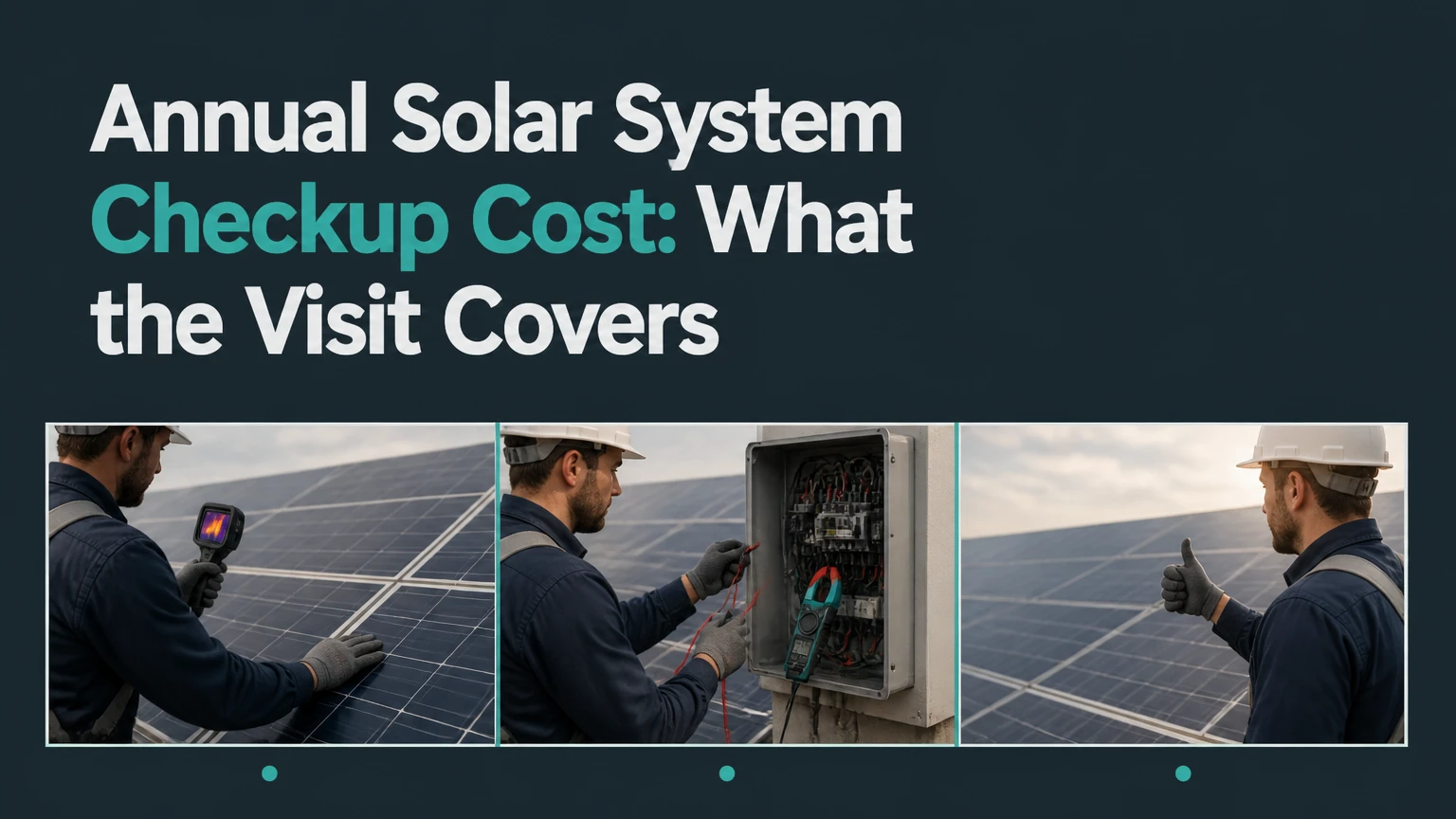
An annual solar system checkup costs typically $150-$350 for a standard residential photovoltaic system in the United States. A visit that includes professional panel cleaning usually costs $390-$720, while advanced electrical testing, steep-roof access, batteries, or complex arrays can raise the total to $450-$800 or more.
Key Facts at a Glance
- A standard residential solar inspection typically costs $150-$350 and takes 30 minutes to 2.5 hours.
- Professional cleaning commonly adds $150-$370, producing a combined annual service cost of $390-$720.
- Level 1 inspections focus on visual, mechanical, monitoring, and basic safety checks.
- Level 2 inspections add thermal imaging, string testing, and insulation diagnostics.
- Battery systems usually need a broader service scope than grid-tied systems with microinverters.
- Central string inverter replacement commonly requires a long-term reserve of $1,000-$3,500 around years 10-15.
What Is the Annual Solar System Checkup Cost?
The annual solar system checkup cost is usually $150-$350 for inspection only, not including panel washing, repairs, pest removal, or replacement parts. The lower end generally applies to an accessible, newer roof with a small grid-tied array; the upper end reflects larger systems, difficult access, higher labor rates, or more extensive testing.
A solar checkup is a preventive photovoltaic operation and maintenance visit. The technician reviews energy production, examines modules and racking, checks exposed wiring and electrical protection, and records defects that could reduce output or create fire, shock, or roof risks.
The U.S. Department of Energy’s Energy Saver guidance describes solar systems as requiring “very little maintenance” under normal conditions. That does not mean solar owners should ignore warning signs. Low routine maintenance and occasional professional verification are compatible: a healthy system may need only monitoring and periodic inspection, while a storm-damaged or aging system needs immediate diagnostics.
Typical Price by Service Scope
| Service scope | Typical U.S. price | Typical duration | Appropriate system |
|---|---|---|---|
| Visual and safety inspection | $150-$250 | 30-60 minutes | Grid-tied system under 5 years old |
| Electrical and thermal inspection | $250-$450 | 1-2 hours | System over 5 years old or underperforming |
| Inspection plus panel cleaning | $390-$720 | 1.5-3 hours | Dusty, pollen-heavy, or bird-affected roof |
| Hybrid or battery checkup | $500-$800+ | 2-4 hours | Solar-plus-storage or off-grid installation |
| Large-array inspection | $350-$650 | 1.5-3 hours | More than 20-25 modules or multiple inverters |
Prices are typical planning ranges rather than regulated national rates. Labor costs in California, Hawaii, New York, and other high-cost markets can exceed these figures, while easy-access systems in lower-cost regions may fall below them.
What Does a Solar Inspection Include?
A professional solar inspection includes production analysis, physical condition checks, electrical measurements, inverter diagnostics, and verification of safety equipment. A basic inspection may stop at visual and operational checks, whereas an advanced service should document string performance, thermal anomalies, insulation resistance, and rapid-shutdown operation.
The technician should begin with the monitoring portal and system history rather than immediately climbing onto the roof. Comparing recent production with prior years, expected irradiance, weather, and utility outages helps distinguish a dirty module from a failed string or a communication problem.
Production and Monitoring Review
The technician compares energy generation in kilowatt-hours with historical system behavior and, when available, site irradiance data. A 15% or greater decline in the same month year over year deserves investigation when weather, shading, and utility conditions are comparable.
Monitoring errors require separate diagnosis. A portal that shows no data may indicate a lost internet connection, gateway failure, or inverter communication fault, while the array may still be producing electricity.
Module, Roof, and Racking Inspection
The physical review covers cracked glass, delamination, discoloration, bird droppings, heavy debris, shading growth, loose clamps, shifted rails, corrosion, and animal nests. The technician also checks whether roof penetrations, flashing, and conduit attachments remain weather-resistant.
Roof access is a major price variable. A two-story home, roof pitch above roughly 30 degrees, fragile tile, or a need for fall-protection equipment can add $100-$150 or more.
Thermal and Electrical Diagnostics
Infrared imaging can reveal abnormal heat at cells, connectors, fuses, and junction boxes. A thermal image is a screening tool, not proof of a specific failure; sunlight level, wind, module load, and camera resolution affect interpretation.
Electrical testing may include open-circuit voltage, short-circuit current, string comparison, polarity, insulation resistance, grounding continuity, and connector condition. Technicians should use equipment and procedures appropriate to live DC circuits because a homeowner can receive a lethal shock even when the utility grid is disconnected.
Inverter and Safety Testing
Inverter diagnostics may include error-log review, firmware status, cooling paths, operating temperature, isolation faults, arc-fault indicators, and communication links. Safety checks can include AC and DC disconnects, rapid shutdown, equipment grounding, surge protection, and visible conduit damage.
Rapid shutdown requirements vary by installation date, equipment, and local code adoption. The technician should identify the installed equipment and report whether the shutdown test was actually performed, rather than listing it as a generic checkbox.
Which Inspection Level Fits Your System?
The right inspection level depends on system age, fault symptoms, equipment type, roof access, and warranty requirements. A newer, monitored grid-tied array may need Level 1 service, while an older system, property sale, storm event, or battery bank justifies Level 2 or Level 3 diagnostics.
| Inspection level | Price range | Main tests | Best use |
|---|---|---|---|
| Level 1 | $150-$250 | Visual condition, monitoring, torque review, inverter codes | Newer systems with stable output |
| Level 2 | $250-$450 | Level 1 plus IR scan, string voltage, insulation resistance | Systems older than 5 years |
| Level 3 | $500-$800+ | Level 2 plus battery testing, firmware, cleaning | Hybrid, off-grid, or complex systems |
| Pre-sale inspection | $250-$600 | Records, roof, production, electrical safety | Home sale or ownership transfer |
| Storm inspection | $200-$500 | Modules, wiring, racking, surge and water damage | Hail, wind, lightning, or flooding |
A Level 3 label is not standardized across the solar industry. Read the scope, instruments, measurements, and report deliverables instead of selecting a package solely by name.
Is Solar Panel Cleaning Included in the Price?
Solar panel cleaning is often excluded from the base inspection price and adds approximately $150-$370 for a typical home. Cleaning is most valuable where dust, pollen, bird droppings, sap, or agricultural residue creates measurable shading; rainfall can remove loose dust but does not reliably remove baked-on contamination.
Cleaning frequency should follow site conditions. A dry, dusty property may need cleaning every six to twelve months, while a rainy suburban roof with a steep pitch may need cleaning only when monitoring data or visible contamination shows a problem.
| Site condition | Typical cleaning frequency | Added annual cost | Main concern |
|---|---|---|---|
| Rainy suburban area | Every 18-36 months | $0-$250 | Bird droppings and pollen |
| Moderate dust and trees | Every 12-24 months | $150-$370 | Sap, leaves, seasonal pollen |
| Desert or unpaved-road location | Every 6-12 months | $300-$740 | Dust film and abrasion |
| Coastal bird exposure | Every 6-12 months | $300-$740 | Droppings and salt residue |
| Agricultural property | Every 6-12 months | $300-$740 | Soil, fertilizer, and crop dust |
Avoid abrasive brushes, pressure washers, harsh detergents, and hard water that leaves mineral deposits. A professional should use manufacturer-compatible methods, soft equipment, and deionized or appropriately treated water when local water quality creates spotting.
What Raises the Annual Solar Maintenance Price?
The largest cost drivers are labor access, array size, diagnostic depth, travel distance, equipment complexity, and repair discovery. A quote should separate inspection labor from cleaning, repairs, replacement parts, roof work, pest removal, and travel.
| Cost driver | Typical increase | Trigger | Why it matters |
|---|---|---|---|
| Extra modules | $5-$15 per module | More than 20-25 panels | Adds visual and electrical review time |
| Steep or high roof | $100-$150+ | Pitch above 30 degrees or two stories | Requires fall protection and slower access |
| Travel | $25-$100+ | Service radius beyond 30 miles | Covers vehicle and technician time |
| Battery storage | $150-$400+ | Lithium-ion or lead-acid bank | Adds state-of-health and terminal checks |
| Multiple inverters | $50-$150+ | Two or more inverter units | Requires separate logs and test points |
| Repairs found | $100-$1,000+ | Connectors, wiring, pests, or controls | Corrective work is outside inspection scope |
Microinverters change the diagnostic workflow. Each module has power electronics, so a single failed unit may reduce one panel’s output rather than disconnecting an entire string, but accessing and testing many roof-level devices can increase labor.
Long-Term Replacement Reserves
A central string inverter commonly costs $1,000-$3,500 to replace, including equipment and labor, around years 10-15, although warranties, capacity, installation design, and market prices change the result. Microinverter replacement may occur one unit at a time, but roof access and labor can make a small failure disproportionately expensive.
A practical reserve is the expected replacement cost divided by the remaining planning years. For example, a $2,400 inverter reserve over 12 years equals $200 per year, separate from inspection and cleaning expenses.
Should You Buy an Annual Maintenance Contract?
An annual maintenance contract can reduce visit pricing by roughly 10%-20%, but the value depends on included labor, response guarantees, monitoring, and exclusions. Pay-as-you-go service usually suits reliable, newer systems, while a contract can make sense for inaccessible roofs, batteries, remote properties, or owners who want documented oversight.
| Service option | Annual commitment | Typical visit economics | Best fit |
|---|---|---|---|
| Pay-as-you-go inspection | $0 | $150-$350 per visit | Newer, stable grid-tied system |
| Inspection plus cleaning | $390-$720 | One bundled visit | Dusty or bird-affected roof |
| Maintenance contract | $250-$700 | Often 10%-20% below separate visits | Hands-off homeowner |
| Remote monitoring only | $0-$240 | Alerts without physical testing | Owner who can arrange repairs |
| Installer warranty service | Contract-specific | $0-$350 outside coverage | Equipment still under warranty |
A contract is weak value when it promises “maintenance” but excludes cleaning, travel, diagnostic testing, and labor for repairs. Ask whether the company owns the monitoring account, guarantees response time, and supplies a dated report after every visit.
How Often Does a Solar System Need a Checkup?
Most healthy, grid-connected residential systems do not need a paid physical inspection every year if monitoring is stable, the roof is accessible, and the manufacturer does not require a specific schedule. A practical baseline is a professional inspection every 1-3 years, with annual review more appropriate for older, complex, high-risk, or warranty-sensitive installations.
Annual service is more defensible when the system is over five years old, production has declined, the property experiences severe weather, or the array sits near dust, salt, agricultural residue, or nesting birds. A new system with a strong installer warranty may need only monthly monitoring, visible ground-level checks, and service after an alert.
Do not postpone a checkup after hail, high wind, lightning, flooding, rodent damage, or roof work. Event-based inspection is more valuable than following a calendar when a known hazard could have damaged energized equipment.
Can You Inspect Solar Panels Yourself?
Homeowners can perform safe ground-level observations and review monitoring data, but DIY inspection cannot replace electrical, thermal, roof, or rapid-shutdown testing. Do not climb onto the array, open an inverter, disconnect DC connectors, or probe live conductors without appropriate training and equipment.
A safe monthly routine includes checking the monitoring app, looking for obvious new shading, observing inverter status from the ground, and recording unusual noises or error codes. Photograph visible conduit damage and contact a qualified solar electrician rather than attempting a temporary repair.
What Should the Technician Give You?
A useful report contains the inspection date, system address, equipment model numbers, production observations, measured electrical values, photographs, defects, urgency ratings, and recommended corrective action. It should also identify tests that were not performed and explain why.
Keep invoices and reports with the original installation contract, warranty certificates, monitoring credentials, and utility interconnection documents. Manufacturers differ in their maintenance requirements, so a record cannot guarantee warranty approval, but missing documentation can complicate a claim.
When Should You Call Before the Annual Visit?
Immediate professional evaluation is appropriate when monitoring shows a sustained production loss of about 15% or more, the inverter displays a red or amber fault, or wiring, conduit, modules, or racking appear physically damaged. These conditions can indicate an electrical fault, storm damage, animal intrusion, or a disconnected string.
| Warning sign | Possible cause | Recommended response | Typical urgency |
|---|---|---|---|
| 15%+ same-month output decline | Failed string, shading, dirt, or inverter issue | Compare weather and monitoring data | Within 1-2 weeks |
| Red inverter light | Ground fault, isolation fault, or shutdown | Record code and call technician | Same day |
| Exposed or drooping conduit | Wind, rodents, failed attachment | Keep away and isolate area | Same day |
| Cracked module glass | Hail, impact, or thermal stress | Photograph, avoid contact, report | Within 24-48 hours |
| Burning smell or arcing sound | Electrical overheating or arc fault | Leave area and call emergency service if fire risk exists | Immediate |
| Battery swelling or unusual heat | Storage failure or thermal event | Do not touch; follow battery emergency guidance | Immediate |
Production comparisons must account for snow, smoke, seasonal sun angle, new shade, utility curtailment, and a changed monitoring connection. A single low-output day is not enough evidence of equipment failure.
Common Maintenance Mistakes That Increase Cost
Rain is not a complete cleaning strategy. Rainwater can remove loose dust while leaving bird droppings, sap, mineral residue, and industrial grime that create localized shading and thermal stress.
Harsh cleaning methods damage surfaces. Dish soap, abrasive tools, untreated hard water, and high-pressure spray can leave films, scratch coatings, force water into unsuitable areas, or void manufacturer cleaning guidance.
Ignoring paperwork creates a second risk. A dated inspection report does not replace a warranty’s terms, but it gives the owner evidence of system condition, maintenance timing, and pre-existing defects.
Three practitioner rules reduce avoidable expense:
- Compare kilowatt-hours, not app availability. A monitoring portal can be online while one string produces nothing.
- Treat a quote with no measured values as a visual visit. A checklist is not evidence that electrical tests occurred.
- Separate cleaning from diagnosis. A cleaner can improve module appearance without identifying an overheated connector or failed inverter.
How to Judge a Solar Inspection Quote
A credible quote identifies the system size, number of modules, inverter architecture, roof-access method, included tests, report format, travel policy, and repair exclusions. The contractor should also state whether a licensed electrician or qualified solar technician will perform electrical measurements.
Use this checklist before approving service:
- Confirm the price for inspection alone.
- Ask whether thermal imaging is included or optional.
- Request the exact electrical tests and expected measurements.
- Verify rapid-shutdown and grounding checks.
- Ask whether cleaning uses soft equipment and compatible water.
- Confirm whether batteries receive individual module or pack diagnostics.
- Check insurance, licensing, and manufacturer training.
- Require photos and written defect priorities.
- Ask who pays for a second truck roll.
- Compare the warranty’s maintenance language with the proposed scope.
A very low price may represent a visual glance rather than a complete health check. A high price is not automatically better if the proposal contains no instruments, measurements, or report.
Which Homeowners Benefit Most From Annual Service?
Annual service is most useful for owners who cannot safely observe the roof, operate systems with batteries, live in contaminating environments, or need clear records for a property transaction. A stable five-year-old system in a clean climate may receive better value from monitoring and event-based service.
| Homeowner situation | Recommended plan | Annual planning cost | Reason |
|---|---|---|---|
| New suburban grid-tied system | Monitoring plus inspection every 2-3 years | $50-$175 averaged | Low routine fault risk |
| Older central-inverter system | Level 2 inspection yearly or biennially | $250-$450 | Aging components and output drift |
| Dusty rural property | Cleaning every 6-12 months plus annual safety check | $450-$800 | Contamination reduces light transmission |
| Battery-backed home | Level 3 annual service | $500-$800+ | Battery safety and state-of-health checks |
| Home being sold | Documented pre-sale inspection | $250-$600 | Buyers need equipment and roof evidence |
Leased and power-purchase-agreement systems require special attention. The provider may own the equipment and control maintenance obligations, so the homeowner should check the contract before paying for a private inspection.
FAQ
Does a solar system need maintenance every year?
A solar system does not always need a paid physical inspection every year. Stable systems under warranty may need monitoring and a professional visit every one to three years, while batteries, older inverters, dusty sites, storm exposure, and production declines support annual service.
How much does solar panel cleaning cost by itself?
Solar panel cleaning typically costs $150-$370 per visit for a standard residential array. Two visits per year can raise annual cleaning expense to $300-$740, especially on steep roofs, large arrays, desert properties, and homes near farms or unpaved roads.
Are solar inspections covered by warranty?
Solar inspections are not automatically covered by a manufacturer warranty. Equipment warranties generally address defects, while labor, travel, cleaning, and preventive inspections may be excluded; the installation contract and warranty terms determine whether documented maintenance is required.
What is the difference between solar maintenance and an inspection?
A solar inspection diagnoses condition and safety at a defined point in time. Solar maintenance is broader and may include cleaning, monitoring, firmware updates, vegetation control, pest work, repairs, and replacement planning, so a maintenance contract can cost more than a single inspection.
How much output loss justifies a solar inspection?
A sustained output decline of approximately 15% or more compared with the same month in a prior year justifies investigation when weather, shading, and utility conditions are similar. Smaller changes can still matter on a high-value system, but one cloudy day does not prove a fault.
Do solar batteries require a separate checkup?
Solar batteries usually require a separate or expanded checkup because technicians must evaluate state of health, temperature, terminal torque, enclosure condition, charge settings, firmware, and cell or module balance. Battery-related service commonly places a hybrid inspection in the $500-$800-plus range.
The Bottom Line
The annual solar system checkup cost is typically $150-$350 for inspection only and $390-$720 with professional cleaning. Choose basic service for a newer, stable grid-tied system; choose advanced testing for aging, underperforming, storm-affected, or sale-bound systems; and budget $500-$800 or more for hybrid installations with batteries. Monitoring data, site contamination, roof access, equipment age, and warranty terms should determine the schedule, not a generic annual requirement.