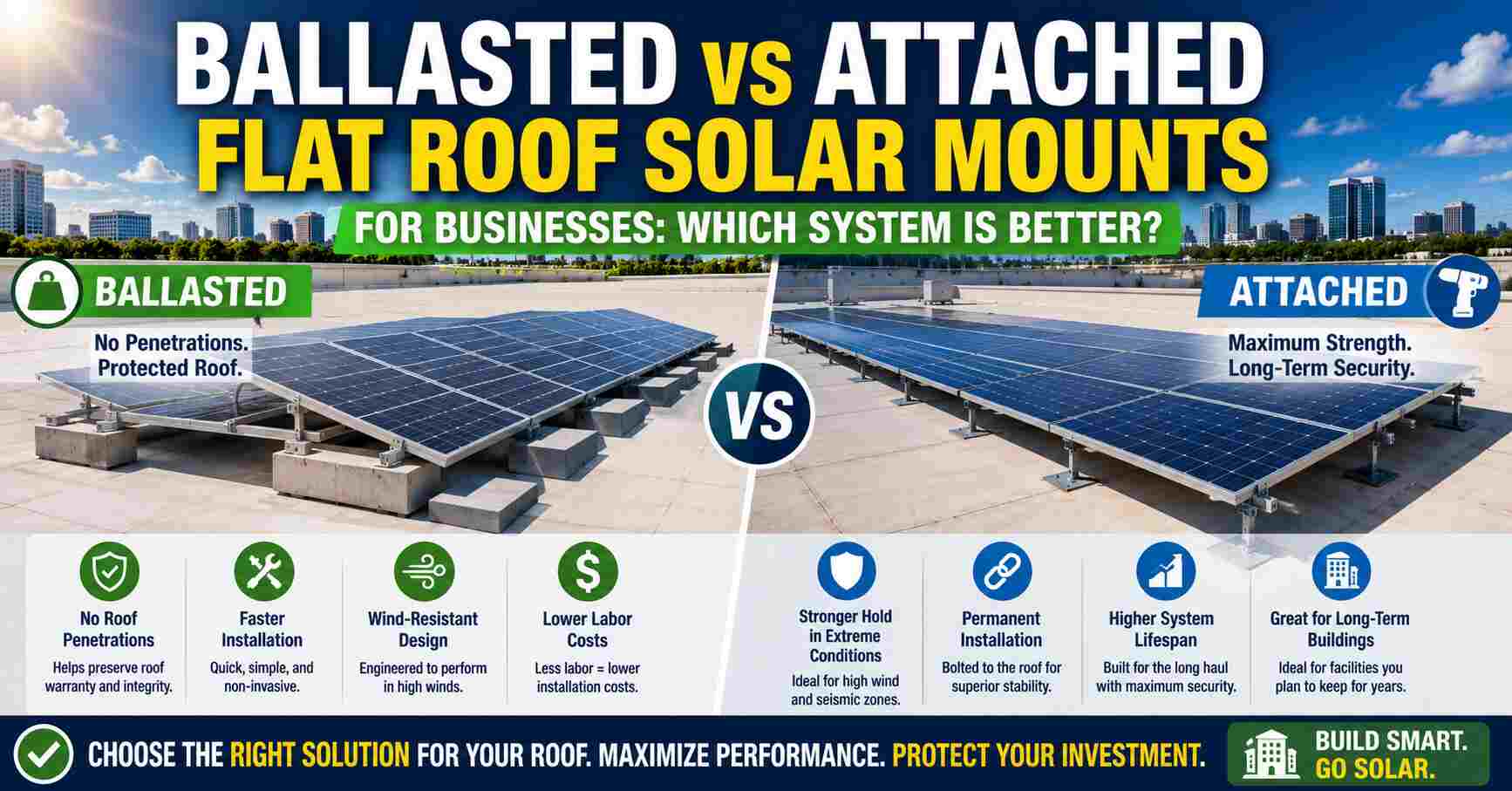
Installing solar panels on a commercial flat roof is rarely as simple as placing modules wherever sunlight is available. Before the first panel reaches the roof, the project team must decide how the entire solar array will be secured to the building.
The two main choices are ballasted solar mounts and attached solar mounts.
A ballasted system uses concrete blocks or another form of weight to hold the solar array in position. An attached system uses mechanical fasteners that connect the racking directly to the roof deck or the building structure.
Neither option is automatically better. The correct choice depends on the roof structure, building height, local wind conditions, roof membrane, drainage layout, warranty requirements, seismic exposure, and expected remaining roof life.
This guide compares ballasted vs attached flat roof solar mounts from a business perspective so property owners can make a safer and more financially informed decision.
What Is a Ballasted Solar Mounting System?
A ballasted solar mounting system secures solar panels using weight rather than relying primarily on structural fasteners.
Panels are installed on interconnected aluminum, steel, or polymer trays. Concrete pavers or manufactured ballast blocks are then positioned within the racking system. Gravity, friction, aerodynamic design, and the connected layout of the array work together to resist movement.
Ballasted mounting is popular on large commercial roofs because it can reduce the number of roof penetrations. The United States Department of Energy describes ballasted racking as a common commercial roof option that uses heavy weights, typically concrete blocks, to anchor photovoltaic systems.
Advantages of Ballasted Solar Mounts
Fewer roof penetrations
A fully ballasted layout may avoid mechanical penetrations across most or all of the array. This reduces the number of locations that require flashing and waterproofing.
Faster installation
Installation teams can often assemble trays, install protective pads, position ballast, and secure modules without locating every structural beam beneath the roof.
Simpler future removal
A ballasted array can usually be dismantled without leaving hundreds of attachment points behind. This can be valuable when the roof must be replaced, repaired, or redesigned.
Potential roof warranty benefits
Some roof manufacturers may accept ballasted systems more readily than extensive penetrations. However, approval is never automatic. The roofing manufacturer and warranty provider must review the proposed system before installation.
Flexible module layouts
Ballasted systems can be configured in compact rows with low tilt angles, which helps businesses maximize usable roof area while reducing wind exposure.
Limitations of Ballasted Solar Mounts
The most important disadvantage is weight.
The roof must support the modules, racking, ballast, wiring, maintenance personnel, snow where applicable, and existing rooftop equipment. The required ballast is not a universal number. It changes based on building height, roof zones, wind speed, parapet height, array position, module tilt, racking aerodynamics, and structural capacity.
National Renewable Energy Laboratory guidance states that a roof must be able to accept the additional load associated with the photovoltaic system and may require extra structural analysis for ballasted racking.
Ballasted arrays can also affect:
- Roof drainage
- Membrane wear
- Snow accumulation
- Access to mechanical equipment
- Fire code pathways
- Roof inspection procedures
- Future repair work
Protective pads must be compatible with the roof membrane. Without proper separation, racking components or ballast blocks may abrade the membrane as the array responds to thermal movement and wind.
GAF warns that ballasted systems positioned over certain roof components may damage the membrane if the array shifts during strong wind conditions.
What Is an Attached Solar Mounting System?
An attached solar mounting system uses mechanical anchors to transfer solar array forces into the roof deck, structural beams, joists, rafters, or concrete structure.
Installers create attachment points through or within the roofing assembly. Each location must be properly flashed, sealed, and integrated with the existing roof system.
Attached systems are often called penetrating mounts, anchored mounts, or mechanically attached solar racking.
NREL guidance notes that attached systems typically involve multiple roof penetrations and may be appropriate where wind loading exceeds the practical capacity of a ballasted system.
Advantages of Attached Solar Mounts
Lower added weight
Mechanical attachments reduce the amount of concrete ballast required. This makes attached systems useful for roofs with limited reserve load capacity.
Strong wind resistance
Because the racking transfers uplift and lateral forces into the building structure, an engineered attached system can provide strong resistance in high wind regions.
Greater layout stability
Attached systems are less dependent on friction and dead weight. This can help prevent sliding, rotation, or gradual movement.
Suitability for higher slopes
Mechanical attachments may be necessary where the roof slope makes a fully ballasted layout impractical.
Reduced point loading from ballast
Removing heavy blocks can reduce concentrated loads on insulation, cover boards, and structural roof components.
Limitations of Attached Solar Mounts
Every penetration is a potential water entry point when it is poorly designed, installed, or maintained.
The risk can be controlled through compatible flashing, approved components, qualified roof contractors, inspections, and detailed installation records. It cannot be controlled by applying sealant without a properly engineered flashing method.
Attached systems also require more coordination. Installers may need to:
- Review structural drawings
- Locate steel members or joists
- Scan the roof
- Confirm deck type
- Select compatible anchors
- Create penetration details
- Coordinate with the roof manufacturer
- Perform pull testing when required
- Document every attachment
Installation may therefore involve more labor and a longer construction schedule.
Ballasted vs Attached Flat Roof Solar Mounts Comparison
The following comparison provides general guidance. Final decisions must be based on project specific engineering.
How Wind Conditions Affect Commercial Flat Roof Solar Mounts
Wind does not apply equal pressure across an entire roof.
Roof corners and perimeter zones often experience greater uplift than central areas. Turbulence can also develop near parapets, rooftop mechanical equipment, penthouses, and changes in roof elevation.
For that reason, ballast quantities may vary throughout a single array. Edge modules might require more ballast, additional wind deflectors, mechanical attachments, or a different layout.
ASCE 7 includes provisions related to wind loads on rooftop solar panels, but the applicable calculation depends on the adopted code edition, building geometry, exposure category, roof height, module dimensions, and array configuration.
Businesses should not rely on a general online ballast estimate. The racking manufacturer and structural engineer should produce a project specific wind analysis.
The Department of Energy recommends mechanical attachments at strategic locations for severe weather resilience rather than relying entirely on ballast in vulnerable conditions.
This creates a third option: hybrid solar mounting.
When a Hybrid Solar Mounting System Is Better
A hybrid system combines ballast with a limited number of mechanical attachments.
Most of the array may use ballast, while strategic anchors are installed in roof corners, perimeter zones, or other areas with higher uplift forces.
A hybrid design can:
- Reduce total ballast weight
- Reduce the number of roof penetrations
- Improve wind resistance
- Expand the usable roof area
- Address structural limits in specific roof zones
- Provide additional security around array edges
Hybrid systems are especially valuable when a fully ballasted layout is too heavy but a fully attached system would create an unnecessary number of penetrations.
The Department of Energy commercial roofing guide recognizes hybrid ballasted systems as a combination of ballast and structural attachment.
Roof Age and Warranty Considerations
Solar panels may operate for decades, but many commercial roofs will require replacement during the solar system lifespan.
Installing solar on an aging roof can lead to expensive removal and reinstallation work only a few years later. NREL recommends installing photovoltaic systems on roofs with a substantial expected remaining service life, commonly at least 15 years in project screening guidance.
Before approving commercial rooftop solar, obtain written answers to these questions:
- How many years of service life remain?
- Is the membrane still covered by a manufacturer warranty?
- Does the warranty permit ballasted, attached, or hybrid solar mounting?
- Must a certified roofing contractor complete the work?
- Are protective pads approved for the membrane?
- How will penetrations be inspected and documented?
- Who pays for removing the array during roof repairs?
- Will the installer provide a roof inspection after construction?
Do not assume that a non penetrating system automatically preserves the warranty. Ballast can compress insulation, block drainage, interfere with inspections, or damage the membrane if incompatible materials are used.
Likewise, an attached system does not automatically void the warranty. Manufacturer approved details and certified installation may preserve coverage.
Structural Capacity and Point Load Analysis
Roof load capacity is more complex than dividing total solar weight by total roof area.
A ballasted array may create concentrated pressure where trays, feet, or blocks contact the roofing assembly. The engineer must evaluate both the overall distributed load and individual point loads.
The review may include:
- Existing dead load
- Roof live load
- Snow load
- Solar system weight
- Ballast placement
- Equipment loads
- Deck capacity
- Joist or beam capacity
- Insulation compression
- Roof deflection
- Load combinations required by code
Older warehouses with lightweight steel decks may have limited reserve capacity. Concrete buildings may support more weight, but the condition of the deck and supporting structure still requires verification.
A structural engineer should review available drawings and inspect the building before the mounting method is finalized.
Materials Used in Commercial Rooftop Solar Racking
Aluminum
Aluminum is widely used for module rails, clamps, trays, and frames because it is lightweight and naturally resistant to corrosion. Its low weight is particularly valuable on commercial roofs.
Galvanized Steel
Galvanized steel provides high strength and stiffness at a competitive cost. Its protective zinc layer helps resist corrosion, although cut edges and damaged coatings require attention.
Stainless Steel
Stainless steel is commonly used for bolts, screws, clips, and critical connectors. It offers strong corrosion resistance, making it valuable in coastal, chemical, and high humidity environments.
Fiber Reinforced Polymer
Fiber reinforced polymer components may be used in specialized systems where electrical isolation or extreme corrosion resistance is required.
Concrete Ballast
Concrete pavers remain the most common ballast material because they provide predictable weight and are widely available. Blocks should be designed or approved for rooftop use and placed according to the engineered ballast plan.
Protective Roof Pads
EPDM, rubber, or manufacturer approved separation pads protect the roof membrane from abrasion and help distribute contact pressure. Material compatibility must be confirmed with the roof manufacturer.
Commercial Solar Mounting Decision Chart
Questions to Ask a Commercial Solar Contractor
Before selecting commercial flat roof solar mounts, ask the contractor to provide:
- A stamped structural assessment
- A project specific wind calculation
- A roof plan showing ballast and attachment locations
- Confirmation from the roof manufacturer
- Details for membrane protection
- Drainage and maintenance access plans
- Fire code pathways and setbacks
- Racking corrosion certifications
- A roof removal and reinstallation plan
- Written responsibility for leaks and membrane damage
- Severe weather inspection procedures
- Documentation for every roof penetration
A proposal that includes only panel capacity, energy production, and project price is incomplete. Mounting design is part of the building envelope and structural system, not merely a solar accessory.
Conclusion
The decision between ballasted vs attached flat roof solar mounts should begin with engineering, not installer preference.
Ballasted systems can reduce roof penetrations, simplify installation, and make future removal easier. Their main challenge is the additional weight placed on the roof and the need to control movement, drainage, and membrane abrasion.
Attached systems reduce ballast weight and transfer wind forces directly into the building structure. They are often better for limited load capacity and demanding wind conditions, but every attachment must be correctly located, flashed, sealed, and documented.
For many commercial buildings, a hybrid mounting system offers the best balance. It can limit roof penetrations while reducing ballast and improving resistance in high uplift zones.
The safest solution is the one supported by a structural assessment, wind analysis, roof manufacturer approval, drainage review, and long term roof maintenance plan.
Next Step
Planning solar for a commercial flat roof? Contact our commercial solar team for a site evaluation, structural review, and customized mounting recommendation. We will compare ballasted, attached, and hybrid options based on your building, roof warranty, local wind conditions, and long term business goals.