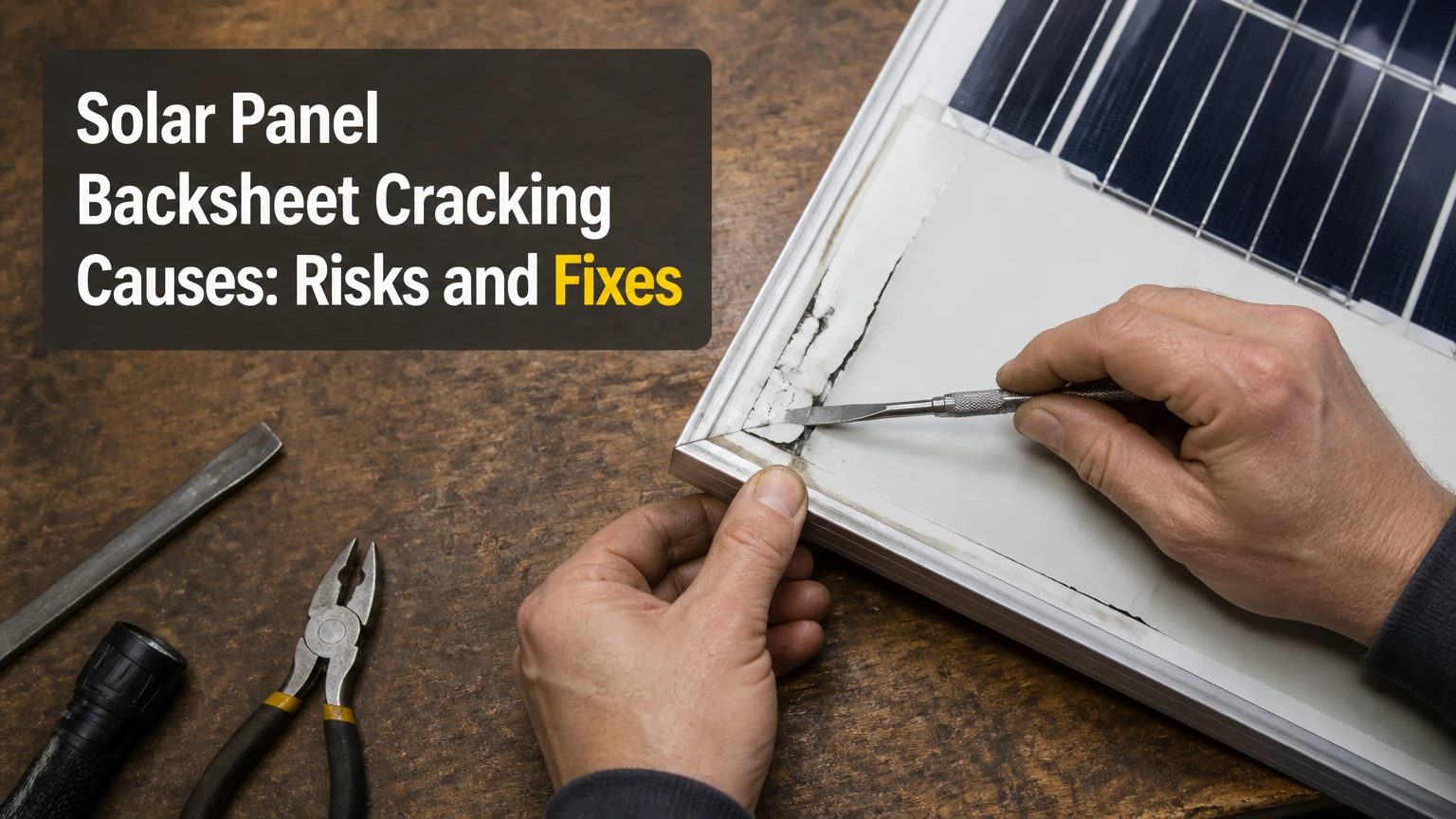
Solar panel backsheet cracking causes usually combine ultraviolet exposure, heat, moisture, polymer oxidation, and repeated thermal cycling. Manufacturing defects, unsuitable resin or adhesive systems, installation stress, chemical exposure, and mechanical damage can accelerate the process. Cracks reduce weather protection and electrical insulation, allowing moisture ingress, corrosion, leakage current, inverter trips, and potentially hazardous contact voltage.
Key Facts at a Glance
A solar backsheet is a multilayer polymer barrier that protects the module from moisture, ultraviolet radiation, chemicals, and electrical contact.
UV oxidation and hydrolysis can embrittle PET, polyamide, and other polymers before visible cracking appears.
Thermal cycling repeatedly loads an aged backsheet because glass, silicon, copper, encapsulant, and polymer layers expand at different rates.
A cracked backsheet does not automatically prove that a module has failed electrically, but it requires documented inspection.
Glass-glass modules eliminate polymer backsheet cracking, but they remain vulnerable to glass breakage, seal failure, junction-box defects, and moisture entering through edges.
Repeated inverter insulation-fault resets are unsafe because a wet module can leak current to its frame or mounting system.
What Is a Solar Panel Backsheet?
A solar panel backsheet is the protective rear layer bonded behind the cells and encapsulant. Conventional backsheets commonly contain an outdoor-facing layer, a structural polymer core, and a cell-side layer, although commercial constructions vary by manufacturer and product generation.
The backsheet performs several jobs simultaneously. It limits water vapor transmission, resists UV and weathering, provides mechanical support, and helps maintain the module’s dielectric insulation. In a high-voltage array, that insulation separates energized conductors from the aluminum frame, racking, and people who may contact the equipment.
Common constructions include PET cores with PVF or PVDF skins, all-polyester laminates, polyamide-based films, and newer multilayer designs. Product names such as TPT, TPE, and PPE describe particular layer combinations or commercial constructions, not a universal performance grade. The exact resin, thickness, adhesive, pigment, stabilizer package, and manufacturing quality matter.
A backsheet can look intact while its inner layer has already lost elongation or dielectric strength. Surface appearance is therefore a screening method, not a complete condition assessment.
What Causes Solar Panel Backsheet Cracking?
Solar panel backsheet cracking causes operate as a chain: environmental exposure weakens the polymer, material interfaces accumulate stress, and mechanical cycling opens the weakened regions. The five most important contributors are UV oxidation, heat and humidity, thermal expansion mismatch, poor material or lamination quality, and mechanical or chemical damage.
UV Radiation Oxidizes the Polymer
Ultraviolet radiation breaks susceptible chemical bonds near the exposed surface. Oxygen then participates in oxidation reactions that reduce molecular weight or alter the polymer structure, depending on the material and stabilizer system.
The result is loss of ductility, surface chalking, discoloration, and a lower crack-resistance margin. A backsheet may therefore become brittle long before a technician sees a continuous fracture. High-altitude sites, tropical locations, desert arrays, and installations with strong annual irradiance receive greater UV stress.
Heat and Humidity Accelerate Hydrolysis
Heat accelerates many degradation reactions, while water can participate in hydrolysis of susceptible polymer bonds. PET and some polyamide formulations can suffer substantial property loss under combined heat and moisture, especially when the laminate or edge seal permits water vapor to accumulate.
A hot, humid climate is more demanding than a hot, dry climate for moisture-sensitive constructions. Nighttime condensation also matters because repeated wet-dry cycles can keep defects active even when daytime weather appears dry.
Thermal Cycling Loads Aged Layers
PV modules heat in sunlight and cool after sunset. Cells, copper ribbons, glass, encapsulant, adhesive, frame aluminum, and backsheet polymers have different coefficients of thermal expansion, so each daily cycle produces small relative movements.
A flexible new laminate can accommodate much of that movement. An oxidized or poorly bonded laminate cannot. Stress concentrates at cell edges, ribbon paths, wrinkles, holes, adhesive voids, and locations where the backsheet has already become stiff. Thousands of modest cycles can therefore create a large crack without one dramatic impact.
Manufacturing and Lamination Defects Create Weak Points
A backsheet can crack prematurely because the film, adhesive, or lamination process was defective. Relevant defects include inadequate bonding between layers, incomplete curing, contamination, incorrect lamination temperature, excessive residual stress, thin outdoor skins, and incompatible material combinations.
Poor edge sealing increases water vapor exposure. Wrinkles and trapped air create local stress concentrations. A module family can show similar cracking across many panels because the root cause is common to a bill of materials or production line, rather than a site-specific installation event.
Installation and Handling Add Mechanical Stress
Walking or kneeling on modules can flex the laminate, damage cells, deform ribbons, and create local stress that appears later as backsheet cracking. Clamping outside the manufacturer’s approved zones can also distort the frame and transfer force into the laminate.
Transport damage, dropped tools, excessive connector strain, and unsupported modules during installation create similar risks. Mechanical damage is particularly important when cracks follow a discrete impact point rather than forming a broad grid or parallel pattern.
Chemicals and Site Conditions Attack the Surface
Salt aerosol, industrial pollutants, cleaning chemicals, agricultural ammonia, and incompatible solvents can increase surface degradation or attack adhesives. Ammonia exposure is a recognized concern for agricultural installations, particularly where ventilation, material selection, and chemical resistance are inadequate.
Windborne sand can abrade the rear film. Bird activity, rodents, and maintenance equipment can puncture the polymer. These causes often coexist with UV aging, so identifying the initiating event requires photographs, module age, climate data, and a pattern review across the array.
How Does a Crack Progress Through a Module?
Backsheet cracking normally progresses from surface embrittlement to deeper laminate failure, but the sequence and speed vary by material, climate, and defect pattern. A visible crack may represent a cosmetic surface defect, a breach of the core, or a pathway to electrical insulation failure.
| Stage | Physical condition | Typical field sign | Main consequence |
|---|---|---|---|
| 1 | UV-aged polymer with reduced elongation | Chalking, fading, yellowing | Lower resistance to flexing |
| 2 | Surface microfissures under 1 mm | Fine lines under angled light | Increased water-vapor pathways |
| 3 | Cracks through an outer film | Spiderweb or linear pattern | Core and adhesive become exposed |
| 4 | Core-layer or cell-side fracture | Open cracks, browning, delamination | Moisture reaches internal conductors |
| 5 | Wet insulation degradation | RISO or isolation alarms | Inverter shutdown and shock hazard |
| 6 | Corrosion or arcing damage | Hotspots, burned areas, power loss | Module replacement and possible fire risk |
Crack geometry provides useful clues. A uniform grid across many modules suggests a material or environmental mechanism. Damage concentrated near clamps, corners, junction boxes, or transport marks points more strongly toward handling, frame stress, or local mechanical loading.
Backsheet cracks do not directly cause silicon cell microcracks in every case. Conversely, a module can contain cell microcracks without a cracked backsheet. Electroluminescence testing, visual inspection, and electrical testing answer different diagnostic questions.
Which Backsheet Materials Crack Most Easily?
Polyamide and non-fluoropolymer polyester backsheets generally demand more scrutiny than well-qualified fluoropolymer-laminated products, but material labels alone cannot predict field life. Resin grade, layer thickness, stabilizers, adhesive, production controls, climate, and module design determine actual durability.
| Backsheet construction | Typical exposure concern | Typical visible onset range | Selection implication |
|---|---|---|---|
| Polyamide multilayer, often called AAA | Moist heat, UV, hydrolysis, embrittlement | 4-8 years in reported high-stress cases | Verify field history and exact BOM |
| PET-PET-PET, all-polyester | UV oxidation, chalking, low surface durability | 7-12 years in demanding climates | Avoid unverified products in high UV or humidity |
| PET with PVF outer layer, such as TPT | Adhesive quality, edge sealing, manufacturing variation | 15-25+ years for qualified products | Confirm genuine film and tested construction |
| PET with PVDF outer layer | Formulation, fluorine content, bonding, UV exposure | Product-specific, often over 10 years | Review supplier data rather than label alone |
| Glass-glass module | No polymer backsheet degradation | Not applicable | Consider weight, edge seals, glass breakage, and transport |
The time ranges are typical field-risk ranges, not guaranteed failure dates. Some modules crack earlier, while properly qualified products can remain intact beyond the ranges shown. A 25-year product warranty also does not mean every polymer surface remains visually perfect for 25 years.
Are Fluoropolymer Backsheets Always Safe?
Fluoropolymer layers usually provide stronger UV and weather resistance than exposed non-fluoropolymer films, but a fluoropolymer label is not a complete quality certificate. Poor adhesion, a weak PET core, thin layers, counterfeit or substituted film, and defective lamination can still produce premature failure.
The exact material declaration should identify the supplier, layer construction, and revision-controlled bill of materials. Procurement teams should treat an unverified “PVDF backsheet” claim as incomplete evidence.
Do Glass-Glass Modules Eliminate Cracking?
Glass-glass modules eliminate polymer backsheet cracking because a rear glass sheet replaces the polymer film. They do not eliminate module failure: rear glass can break, edge seals can leak, junction boxes can detach, and encapsulant can discolor or delaminate.
Double-glass modules also weigh more. A typical framed module may weigh approximately 20-25 kg, while a comparable glass-glass module can weigh about 25-35 kg, depending on dimensions and glass thickness. Roof structure, handling equipment, clamps, and transport planning must accommodate the difference.
What Damage Can a Cracked Backsheet Cause?
A cracked backsheet can reduce insulation resistance, admit moisture, accelerate conductor corrosion, and trigger inverter shutdowns. The most serious outcomes occur when water reaches energized ribbons or busbars and creates a conductive path to the frame or racking.
| Failure consequence | Observable symptom | Verification method | Operational risk |
|---|---|---|---|
| Reduced insulation resistance | RISO or isolation fault during damp periods | Insulation resistance test by qualified technician | Shock and automatic shutdown |
| Cell or ribbon corrosion | Browning, white deposits, power decline | Visual inspection and IV-curve comparison | Permanent energy loss |
| Moisture-related leakage | Trips after rain, dew, or washing | Wet-condition electrical testing | Repeated outages |
| Localized heating | Hotspot or irregular thermal pattern | Infrared thermography under load | Accelerated damage and fire risk |
| Encapsulant or adhesive delamination | Bubbles, whitening, lifted areas | Close visual inspection and imaging | Further moisture penetration |
| Frame potential or grounding issue | Unexpected voltage or protective-device operation | Grounding and bonding tests | Personnel hazard |
A cracked surface does not establish that a module is safe to continue operating. Conversely, a single superficial fissure may not justify immediate replacement if testing confirms intact insulation and the manufacturer accepts the condition. The decision belongs to a qualified PV professional who can interpret the module design and applicable electrical code.
How Do You Inspect a Cracked Backsheet Safely?
A safe inspection begins with visual documentation and inverter records, then proceeds to electrical testing by a trained technician. Do not touch the rear film, disconnect energized connectors, or repeatedly reset a ground-fault alarm as a substitute for diagnosis.
Step 1: Document the Pattern
Photograph the rear of representative modules from several distances. Record module model, serial number, installation date, orientation, row location, and whether cracks occur near corners, clamps, junction boxes, or cell boundaries.
Count affected modules by string and compare sunny, shaded, roof-edge, and interior positions. A batch pattern supports a common product or exposure issue and strengthens a warranty claim.
Step 2: Review Inverter and Monitoring Data
Look for isolation resistance faults, ground faults, RISO alarms, unexplained string outages, and trips that correlate with rain or morning dew. Compare string current and voltage with unaffected strings under similar irradiance.
Monitoring data cannot identify the backsheet as the cause by itself. Damaged connectors, cable insulation, junction boxes, optimizers, and buried conductors can produce similar alarms.
Step 3: Perform Electrical Testing
A qualified technician may isolate strings, measure insulation resistance, inspect bonding, and compare results with manufacturer requirements and applicable standards. IEC 61730 addresses PV module safety qualification, while installation-level testing must also follow local electrical rules and the equipment manufacturer’s procedures.
A wet insulation test can reveal moisture-sensitive leakage, but the test voltage, wetting method, module configuration, and acceptance threshold must be controlled. Improvised megger testing can damage equipment or expose the tester to hazardous voltage.
Step 4: Use Thermal Imaging as Corroboration
Infrared imaging can locate hotspots, inactive cell regions, bypass-diode behavior, and abnormal current paths under suitable load and irradiance. It cannot prove that a dark line is a backsheet crack or that every crack has caused internal corrosion.
Thermography works best when combined with photographs, electrical measurements, and an unaffected reference module. Drone inspections improve coverage for large fleets, but close visual confirmation remains necessary.
| Diagnostic method | Best use | Typical limitation | Qualified professional needed |
|---|---|---|---|
| Rear-film photography | Pattern, severity, warranty evidence | Cannot measure insulation | No for distance-only photos |
| Inverter log review | Timing and string correlation | Non-specific fault source | Usually no |
| Insulation resistance testing | Electrical safety assessment | Dangerous if improvised | Yes |
| IV-curve tracing | String performance comparison | Does not locate every defect | Yes |
| Infrared thermography | Hotspot and bypass behavior | Needs load, sun, and interpretation | Recommended |
| Electroluminescence imaging | Cell and interconnect cracks | Usually requires controlled test setup | Yes |
Should You Keep Operating a Panel With Cracks?
A module with open, deep, spreading, or moisture-associated backsheet cracks should be treated as a potential electrical safety defect until testing proves otherwise. Immediate isolation is especially appropriate when the inverter reports an insulation fault, the frame shows abnormal voltage, or the module has exposed conductive layers.
A superficial line without electrical symptoms may remain temporarily in service under a documented monitoring plan, subject to the manufacturer’s instructions and local code. Monitoring should include periodic photographs, insulation results, string performance, and weather-related alarm records.
Do not apply household tape, paint, sealant, or pressure-washer treatment. These materials can trap moisture, conceal propagation, interfere with warranty inspection, or fail under UV exposure. A field coating may extend service in selected cases, but it does not recreate the original certified laminate or necessarily restore dielectric compliance.
Can a Cracked Backsheet Be Repaired?
Backsheet repair is possible in limited circumstances, but it is not equivalent to replacing the factory laminate. Specialized repair tapes, patches, or UV-resistant coatings may reduce further water entry when the module remains electrically sound and the repair system is approved for the application.
| Response | Typical direct cost per module | Typical duration | Appropriate use |
|---|---|---|---|
| Visual inspection and report | $25-$100 | 30-90 minutes | Initial screening |
| Electrical diagnostic visit | $150-$500 per site | 1-4 hours | Fault confirmation |
| Specialized patch or coating | $20-$100 | 30-90 minutes | Limited, non-catastrophic damage |
| Module removal and replacement | $200-$450+ | 1-3 hours | Failed or unsafe module |
| Large commercial replacement campaign | $150-$400 per module, typical | Project-dependent | Batch warranty or fleet work |
Costs vary sharply by region, roof access, module availability, lift equipment, labor rates, and whether rewiring or disposal is required. The lower repair range reported in some markets applies to materials or simple labor, not the complete cost of engineering, testing, access, documentation, and future monitoring.
Replacement is generally preferable when insulation resistance fails, corrosion is visible, cracking is widespread, the product is under a defect warranty, or the repair would require repeated site visits. Ask the manufacturer whether a repair preserves product coverage before authorizing work.
How Can Owners Prevent Backsheet Cracking?
Owners prevent backsheet cracking by selecting a documented laminate, controlling installation stress, limiting chemical exposure, and detecting early degradation before insulation failure. Prevention is more effective at procurement and installation than after a polymer has become brittle.
Use the following controls:
- Specify the exact BOM. Request the backsheet manufacturer, layer construction, film thickness, adhesive system, and revision-controlled module datasheet.
- Screen the climate. Treat hot-humid, coastal, desert, high-altitude, and agricultural sites as different exposure environments.
- Review certification evidence. Check applicable IEC 61215 and IEC 61730 qualification documentation, but do not mistake qualification testing for a guarantee against every field failure.
- Control handling. Prohibit walking, kneeling, unsupported lifting, dropped tools, and connector pulling during installation.
- Follow clamping limits. Use the manufacturer’s clamp zones and torque values. Frame distortion can transfer stress into the laminate.
- Avoid aggressive cleaning. Use the module manufacturer’s approved water quality, pressure, brushes, and detergents.
- Track batches. Record serial numbers and photograph backsheets during commissioning and scheduled inspections.
- Escalate recurring faults. A repeated insulation alarm warrants investigation, not repeated inverter resets.
A practitioner rule of thumb is to prioritize pattern recognition over isolated appearance. Ten similarly aged modules cracking in the same way are more significant than one panel with a small local mark.
Which Backsheet Is Best for Different Projects?
The best backsheet depends on climate, structural limits, expected service period, warranty support, and evidence for the exact module construction. Premium fluoropolymer laminates or glass-glass designs usually offer the strongest risk reduction, while low-cost polymer options may be reasonable only when field history and testing support them.
| Project condition | Preferred construction | Reason | Main trade-off |
|---|---|---|---|
| Hot and humid rooftop | Verified fluoropolymer or glass-glass | Better moisture and UV margin | Higher purchase price or weight |
| High-UV desert site | Qualified PVF or robust PVDF laminate | Strong outdoor weather resistance | Dust, heat, and maintenance remain |
| Agricultural ammonia exposure | Chemical-resistant laminate or glass-glass | Reduced polymer and adhesive exposure | Requires site-specific validation |
| Lightweight residential roof | Verified fluoropolymer backsheet | Lower mass than double glass | Polymer aging remains possible |
| Long-life utility project | Glass-glass or proven premium laminate | Lower premature replacement risk | Higher logistics and structural cost |
| Budget installation with mild climate | Documented PET laminate | Lower initial cost | Greater need for inspection and evidence |
No material should be selected from a marketing abbreviation alone. Two products labeled PVDF can differ in outer-layer thickness, formulation, adhesion, and qualification history.
What Are the Most Common Diagnostic Mistakes?
The most damaging mistakes are treating appearance as proof, treating a warranty as a repair plan, and treating inverter alarms as nuisance events. Each error delays the evidence needed to separate a backsheet defect from a cable, connector, junction-box, or grounding problem.
- Resetting the inverter repeatedly: Clear alarms only after the fault source is tested and corrected.
- Calling every rear line a backsheet crack: Confirm whether the mark is a surface scratch, coating line, cell shadow, delamination boundary, or through-layer fracture.
- Assuming glass-glass has no failure pathway: Inspect edge seals, junction boxes, glass surfaces, and encapsulant.
- Using a pressure washer: High pressure can force water into defects and damage connectors or seals.
- Repairing before documenting: Photograph, test, and notify the manufacturer first, because an unapproved repair can complicate a claim.
- Replacing only the visibly worst panel: Survey the whole product batch when the pattern suggests a common material defect.
One counterintuitive point matters: a panel can produce normal power while presenting a serious insulation risk. Power output and electrical safety measure different failure dimensions.
What Should a Warranty Claim Include?
A strong backsheet warranty claim includes module serial numbers, installation and purchase records, dated photographs, environmental conditions, inverter alarm logs, electrical test results, and a count of affected modules. The claim should identify whether cracking is superficial, through-layer, widespread, or associated with insulation loss.
Product warranties and linear performance warranties cover different issues. A performance warranty addresses expected power retention, while a product warranty may address defects in materials or workmanship. Some manufacturers also define exclusions for installation damage, unauthorized modifications, chemical exposure, or normal appearance changes.
Ask four precise questions:
- Does the warranty cover cosmetic cracking, or only electrical and functional failure?
- Will the manufacturer inspect a sample or the entire affected population?
- Does replacement include labor, removal, shipping, disposal, and rewiring?
- Must the owner use an approved repair system before replacement eligibility remains valid?
The answer depends on the contract, jurisdiction, module revision, and evidence. Do not rely on a salesperson’s verbal interpretation.
FAQ
How long do solar backsheets last?
A qualified backsheet can remain functional for 20-30 years, but premature cracking has been reported in some polyamide and all-polyester products after approximately 4-12 years. Climate, formulation, lamination quality, UV dose, humidity, and installation stress determine the actual result. Warranty duration is not a guaranteed visual service life.
Is backsheet cracking covered by solar panel warranties?
Backsheet cracking may be covered when the manufacturer classifies it as a material or workmanship defect, but coverage varies. Cosmetic damage, installation stress, chemical exposure, and unauthorized repair may be excluded. Submit photographs, serial numbers, electrical tests, and purchase records before applying a patch or coating.
Can backsheet cracks cause a house fire?
Backsheet cracks can contribute to fire risk when moisture reaches energized conductors, insulation resistance falls, arcing develops, or a hotspot persists. Cracking alone does not prove an imminent fire. An inverter ground-fault alarm, burned area, exposed conductor, or abnormal thermal image requires prompt professional isolation and investigation.
Are white lines on a solar backsheet always cracks?
White lines may indicate chalking, surface abrasion, stress whitening, delamination, adhesive failure, or an actual crack. A close inspection under controlled lighting can distinguish some patterns, but only electrical testing and, when needed, laboratory or microscopic examination can establish whether the laminate has lost insulation integrity.
Does a new inverter solve backsheet problems?
A new inverter does not solve a cracked backsheet. The inverter may report or suppress the symptom, while the module defect remains. Technicians should test modules, connectors, junction boxes, string cables, grounding, and insulation resistance before replacing power electronics.
Should an entire array be replaced?
An entire array usually does not require replacement for one superficial, electrically sound defect. Broad cracking across a shared module model, repeated insulation faults, visible corrosion, or an expired and unsupported product can justify a batch replacement analysis. Compare repair cost, remaining yield, warranty recovery, access cost, and safety results.
The Bottom Line
The main solar panel backsheet cracking causes are UV oxidation, heat and humidity, thermal cycling, weak laminate design or production quality, installation stress, and aggressive site exposure. A cracked backsheet is a condition requiring evidence, not an automatic cosmetic judgment: document the pattern, review inverter alarms, obtain qualified insulation testing, and preserve warranty records before repair. For new projects, select the exact BOM for the climate and consider verified fluoropolymer or glass-glass construction when premature polymer failure would be expensive.
Title tag: Solar panel backsheet cracking causes: Fixes and risks
Meta description: Find UV, heat, moisture, and installation causes, then use the safe inspection steps and $20-$450 repair ranges to decide what to do.