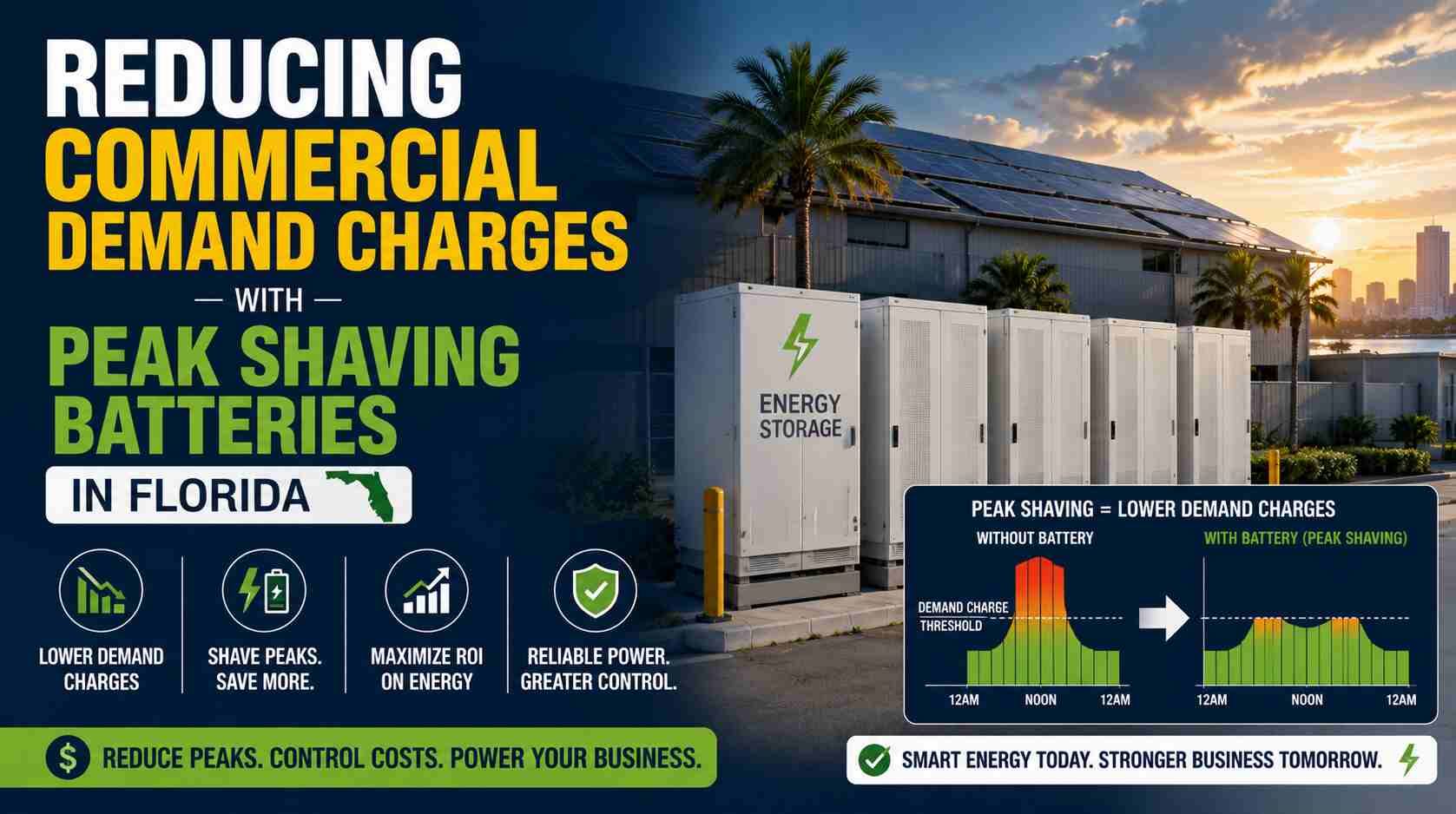
If your Florida business runs commercial HVAC, compressors, refrigeration, or heavy machinery, a single 15 minute burst of power can define your entire monthly electric bill. Peak shaving batteries change that. By discharging stored energy the instant your load spikes, a commercial battery energy storage system keeps your meter from ever recording that expensive peak. This guide breaks down the real math behind Florida demand charges, how peak shaving works, what it costs, and how to know if your facility is a strong candidate.
The short answer: Commercial peak shaving batteries in Florida cut utility demand charges by roughly 20% to 40% by automatically discharging stored power during high draw intervals. Because providers like Florida Power & Light and Duke Energy bill on your single highest 15 minute peak, shaving that spike removes one of the largest line items on your bill.
Why Florida Demand Charges Hurt So Much
Most commercial owners understand the energy portion of their bill, the kilowatt hours (kWh) they consume over the month. Demand charges are different, and far less intuitive. A demand charge bills you for the rate at which you pull power, measured in kilowatts (kW), not the total volume you use.
Florida utilities measure your power draw in continuous 15 minute intervals. The single highest interval recorded during the billing cycle sets your demand charge for the whole month. Run a bank of chillers and compressors together for just 15 minutes and that brief overlap can dictate a charge that follows you for 30 days.
The 15 Minute Peak Explained
Imagine a facility that averages 200 kW throughout the day but hits 480 kW for one 15 minute window when a large motor and rooftop units start together. The utility does not average that away. It bills the 480 kW peak. At a demand rate of $25 per kW, that single spike alone adds $12,000 to the monthly bill regardless of how efficient the rest of the month was.
For commercial and industrial accounts, this demand component commonly represents 30% to 70% of the total monthly electric bill. That is why demand charge reduction, not just energy efficiency, is where the biggest savings live.
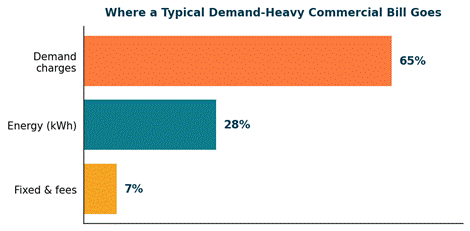
Figure 1. Illustrative split for a demand-heavy commercial account. Actual ratios vary by tariff and load profile.
How Peak Shaving Batteries Reduce Demand Charges
Peak shaving is simple in concept. A battery energy storage system (BESS) sits between the grid and your facility. An intelligent Energy Management System (EMS) watches your load in real time and steps in the moment a spike begins, so the grid meter never sees the full peak. Unlike traditional demand response, peak shaving does not ask you to shut anything down. Your machinery, lighting, and production run exactly as normal. The battery acts as an invisible buffer.
The Step by Step Peak Shaving Process
- Set a threshold. The EMS analyzes your historical load and sets a target kW ceiling that your bill should not exceed.
- Detect the spike. The system tracks real time draw from heavy equipment such as commercial HVAC chillers, refrigeration compressors, or manufacturing lines.
- Discharge instantly. The moment demand approaches the ceiling, the battery injects stored power locally to cover the difference.
- Hold the tier. Because that power comes from the battery, the utility meter records a lower peak and a lower demand tier.
- Recharge smartly. The system refills overnight during cheap off peak hours or from on site solar during the day.
Solar pairing bonus: When batteries are paired with commercial solar, you can store excess midday generation instead of exporting it at low rates, then deploy that clean energy during expensive afternoon and evening demand windows. It stretches both the demand savings and the solar payback.
Florida Utility Demand Charges at a Glance
Understanding your specific provider matters because tariffs and programs differ across the state.
| Utility Provider | Billing Basis | Typical Demand Rate | Programs Worth Noting |
| Florida Power & Light | Highest 15 min kW interval | $15 to $30+ /kW | Commercial demand tariffs, GSD schedules |
| Duke Energy Florida | Peak monthly kW demand | $15 to $25+ /kW | Custom Incentive Program, EnergyWise Business |
| New Smyrna Beach Utilities | Municipal demand rate | Varies by schedule | $150/kWh rebate (to $3,000) |
Duke Energy Florida’s Custom Incentive Program can cover up to 50% of a verified efficiency project (capped at $250,000), while its EnergyWise Business demand response compensates you for reducing load during grid stress, with incentives reaching roughly $50 per average kilowatt saved. Always confirm current terms directly with your utility, since program details change year to year.
The Real Numbers: Cost, Incentives, and ROI
Hardware pricing has fallen steadily, and federal incentives make the effective cost far lower than the sticker price.
| Line Item | Detail | Impact |
| Baseline system (100 kWh) | Typical installed range | $50,000 to $80,000 |
| Federal ITC (Section 48E) | Clean energy investment tax credit | 30% minimum |
| Domestic content bonus | 40%+ US made components | +10% |
| MACRS depreciation | Accelerated cost recovery | Stacks with ITC |
| Florida property tax exemption | On added storage value | 100% |
| Florida sales tax exemption | On eligible equipment | Applies |
Standalone battery systems now qualify for the Section 48E credit even without solar, a major shift that opens peak shaving to facilities that never planned a solar array. Stack the 30% base credit, a possible 10% domestic content bonus, MACRS depreciation, and Florida’s tax exemptions, and the net investment can drop well below half of the gross price.
How Fast Does It Pay Back?
Payback is driven almost entirely by demand charge avoidance. A well sized system commonly returns its net cost within 3 to 5 years, and even conservative mid sized deployments land in the 4 to 7 year range. After that, the demand savings flow straight to your bottom line for the remaining life of the batteries.
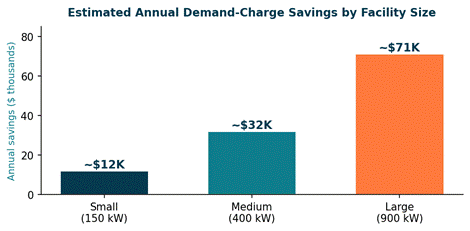
Figure 2. Illustrative annual savings before incentives, based on a 30% average reduction at $22/kW. Your figures depend on tariff, peak shape, and sizing.
Is Your Facility a Good Candidate?
Peak shaving delivers the strongest return for facilities with a specific load personality. You are likely an excellent fit if you recognize your operation below.
- High peak to average ratio. Short, intense spikes rather than a flat baseline. The spikier your load, the more there is to shave.
- Predictable peaks. Regular shifts, midday heavy operations, or scheduled batch processes make thresholds easy to model.
- High demand rates. Any commercial tariff where the demand fee exceeds $15 per kW.
- Heavy startup loads. Manufacturing lines, cold storage, data centers, hospitality, and large retail with big HVAC systems.
Sizing matters most. Proper design means identifying your target kW reduction, then measuring how far and how long your peaks exceed that level. Undersize the battery and it empties before the spike ends. Oversize it and you overpay. A good energy partner uses interval data from your actual bills to size for the sweet spot.
Peak Shaving vs Other Demand Strategies
Businesses sometimes try to manage demand manually by staggering equipment start times or curtailing operations. These tactics help but they are fragile. One missed schedule, one unexpected order, or one hot Florida afternoon can blow past the threshold and reset your peak for the month.
Battery peak shaving automates the protection. The EMS reacts in milliseconds, faster than any operator, and it never forgets. That reliability is why manufacturing plants, cold chain facilities, and data centers increasingly treat storage as core infrastructure rather than an add on.
Frequently Asked Questions
How much can peak shaving batteries save on my Florida demand charges?
Most commercial facilities see a 20% to 40% reduction in demand charges. Since demand can be 30% to 70% of the total bill, the dollar impact often runs into the tens of thousands per year for larger sites.
Do I need solar to install a peak shaving battery in Florida?
No. Thanks to the Section 48E credit, standalone commercial batteries now qualify for the 30% federal tax credit without solar. Solar simply enhances the economics by supplying free daytime charging.
Will peak shaving interrupt my operations?
No. The battery works silently in the background. Your equipment runs normally while the system absorbs the spikes, so there is no production impact.
What size battery does my business need?
It depends on how high and how long your peaks run. Sizing should be based on interval data from your actual utility bills, not a rough estimate, to match capacity to your true peak shape.
Take the Next Step
Demand charges are one of the few large business costs you can attack directly with proven technology. Peak shaving batteries let Florida commercial facilities flatten expensive spikes, capture generous federal and state incentives, and turn a volatile line item into predictable, lower monthly bills.
Get a free demand charge analysis using your real utility bills. A qualified provider will model your peaks, size the ideal battery system, and show your projected savings and payback before you spend a dollar. Contact us today to request your free savings analysis.
Note: rates, tariffs, and incentive figures are illustrative and change over time. Confirm current terms with your utility and a qualified energy provider before making investment decisions.