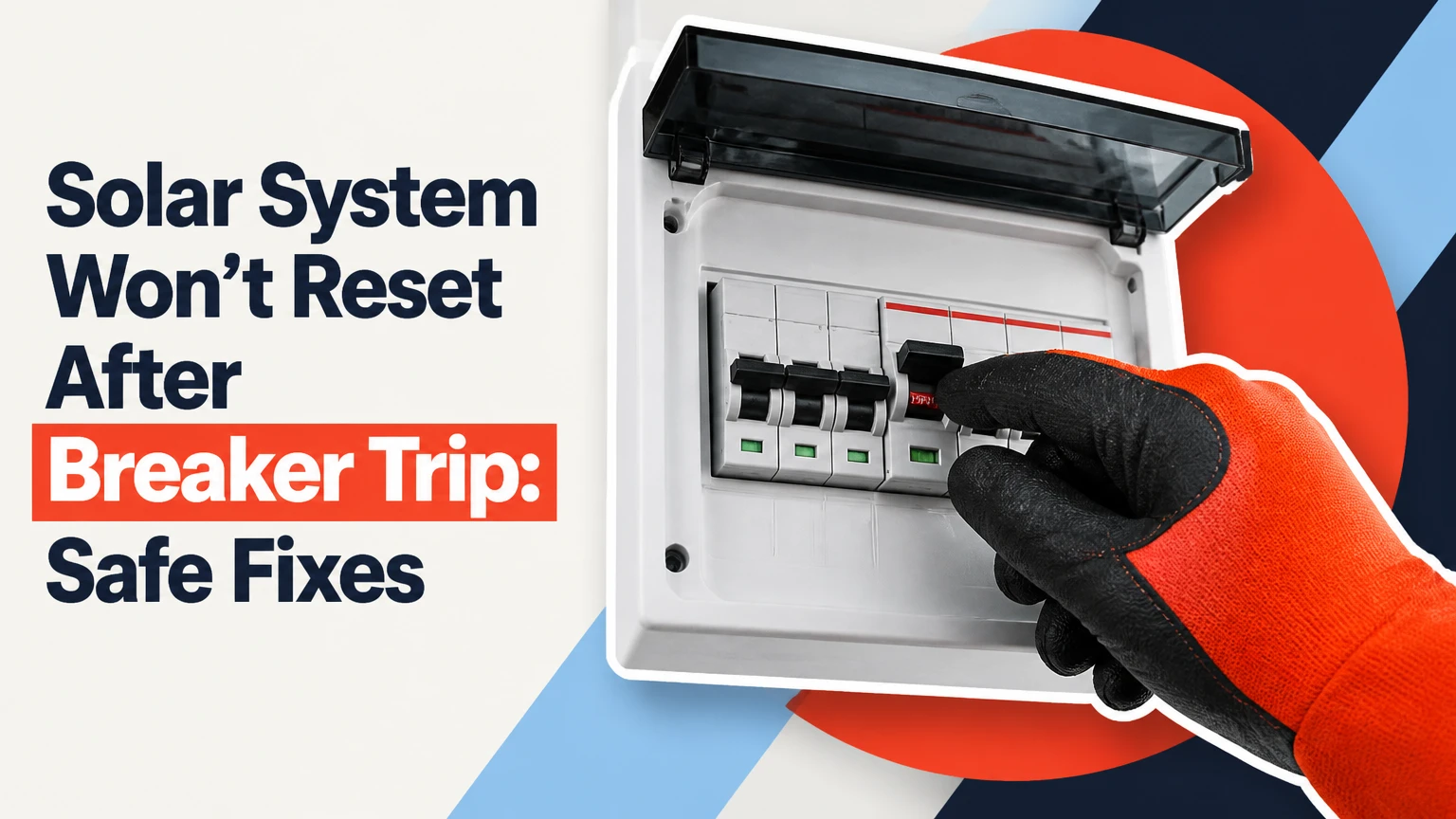
A solar system that will not reset after a breaker trip usually has an active electrical fault, an inverter lockout, or a startup condition the equipment has not cleared. Turn the solar breaker fully OFF, isolate the system only according to its equipment labels and manual, wait the specified period, and attempt one controlled restart. If the breaker trips again, leave it OFF and call a qualified solar electrician.
Key Facts at a Glance
A solar installation can receive energy from the utility grid, photovoltaic array, and battery simultaneously.
A breaker that trips instantly after reset usually indicates a short circuit, ground fault, arc fault, or failed equipment.
An inverter that remains offline while the breaker stays ON may have a utility-voltage problem, internal fuse failure, or control-board fault.
Most grid-tied inverters wait approximately 1-5 minutes before reconnecting after acceptable grid power returns.
Exact shutdown and startup order varies by inverter, battery, rapid-shutdown equipment, and local electrical design.
Never tape, hold, or repeatedly force a tripped breaker into the ON position.
Why Won’t a Solar System Reset After a Breaker Trip?
A solar system refuses to reset when protective equipment still detects unsafe current, the inverter has entered a fault state, or the utility supply does not meet reconnection limits. A circuit breaker protects conductors from excessive current, while an inverter may independently stop production for anti-islanding, insulation, frequency, voltage, or temperature faults.
A normal household circuit generally has one upstream source. Solar equipment can have an AC path from the utility and a DC path from rooftop modules. A hybrid installation may add a battery inverter, transfer switch, backup-load panel, and battery-management system.
The inverter must not energize a de-energized utility circuit. This anti-islanding requirement prevents solar equipment from sending voltage onto lines that utility workers may believe are dead. IEEE 1547 and local interconnection rules govern these grid-support and reconnection behaviors, while the inverter manufacturer sets the operating thresholds and delay.
NFPA 70, the National Electrical Code, states that its purpose is “the practical safeguarding of persons and property from hazards arising from the use of electricity” in Article 90.1(A). A failed reset is therefore a protection event to diagnose, not a nuisance to defeat.
What Happens Electrically During the Trip?
A breaker opens the AC circuit when its thermal or magnetic mechanism detects excessive current, but opening that breaker does not automatically remove DC voltage from illuminated solar modules. Photovoltaic modules produce voltage whenever light reaches them, even when the inverter display is dark.
An inverter may record the trip as grid loss, AC overvoltage, AC undervoltage, frequency error, residual-current fault, or an internal hardware fault. Capacitors inside power electronics can retain energy for a period specified by the manufacturer, so covers should remain closed and terminals should not be touched.
The following distinction helps identify the failure boundary:
| Observed condition | Likely protection boundary | Safe interpretation |
|---|---|---|
| Solar breaker handle returns to TRIP instantly | AC short, ground fault, arc fault, or failed inverter | Stop resetting and isolate professionally |
| Breaker trips after 5-30 minutes | Thermal overload, loose termination, heat, or voltage rise | Record time, weather, and load conditions |
| Breaker stays ON, inverter shows Grid Loss | Utility voltage, frequency, disconnect, or grid outage | Wait for stable grid and inspect display |
| Breaker stays ON, inverter is completely dark | AC feed, fuse, auxiliary supply, or control board | Do not open inverter; arrange testing |
| Battery system is offline but PV operates | BMS, battery isolator, communication, or state-of-charge issue | Follow battery-specific manual procedure |
| Monitoring app is offline, display operates | Internet, gateway, or communications failure | The array may still be producing power |
How Should You Reset a Tripped Solar Breaker?
A controlled reset takes about 10-20 minutes when no fault is present, requires no opening of electrical equipment, and succeeds only when the inverter, utility supply, and protective devices are healthy. The most important rule is to attempt the reset once, then stop if the breaker trips again.
Before You Start
| Item | Typical value | Limitation |
|---|---|---|
| Reset time | 10-20 minutes | Manufacturer instructions override this range |
| Waiting interval | 5-10 minutes | Some equipment specifies longer |
| Homeowner tools | Flashlight, phone camera, manual | No panel covers removed |
| Acceptable inspection | Labels, handle positions, display, smell, sound | No terminal or live-voltage testing |
| Professional test equipment | CAT III/IV meter, clamp meter, insulation tester | Qualified person only |
| Stop condition | Second immediate trip, smoke, heat, arcing, water | Leave system OFF |
Step 1: Record the System Condition
Photograph the inverter display, LED pattern, error code, breaker position, battery status, and disconnect labels before changing anything. Record whether the trip happened during bright sun, heavy rain, a utility outage, or high household demand.
A precise message such as “Fronius State 567, insulation resistance low, after rain” gives an installer more useful evidence than “solar stopped.” Do not erase an error history unless the manufacturer specifically requires it.
Step 2: Remove Ordinary Household Loads
Turn off large non-solar loads such as electric water heaters, heat pumps, ovens, and workshop equipment before resetting a shared service breaker. This step reduces startup demand, but it will not correct a fault on a dedicated photovoltaic feeder.
Do not switch off random solar disconnects without identifying them. Battery systems can have separate AC, DC, and emergency-backup controls, and the wrong operation can leave a backup circuit energized.
Step 3: Put the Solar Circuit Fully OFF
Move the tripped breaker firmly to OFF, if the breaker handle and panel are dry, cool, and undamaged. Check the inverter label or manufacturer shutdown procedure for the required positions of the AC disconnect, PV DC isolator, battery switch, and rapid-shutdown control.
Many installations use a general sequence of battery OFF, AC disconnect OFF, then PV DC isolator OFF. That sequence is not universal. Some battery manufacturers require the inverter AC supply to remain present while the battery shuts down, and some integrated systems manage isolation electronically.
The success checkpoint is a stable OFF position and no active alarm, burning odor, buzzing, water entry, or visible damage. The common mistake is treating a dark screen as proof that the roof array is electrically dead.
Step 4: Wait for the Specified Discharge Period
Leave the equipment isolated for the interval printed in the manual, commonly 5-10 minutes for a basic reset. Waiting allows control electronics to shut down, relays to open, and stored energy to decrease, but waiting cannot clear a continuing ground fault or damaged component.
Never remove an inverter cover to speed discharge. A photovoltaic array can maintain dangerous DC voltage in daylight, and internal capacitors may remain hazardous even after AC power is removed.
Step 5: Restore AC Before Production, If the Manual Specifies It
A common grid-tied restart sequence is solar breaker ON, inverter AC disconnect ON, PV DC isolator ON, followed by battery activation when the battery manual permits that order. Use the equipment’s printed sequence when it differs.
The success checkpoint is that the inverter powers up without an immediate fault and begins a grid-verification countdown. The common mistake is assuming that DC-first operation always damages an inverter. The real issue is that an incorrect sequence can conflict with manufacturer control logic, so the manual and installer labels control.
Step 6: Wait Through the Grid Reconnection Test
Allow approximately 1-5 minutes for a grid-tied inverter to verify voltage and frequency before producing power. Some models take longer after repeated faults, firmware events, utility outages, or battery synchronization.
The success checkpoint is a normal operating message, production indicator, or stable status LED. The mobile application may lag by 5-30 minutes, so use the inverter’s local display first.
Which Fault Pattern Matches Your Solar System?
The timing of a second trip is more useful than the fact of the first trip. Immediate operation points toward a low-impedance fault, while delayed operation more often involves heating, sustained current, environmental moisture, or utility conditions.
| Trip timing or symptom | Common causes | Homeowner action | Professional next test |
|---|---|---|---|
| Instant trip in under 1 second | Short circuit, ground fault, arc fault, failed inverter | Leave breaker OFF | Insulation resistance and circuit isolation |
| Trip within 5-30 minutes | Overload, loose lug, hot enclosure, undersized breaker | Record load and temperature | Torque audit, thermal scan, current measurement |
| Trip only during rain | Wet connector, damaged cable, insulation breakdown | Do not reset in wet conditions | DC insulation and connector inspection |
| Trip only at midday | Heat, high array output, utility voltage rise | Record grid voltage event if displayed | AC voltage logging and breaker coordination |
| No trip, no production | Grid loss, inverter lockout, disconnected isolator | Photograph code and switch positions | AC/DC supply and inverter diagnostics |
| Black display after confirmed AC supply | Fuse, auxiliary power supply, board failure | Do not open housing | Manufacturer service diagnosis |
What Do Common Inverter Errors Mean?
An “ISO,” “Insulation,” or “Ground Fault” message means the equipment detects unwanted leakage between an energized conductor and earth, although the exact detection method varies by model. Moisture, crushed cable, rodent damage, failed module electronics, and contaminated connectors are common field causes.
“GFCI,” “RCD,” or “RCMU” errors indicate residual-current protection has operated. “Arc Fault” indicates the inverter or external protection detected electrical characteristics associated with arcing. Neither message identifies the exact physical location, and neither should be cleared through repeated resets.
“Grid Loss,” “AC Voltage,” and “Frequency” errors can result from a real utility event, an open AC disconnect, loose wiring, incorrect settings, or voltage rise on a long feeder. A displayed value above approximately 253 volts on a nominal 230-volt system may exceed a local operating limit, but the actual threshold depends on jurisdiction and inverter settings.
“Battery BMS,” “overtemperature,” and “isolation” errors require battery-specific handling. Do not bypass a battery-management system, connect an unknown replacement battery, or reset a high-voltage battery enclosure without qualified service.
How Do String, Microinverter, and Hybrid Systems Differ?
String-inverter systems usually lose production across the whole array when one central inverter or its AC breaker fails. Microinverter systems distribute conversion across modules, so one fault may affect one panel, one branch circuit, or a communications gateway rather than the complete array.
| System architecture | Typical affected area | Common reset symptom | Typical professional access |
|---|---|---|---|
| String inverter | Entire PV array | One inverter offline or one solar breaker trips | Ground-level inverter and roof circuit testing |
| Microinverters | One module, branch, or gateway | Several panels missing from monitoring | Roof access may be required |
| DC-coupled hybrid | PV, battery, or backup loads | Battery and inverter lockout | Inverter, battery, and DC protection |
| AC-coupled battery | Battery subsystem and backup loads | Backup panel offline while PV remains active | Battery inverter and transfer equipment |
| Optimizer plus string inverter | Array section or whole string | Optimizer, string, or inverter fault code | Roof and inverter diagnostics |
Microinverters do not make a tripped AC breaker harmless. Their rooftop electronics still connect to branch AC circuits, and module-level DC conductors remain subject to daylight voltage.
Hybrid systems need extra caution because a main grid breaker may trip while a backup panel continues operating. A homeowner can mistakenly believe the property is unpowered when the battery inverter is supplying selected circuits.
What Should You Check Without Opening Electrical Equipment?
A homeowner can safely perform a visual and informational check when the equipment is dry, intact, and accessible without ladders or cover removal. Live testing at breaker terminals, inverter terminals, rooftop connectors, or battery cabinets belongs to a qualified electrician or solar technician.
Check these items:
- Confirm whether the utility has an outage or voltage-quality event.
- Read the inverter’s exact code and photograph the status screen.
- Verify that the breaker is fully OFF, not sitting in its spring-loaded middle position.
- Look for scorch marks, melted plastic, cracked isolator housings, water entry, or a burning smell.
- Note whether the fault occurs only during rain, heat, high production, or battery charging.
- Check monitoring timestamps against the breaker trip time.
- Locate the installation manual, single-line diagram, warranty, and installer contact.
- Keep children and other occupants away from damaged equipment.
A non-contact voltage pen cannot prove a circuit is de-energized, especially around DC conductors, induced voltage, shielded cables, and equipment with multiple sources. A digital multimeter can also create an arc or give a misleading result when used incorrectly. Tool ownership is not equivalent to electrical qualification.
How Much Does Solar Breaker Repair Cost?
Typical residential solar troubleshooting costs about $150-$400 for a service visit, while breaker replacement commonly reaches $200-$600 when labor, testing, enclosure access, and parts are included. A failed inverter or concealed roof fault costs substantially more and varies by system size, access, warranty, and region.
| Repair or diagnosis | Typical US cost | Typical time | Main price variable |
|---|---|---|---|
| Diagnostic service call | $150-$400 | 1-2 hours | Travel and testing depth |
| AC breaker replacement | $200-$600 | 1-3 hours | Panel type and permit needs |
| DC isolator replacement | $250-$800 | 2-4 hours | Roof access and enclosure damage |
| Connector or cable repair | $300-$1,500 | 2-8 hours | Fault location and roof labor |
| String inverter replacement | $1,500-$5,000 | 3-8 hours | Capacity, brand, and warranty |
| Battery inverter or BMS service | $500-$3,000 | 2-10 hours | Battery voltage and manufacturer |
| Roof water or rodent fault | $500-$2,500 | 4-16 hours | Array removal and cable routing |
These are typical planning ranges, not quotations. Local prices in Australia, the United Kingdom, India, Bangladesh, and other markets can differ sharply because labor rates, taxes, permits, and equipment availability differ.
A warranty may cover an inverter, optimizer, or microinverter but exclude labor, roof access, storm damage, rodent damage, or an incorrectly installed breaker. Ask the installer to separate diagnostic findings, covered parts, labor, and code-compliance work on the estimate.
When Should You Stop Resetting and Call a Professional?
Stop immediately when the breaker trips a second time, trips instantly, becomes hot, smells burned, produces crackling, or shows visible damage. Also stop when water has entered the inverter, a battery is swollen, smoke is present, or the system has a ground-fault, insulation, or arc-fault message.
| Situation | Leave breaker OFF? | Appropriate contact |
|---|---|---|
| One trip, no damage, normal display | Not necessarily | Follow manual once |
| Second immediate trip | Yes | Licensed solar electrician |
| Burning odor or melted breaker | Yes | Electrician, emergency services if fire risk |
| Battery swelling or venting | Yes, keep distance | Manufacturer and emergency services |
| Roof cable visibly damaged | Yes | Solar contractor |
| Utility outage only | Usually | Utility company first |
| Warranty fault with no physical damage | Yes if offline | Installer or manufacturer |
The original installer is usually the best first contact because the company has the single-line diagram, commissioning settings, and warranty record. If the installer is unavailable, provide the inverter serial number and exact fault history to the manufacturer and hire a licensed electrician for site work.
What Mistakes Make the Fault Worse?
Repeated resetting is the most common unhelpful response because each attempt adds stress without identifying the fault. A breaker is designed to interrupt dangerous current, not to negotiate with a persistent short circuit.
Avoid these mistakes:
- Holding the breaker ON: Taping or physically holding a breaker closed defeats protection and can overheat conductors.
- Resetting in wet conditions: Water can create leakage paths and increase shock risk around outdoor disconnects.
- Opening the inverter: Internal capacitors and PV conductors can remain energized after shutdown.
- Replacing the breaker with a larger rating: A higher ampere rating can leave undersized wiring unprotected.
- Bypassing an error: Disabling GFCI, arc-fault, rapid-shutdown, or battery protection removes a safety function.
- Assuming the app is authoritative: Internet outages can report a false offline condition while the inverter operates normally.
- Ignoring delayed trips: A breaker that trips after 20 minutes may indicate heating at a loose termination, not a defective breaker alone.
An experienced technician checks conductor sizing, breaker rating, terminal torque, enclosure temperature, voltage, current, insulation resistance, and inverter event logs before recommending replacement. Swapping parts without those tests often moves the fault rather than fixes it.
What Changes During an Outage, Rainstorm, or Night?
A grid-tied solar system normally remains off during a utility outage, even in strong sunlight, unless it includes approved battery backup and islanding equipment. Solar panels do not automatically power a home when the main utility supply disappears.
Rain can expose insulation breakdown, poorly sealed connectors, and damaged rooftop cable. Nighttime removes PV production but does not make every conductor safe, because grid AC and battery circuits may remain energized.
During a storm, leave outdoor disconnects untouched if they are wet, flooded, cracked, or difficult to reach. After the weather clears, photograph the condition and arrange inspection rather than using a reset to test suspected water damage.
A battery-backed system may keep selected loads alive while the solar breaker remains off. Turn off unnecessary backup loads through the approved load-management controls, not by opening battery covers or disconnecting high-voltage terminals.
How Can You Document the Fault for Warranty Service?
Useful documentation includes the inverter brand and model, serial number, error code, LED sequence, breaker label, trip time, weather, household load, and whether production resumed. Include photographs of the display and switch positions before and after the single permitted reset attempt.
| Information to collect | Example entry | Why it matters |
|---|---|---|
| Inverter model | SMA Sunny Boy 7.7 | Determines code meanings and reset process |
| Fault message | “AC voltage too high” | Separates grid and hardware paths |
| Trip timing | 12:42 p.m., 8 minutes after restart | Supports thermal or voltage diagnosis |
| Weather | 34°C, direct sun, no rain | Helps identify heat-related behavior |
| System topology | 24 panels, string inverter, no battery | Narrows likely failure points |
| Monitoring result | Production fell from 5.8 kW to 0 | Confirms operational impact |
Keep the breaker off until the installer responds if the system has a repeat trip or safety-related code. A complete event record can reduce a return visit and improve the chance that warranty service covers the correct component.
Frequently Asked Questions
Can I reset solar panels without resetting the inverter?
No, solar panels do not contain a general household-style reset control. The inverter, AC disconnect, DC isolator, rapid-shutdown equipment, and battery controls manage system operation, while modules continue producing voltage in daylight. Follow the labeled shutdown procedure and never disconnect rooftop connectors as a reset method.
Why does my solar inverter work at night but fail in sunlight?
A fault that appears only in sunlight often involves PV-side insulation, high DC voltage, overheating, or an output condition that occurs at peak generation. Record the time, irradiance conditions, temperature, and code. A technician can compare string voltage, insulation resistance, and inverter temperature under controlled conditions.
Can a utility voltage problem trip my solar breaker?
A utility voltage problem can shut down an inverter and, in some installations, contribute to breaker heating or nuisance operation, but an inverter grid fault does not automatically mean the breaker itself is defective. The electrician should log voltage at the service and inverter terminals before changing protection ratings.
How long does a solar inverter take to restart after a power outage?
A grid-tied solar inverter commonly waits 1-5 minutes after acceptable utility voltage and frequency return. Some models use longer delays after faults or firmware events, and battery systems may take additional time to synchronize. A countdown is normal; repeated failure after the countdown requires diagnosis.
Is a solar breaker different from a normal circuit breaker?
A solar breaker may have the same fundamental overcurrent role as another AC breaker, but its rating, interrupting capacity, pole configuration, conductor sizing, enclosure, and coordination with inverter output must match the installation. DC breakers and PV isolators are different devices and must not be substituted casually.
Should I turn off the solar breaker before selling or leaving the house?
Use the manufacturer’s full shutdown procedure before extended vacancy, especially when batteries, backup circuits, freezing weather, or severe storms are involved. Do not rely on the solar breaker alone because the array, battery, and utility circuits may remain energized. Ask the installer for a written shutdown sequence.
The Bottom Line
A solar system that will not reset after a breaker trip is reporting a protection problem, not asking for repeated force. Check the display, fully reset the breaker only once under dry and undamaged conditions, follow the inverter and battery shutdown instructions, and wait through the normal grid-verification period. If the solar system won’t reset after breaker trip, or the breaker trips again, leave it OFF and contact a qualified solar electrician.