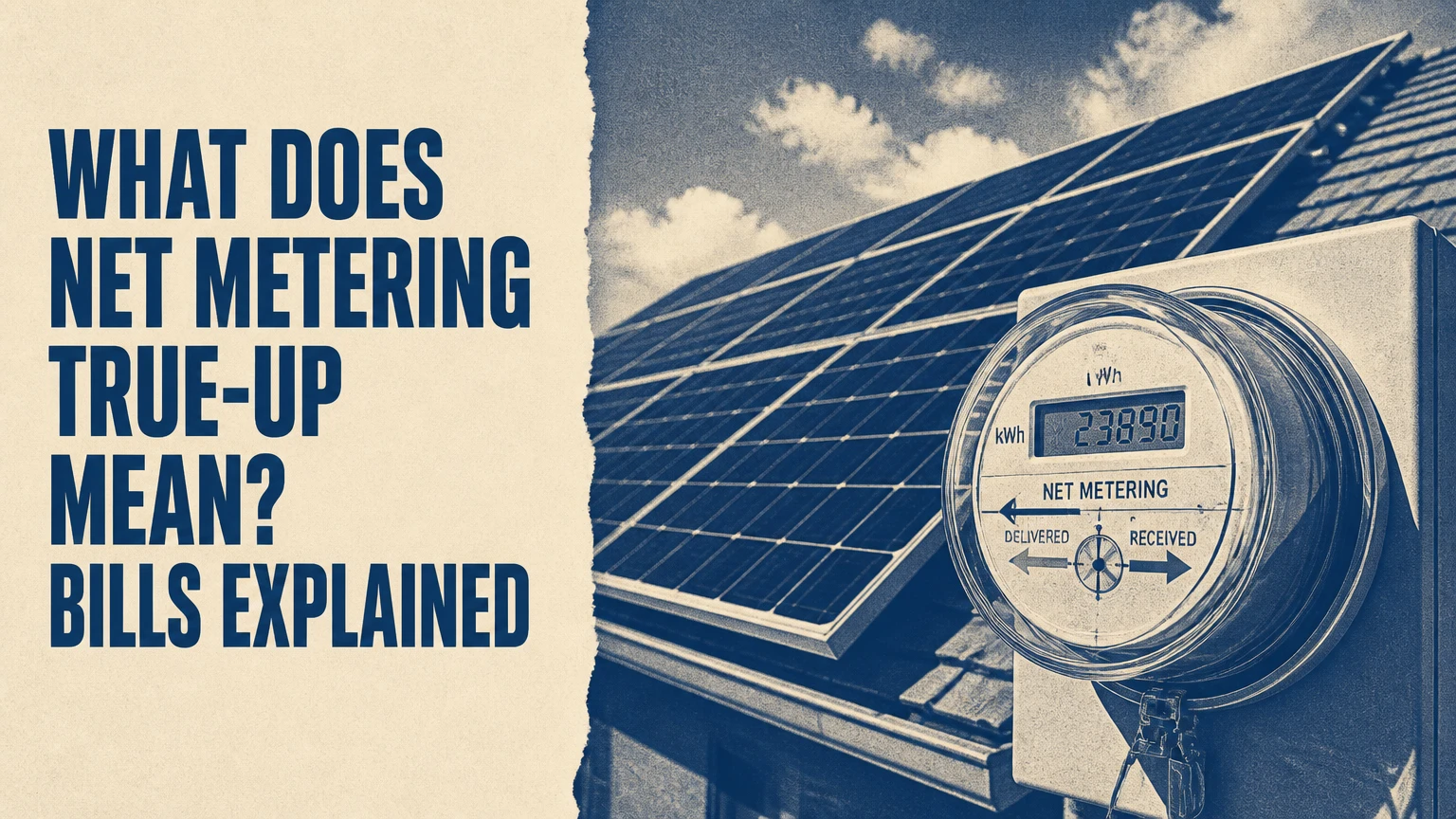
Net metering true-up is the utility’s final reconciliation of electricity imported from the grid, electricity exported by a solar system, accumulated credits, and remaining charges at the end of a billing cycle. The cycle often lasts 12 months, but the settlement date, credit value, payout, and expiration rules depend on the utility tariff and jurisdiction.
Key Facts at a Glance
- A solar true-up compares grid imports and exports over a defined settlement period, often 12 months.
- A true-up bill can remain due even when annual imported and exported kilowatt-hours appear equal.
- Fixed customer charges, minimum bills, taxes, and non-bypassable charges commonly remain payable.
- Surplus credits may receive retail-rate value, avoided-cost value, reduced net-billing value, or no payout.
- A permission-to-operate date often establishes the annual cycle, but some utilities use a calendar or selected billing month.
- A large true-up balance can result from lower solar production, higher household consumption, time-of-use pricing, or tariff changes.
What Does Net Metering True-Up Mean?
Net metering true-up means the utility closes a solar customer’s accounting period and settles the remaining energy or credit balance. During the period, a bidirectional meter records electricity imported from the grid and surplus electricity exported to the grid; at settlement, the utility applies its tariff rules to those records and any monetary credits.
The phrase can describe two related events. First, the utility reconciles energy usage over the period. Second, it settles the financial value of the resulting balance. Those events are not always equivalent because one exported kilowatt-hour may be worth less than one imported kilowatt-hour under net billing or time-of-use pricing.
A true-up is therefore not automatically a refund, and it is not always an annual bill. It is a tariff-defined settlement event. California’s transition from traditional Net Energy Metering to the CPUC’s successor Net Billing Tariff illustrates why the customer’s program matters more than the word “true-up” on the bill.
How Does the Solar True-Up Process Work?
The solar true-up process records monthly imports and exports, carries eligible credits forward, calculates the end-of-period balance, applies the tariff’s compensation rules, and begins the next accounting period. The utility’s bill usually contains enough data to reconstruct the calculation, although the labels differ by provider.
The Five Accounting Stages
- Monthly measurement: The meter records grid electricity delivered to the property and excess solar electricity sent to the grid.
- Monthly billing: The utility applies imports, exports, rates, fixed charges, taxes, and any credit rules to the statement.
- Credit carryover: Eligible energy or dollar credits move into later billing periods according to the customer’s tariff.
- True-up calculation: The utility totals the relevant values at the settlement date and determines whether the account is a net consumer or net producer.
- Settlement and restart: The utility bills remaining charges, pays or carries eligible surplus, expires ineligible credits, and starts the next period.
The meter’s annual kWh totals are only part of the calculation. A customer can export 10,000 kWh and import 10,000 kWh yet owe money if imports occurred during expensive evening hours, exports occurred during low-value midday hours, or fixed charges were excluded from netting.
When Does a Net Metering True-Up Happen?
A net metering true-up commonly occurs every 12 months, but the exact date comes from the utility tariff or enrollment agreement. Utilities may use the system’s permission-to-operate anniversary, a fixed calendar month, the customer’s regular billing anniversary, or a customer-selected settlement month.
| Settlement trigger | Typical timing | Where it appears | Why it matters |
|---|---|---|---|
| Permission to operate anniversary | Every 12 months after PTO | Interconnection records | Aligns the cycle with system activation |
| Calendar-year settlement | December or January | Utility tariff | Can coincide with winter production lows |
| Customer-selected month | One chosen month annually | Rate-plan election | May place settlement after high-production months |
| Account closure | Move-out or service termination | Final utility bill | Can force early credit settlement |
| Tariff transition | Effective date in utility notice | Program documents | Can change credit valuation midstream |
The permission-to-operate date is common, not universal. Customers should verify the phrase “true-up date,” “annual settlement,” “service agreement anniversary,” or “net generation balance” on the utility statement.
How Are Solar Credits Valued at True-Up?
Solar credits are valued according to the customer’s program, and the value can range from the applicable retail energy rate to zero. Traditional retail-rate net metering generally gives exported energy a bill credit tied to the retail energy charge, while net billing often uses an export rate that varies by hour and may be far below the import rate.
| Compensation framework | Export value | Surplus treatment | Practical result |
|---|---|---|---|
| Retail-rate net metering | Often near the energy charge, such as $0.15-$0.35/kWh | Rollover, payout, or tariff-specific settlement | Strongest value for annual energy offset |
| Avoided-cost settlement | Often about $0.02-$0.08/kWh, utility dependent | Cash payment or account credit | Extra production has limited value |
| Hourly net billing | Varies by hour, season, and market rule | Export credits offset imports under tariff rules | Midday exports may be worth less |
| Use-it-or-lose-it credit | $0 at expiration under the tariff | Credit disappears | Oversizing can reduce project economics |
| Monetary credit rollover | Dollar value fixed by prior billing | Carries forward until a defined date | kWh and dollars no longer track directly |
These are typical ranges, not universal rates. The tariff controls the answer. A utility may also distinguish between energy charges, delivery charges, public-purpose charges, taxes, and other line items that cannot be offset by solar exports.
Why Retail and Export Rates Can Differ
Retail-rate net metering credits often offset an energy charge that includes more than the utility’s fuel cost. An avoided-cost rate generally reflects what the utility says it would have paid to procure or generate that electricity, excluding many distribution and customer-service costs. Net billing programs can use an avoided-cost or hourly avoided-cost schedule.
The U.S. Department of Energy describes net metering as a billing arrangement in which customers can “receive credits on their electric bills for electricity they generate and send back to the grid.” The quotation describes the credit mechanism, not a guarantee that every credit receives the full retail rate or survives the true-up.
What Does a True-Up Bill Include?
A true-up bill can include net energy charges, fixed customer charges, minimum bills, taxes, demand charges, and tariff-specific fees. Solar credits usually offset only the categories named in the net-metering agreement, so a zero energy balance does not necessarily produce a zero annual bill.
| Bill component | Typical treatment | Example amount or basis | Can solar exports offset it? |
|---|---|---|---|
| Imported energy charge | Netted or credited under tariff | $0.12-$0.40/kWh | Often yes |
| Fixed customer charge | Charged monthly | $10-$25/month | Usually no |
| Minimum bill | Minimum monthly payment | $5-$20/month | Usually no |
| Non-bypassable charge | Applied to imported kWh | $0.01-$0.05/kWh | Often no |
| Taxes and public-purpose fees | Calculated under local rules | 3%-15% of applicable charges | Usually limited |
| Demand charge | Based on peak kW | $5-$30/kW-month | Usually no |
A bill showing twelve months of $0 energy charges may still accumulate $120-$300 in fixed charges before taxes. A customer who receives a $500-$3,000 true-up bill may have a real annual shortfall, but that range is a possible scenario rather than a universal typical outcome.
Net Metering, Net Billing, and Feed-In Tariffs Compared
Net metering, net billing, and feed-in tariffs all compensate distributed generation, but they assign different values and accounting methods to exported electricity. Traditional net metering usually nets imports and exports against a retail energy charge, whereas net billing values exports separately and feed-in tariffs pay a defined rate for delivered generation.
| Feature | Traditional net metering | Net billing | Feed-in tariff |
|---|---|---|---|
| Import valuation | Retail energy rate | Retail or time-based import rate | Customer buys normal retail power |
| Export valuation | Often retail-linked | Hourly, avoided-cost, or scheduled rate | Contracted generation rate |
| Battery importance | Moderate | High | Depends on contract |
| Annual true-up | Common | Program dependent | Contract settlement dependent |
| Oversizing risk | Lower under generous crediting | Higher when export rates are low | Limited by contract terms |
| Main optimization | Annual load matching | Self-consumption and timing | Contract compliance and production |
California’s NEM 2.0 and NEM 3.0 are useful examples, but they should not be treated as national defaults. The California Public Utilities Commission approved the successor Net Billing Tariff in 2022, and its export compensation structure differs materially from the earlier retail-credit framework.
Why Did I Receive a Large Solar True-Up Bill?
A large solar true-up bill usually means annual billable imports or non-offsettable charges exceeded the credits available under the tariff. The most common causes are lower system production, increased household consumption, a rate-plan change, credit expiration, or a mismatch between export value and import cost.
| Cause | Typical indicator | Verification method | Corrective action |
|---|---|---|---|
| Inverter or production fault | Production below prior-year pattern | Inverter portal and alerts | Repair equipment and document outage |
| New EV load | About 2,500-4,000 kWh/year for many drivers | Charging history and odometer | Add load to system model |
| Heat pump or pool load | Seasonal consumption spike | Interval data by month | Recalculate annual demand |
| Time-of-use mismatch | Noon exports, evening imports | Hourly utility data | Shift loads or add battery capacity |
| Shading or soiling | Gradual production decline | Site inspection and inverter data | Remove obstruction or clean panels |
| Tariff transition | New export-rate line item | Utility notice and tariff sheet | Reevaluate system economics |
An electric vehicle can add roughly 2,500-4,000 kWh per year, depending on vehicle efficiency, miles driven, climate, and charging losses. That demand can consume a credit surplus quickly, especially when the EV charges after sunset.
The counterintuitive issue is that annual kWh neutrality does not guarantee bill neutrality. Under time-of-use pricing, exporting 1 kWh at a low-value midday period can offset less than the cost of importing 1 kWh during a high-value evening period.
How Can You Audit a True-Up Statement?
Audit a true-up statement by comparing the utility’s import data, export data, credit ledger, tariff rates, and non-offsettable charges against the solar inverter’s production record. The audit should cover the entire settlement period, not only the final page of the bill.
- Confirm the dates. Match the first and last billing periods to the stated true-up anniversary.
- Record monthly imports. Copy delivered kWh for every month into a spreadsheet.
- Record monthly exports. Separate exported kWh from total solar production.
- Check the credit ledger. Identify opening credits, monthly additions, deductions, expirations, and closing credits.
- Compare production. Use Enphase, SolarEdge, Tesla, or another inverter portal, remembering that inverter production is not identical to exported energy.
- Review rate changes. Check whether the utility moved the account to time-of-use pricing or a new net-billing tariff.
- Separate fixed charges. Mark customer charges, minimum bills, taxes, and non-bypassable items that solar credits cannot erase.
- Request interval data. Ask the utility for hourly or 15-minute records when time-of-use pricing is involved.
- Dispute specific errors. Give the utility dates, meter readings, and line-item calculations rather than stating only that the bill seems wrong.
You will know the audit is complete when monthly imports and exports reconcile to the utility’s annual totals and every dollar on the settlement statement has a defined source.
Can You Avoid a High True-Up Balance?
You can reduce a high true-up balance by matching system size to actual annual load, increasing daytime self-consumption, monitoring production, and selecting a settlement date that fits seasonal usage. The best strategy depends on whether the tariff rewards exports at retail value or discounts them sharply.
Practical Strategies by Customer Type
| Customer situation | Main risk | Recommended action | Typical planning target |
|---|---|---|---|
| Stable household, retail NEM | Underproduction | Size near annual consumption | 95%-105% of annual load |
| EV, pool, or heat pump | Load growth | Include new loads in design | 105%-115% after verified load analysis |
| Low export-rate net billing | Excess midday exports | Prioritize self-consumption | 85%-100% annual offset initially |
| Use-it-or-lose-it credits | Expired surplus | Avoid chronic overproduction | 85%-95% annual offset |
| Frequent outages | Lost solar during grid outage | Add code-compliant battery backup | Battery sized to critical loads |
These percentages are practitioner planning ranges, not utility requirements. A solar designer should use at least 12 months of interval or monthly data, local production modeling, roof orientation, shading, weather assumptions, and documented future loads.
Battery storage can improve timing but cannot repair an undersized solar array. A battery may shift midday generation into evening consumption, yet round-trip losses commonly reduce delivered energy by roughly 10%-20%, and the equipment adds upfront cost, maintenance considerations, and replacement planning.
What Happens to Credits When They Expire?
Expired solar credits disappear when the tariff’s rollover or settlement rule says they are no longer eligible, while other programs convert surplus credits into a payment or continue them under defined conditions. Customers must identify whether the account tracks kWh credits, dollar credits, or a separate surplus-generation balance.
A utility may reset a credit counter at true-up, but “reset to zero” does not describe every program. Some tariffs pay a wholesale rate for net surplus generation, some carry dollar credits into the next period, and some apply credits to future bills after a final reconciliation.
Account closure creates a separate edge case. Moving, changing utility service, selling a property, or removing a system can trigger an immediate settlement rather than allowing credits to remain until the normal anniversary.
Is a Battery Better Than Oversizing Solar?
A battery can be financially preferable to oversizing solar when export credits are low, but a battery is not automatically the cheaper option. The decision depends on export compensation, evening import rates, battery installed cost, usable capacity, degradation, backup value, and the customer’s ability to consume solar during daylight.
| Option | Primary benefit | Main limitation | Best-fit condition |
|---|---|---|---|
| Larger solar array | Produces more annual kWh | Creates low-value exports | Retail-rate credits remain available |
| Battery storage | Shifts solar to evening | Adds capital and losses | Evening rates exceed export rates |
| Load shifting | Uses existing solar directly | Requires schedule flexibility | EV, water heating, or laundry can run midday |
| Smaller array | Reduces surplus exposure | Leaves more grid purchases | Export compensation approaches $0 |
| Community solar | Avoids rooftop constraints | Credit rules vary by program | Roof is shaded or unavailable |
A practitioner rule is to calculate the value of one additional solar kWh and one battery-delivered kWh separately. Comparing panel production directly with battery capacity hides conversion losses and tariff differences.
Expert Rules for Interpreting True-Ups
Rule 1: Track dollars, not only kilowatt-hours. A kWh credit ledger can look healthy while monetary credits lose value under a new export schedule.
Rule 2: Treat a zero monthly bill as incomplete information. The statement may show no current energy payment while fixed charges or deferred annual settlement amounts continue accumulating.
Rule 3: Design for the next load, not the last load. An EV, heat pump, electric water heater, or home addition can change annual consumption more than a modest panel degradation rate.
Rule 4: Check the tariff before buying storage. A battery improves self-consumption under many net-billing plans, but it may add little financial value under generous retail net metering unless backup power matters.
FAQ
Does a true-up mean I owe the utility money?
No. A true-up can produce a bill, a payment, a rollover credit, or no additional energy charge. The result depends on imported electricity, exported electricity, fixed charges, credit expiration, and the tariff’s settlement method. A net-consuming customer usually owes a balance, while a net-producing customer may receive reduced compensation.
Are solar panels worth it if the utility has a true-up?
Solar panels can remain worthwhile under a true-up, but the financial result depends on system cost, retail electricity rates, export compensation, financing, and self-consumption. A system designed for high retail-rate net metering may perform differently after a utility moves customers to low-value net billing.
Can I change my true-up month?
Some utilities allow customers to select or change the annual settlement month, while others assign the date from permission to operate or the service agreement. Contact the utility before requesting a change because the request may create a partial settlement, alter credit treatment, or be limited to one change per year.
Do solar credits carry over after the true-up?
Solar credits carry over only when the tariff permits rollover. Some programs preserve dollar credits, some pay net surplus generation at an approved rate, and some erase unused credits. The utility’s tariff should specify whether the balance is measured in kWh, dollars, or a separate export-credit category.
Can a utility charge me for electricity during a solar outage?
Yes. A solar system that is offline stops offsetting household consumption, so the property imports more electricity from the grid. Grid-connected systems also generally shut down during an outage unless they include approved islanding equipment and a battery or other backup configuration.
The Bottom Line
What does net metering true-up mean? It means the utility performs a final settlement of a solar account after a defined billing period, often 12 months, and determines which energy credits, charges, and surplus payments remain. The result is controlled by the tariff, not by annual kWh totals alone. Check the settlement date, import and export records, credit valuation, fixed charges, and rate plan before judging whether the bill is correct.