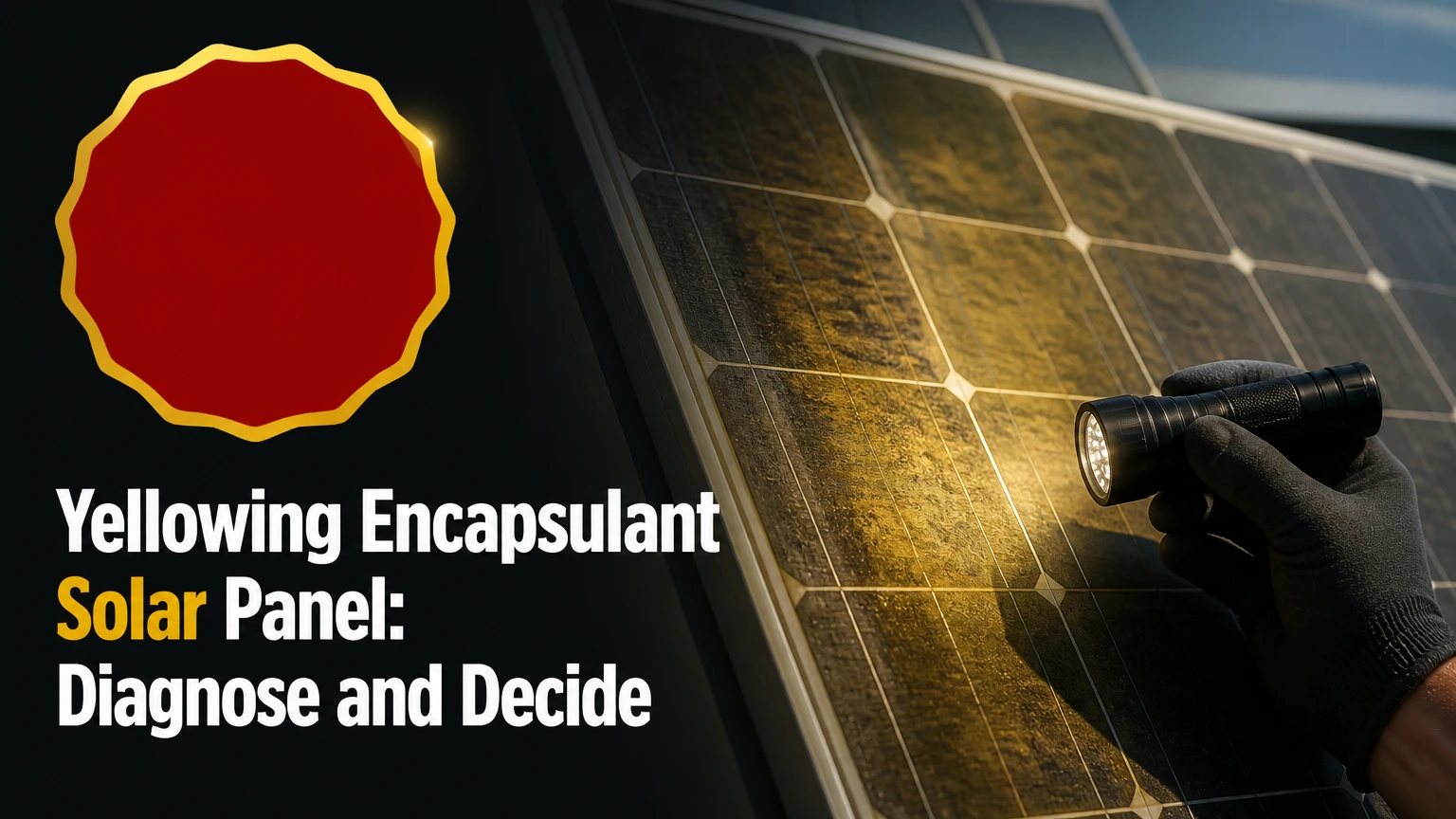
Yellowing encapsulant in a solar panel is discoloration and chemical degradation of the transparent polymer layer surrounding the photovoltaic cells. EVA is the most common affected material; ultraviolet radiation, heat, oxygen, and moisture can create light-absorbing compounds, reduce irradiance reaching the cells, and sometimes contribute to delamination and corrosion.
Key Facts at a Glance
- A yellowed encapsulant is inside the laminated module, so ordinary washing cannot remove the discoloration.
- EVA can produce acetic acid during degradation; POE contains no vinyl acetate and avoids that specific acid-forming pathway.
- Yellowing does not have a universal age threshold; heat, UV dose, moisture, formulation, lamination quality, and module design determine the rate.
- Power loss may be smaller than the visible color change when yellowing is mild, but severe browning, delamination, or corrosion can cause substantial loss.
- A warranty claim needs measured evidence, including serial numbers, photographs, production history, and electrical test results.
- A qualified technician should inspect delaminated or electrically abnormal modules because moisture ingress can create insulation and ground-fault hazards.
What Is Yellowing Encapsulant in a Solar Panel?
Yellowing encapsulant is the visible result of polymer aging between the front glass and photovoltaic cells. The encapsulant bonds the layers together, cushions cells against mechanical stress, limits moisture movement, and electrically isolates conductive cell components from the glass and backsheet.
Most crystalline-silicon modules historically used ethylene-vinyl acetate, or EVA. The polymer is initially transparent, but prolonged ultraviolet exposure and elevated temperature can alter its chemistry. The altered material absorbs more short-wavelength light, producing a yellow, amber, or brown appearance.
The color alone does not quantify the power loss. A module can look visibly yellow while retaining acceptable output, whereas a less obvious defect near cell interconnections can produce a larger electrical loss. Diagnosis therefore combines visual inspection with production data and, when justified, current-voltage testing.
Where Is the Encapsulant Located?
The encapsulant is a thin laminated film on both sides of the solar cells. In a conventional glass-backsheet module, the layer order is usually front glass, front encapsulant, cells, rear encapsulant, and polymer backsheet.
| Module layer | Typical material | Primary function | Failure concern |
|---|---|---|---|
| Front cover | 3.2 mm tempered glass | Optical protection and rigidity | Breakage, abrasion, haze |
| Front encapsulant | EVA, POE, or EPE | Cell bonding and insulation | Yellowing, bubbles, delamination |
| Photovoltaic cell | Silicon, typically 80-220 µm thick | Converts light into electricity | Cracks, corrosion, shading |
| Rear encapsulant | EVA, POE, or EPE | Rear bonding and insulation | Moisture transport, adhesion loss |
| Back cover | Polymer backsheet or glass | Environmental barrier | Cracking, chalking, moisture ingress |
The encapsulant cannot normally be accessed without opening the laminate. That distinction separates internal yellowing from surface contamination, which is removable during proper cleaning.
Why Does EVA Encapsulant Turn Yellow or Brown?
EVA yellowing begins when long-term photo-thermal exposure changes the polymer and consumes some stabilizing additives. Deacetylation can release acetic acid, while oxidation and unsaturated structures can create chromophores that absorb blue and ultraviolet wavelengths.
A simplified progression is:
- UV stabilizers and absorbers lose effectiveness.
- Heat and UV promote chemical changes in EVA.
- Deacetylation may release acetic acid from vinyl acetate groups.
- Conjugated unsaturated structures, often described as polyenes, absorb more light.
- The encapsulant appears yellow, amber, or brown.
- Adhesion can weaken, allowing bubbles or delamination.
- Acid, moisture, and oxygen can accelerate corrosion of metallization and interconnects.
The exact pathway depends on the EVA formulation, antioxidant package, curing level, laminate temperature history, oxygen availability, and module construction. Treating every yellow module as chemically identical is an analytical mistake.
A published review by Kempe, 2006, describes EVA degradation as a combination of photochemical and thermal processes rather than a single switch-like reaction. The practical consequence is important: the visible symptom identifies a material-aging concern, but it does not independently prove acetic-acid concentration, corrosion, or a specific percentage of output loss.
How Quickly Does Encapsulant Yellow?
Encapsulant yellowing can appear within several years in severe environments or remain visually minor for decades in well-designed modules. Fixed claims such as “all panels yellow after 10 years” are unreliable because field exposure varies by temperature, UV intensity, humidity, formulation, and manufacturing quality.
| Exposure condition | Typical stress profile | Likely visible progression | Inspection priority |
|---|---|---|---|
| Hot desert roof | High module temperature, strong UV, low humidity | Local tint may precede broad discoloration | Infrared and I-V testing |
| Tropical coastal site | Heat, high humidity, salt aerosol, thermal cycling | Yellowing may combine with edge delamination | Insulation and edge inspection |
| Temperate residential roof | Moderate UV and seasonal temperature changes | Gradual, often slower cosmetic change | Annual production comparison |
| Agricultural or industrial site | Dust, ammonia, soot, chemical pollutants | Soiling can mimic or worsen optical loss | Cleaning before diagnosis |
| Snow or high-altitude site | High UV, cold cycling, snow loading | Mechanical and UV stress can coexist | EL and visual cell inspection |
NREL research led by Dirk C. Jordan and Sarah R. Kurtz found a median module degradation rate of approximately 0.5% per year across reviewed field studies. Their widely cited summary states, “The median degradation rate is 0.5%/year.” That figure describes overall module degradation, not yellowing specifically.
What Are the Stages of Yellowing?
Yellowing commonly progresses from localized optical change to broader discoloration and, in some modules, delamination or corrosion. The stages below are practical diagnostic categories, not guaranteed age bands.
| Stage | Visual evidence | Electrical implication | Recommended response |
|---|---|---|---|
| Early change | Pale yellow tint near hot cell regions | Often unmeasured or modest current loss | Photograph and trend output |
| Localized yellowing | Yellow or amber patches aligned with cells | Local photocurrent reduction possible | Clean, inspect, and compare I-V data |
| Broad discoloration | Amber or brown area across multiple cell strings | Measurable short-circuit-current loss may occur | Obtain professional test and warranty advice |
| Advanced failure | Dark brown regions, bubbles, peeling, corrosion | String mismatch, insulation faults, or major power loss | Isolate unsafe equipment and plan replacement |
No responsible diagnosis assigns a failure date from color alone. A module’s operating temperature, irradiance, and cell architecture can make two visually similar panels perform differently.
Does Yellowing Reduce Solar Panel Output?
Yellowing can reduce solar-panel output by absorbing or scattering light before it reaches the cells, but the percentage loss varies too widely for a universal number. Mild discoloration may have little effect on annual energy, while severe browning combined with delamination or corrosion can cause significant current loss and electrical mismatch.
Short-circuit current, or Isc, is usually more sensitive to reduced optical transmission than open-circuit voltage, or Voc. However, a falling Isc does not prove yellowing because shading, soiling, irradiance error, cell cracks, connector resistance, and temperature can produce similar observations.
The frequently repeated figures of 4-10% loss for mild yellowing and 25-50% for severe browning should be treated as case-dependent estimates, not guaranteed field outcomes. Laboratory transmission results cannot be transferred directly to annual energy yield without controlling spectrum, angle of incidence, irradiance, cell response, and temperature.
Which Measurements Confirm Performance Loss?
| Test or evidence | What it measures | Useful finding | Main limitation |
|---|---|---|---|
| Cleaning and photographs | Surface condition and visual pattern | Separates dirt from internal discoloration | Cannot quantify power loss |
| Inverter monitoring | Energy production over time | Detects sustained underperformance | Weather and clipping distort comparison |
| I-V curve trace | Current, voltage, fill factor, curve shape | Identifies current loss, mismatch, or resistance | Requires correct irradiance and temperature correction |
| Electroluminescence imaging | Cell cracks and inactive areas | Reveals damage hidden behind glass | Needs specialized equipment and nighttime setup |
| Infrared thermography | Hot cells, bypass diodes, resistive areas | Finds localized electrical heating | Yellowing itself may not create a hot spot |
| Insulation resistance test | Leakage between circuit and frame | Identifies moisture-related electrical risk | Requires trained personnel and safe isolation |
A useful field comparison is same-model testing under similar irradiance, module temperature, and orientation. Comparing one old panel with a different model or an inverter-limited array can produce a false failure diagnosis.
Can Cleaning Remove Yellowing?
Cleaning removes surface dirt, pollen, soot, bird residue, and mineral deposits, but cleaning cannot remove encapsulant yellowing inside the laminate. If the color remains after a manufacturer-approved wash with clean water and a soft nonabrasive tool, internal discoloration becomes more likely.
Do not scrape the glass, apply solvents, or use abrasive pads. Aggressive cleaning can damage anti-reflective coatings, create scratches, and complicate a warranty claim.
A practical inspection sequence is:
- Record the module serial number and photograph the full panel.
- Compare the suspected panel with adjacent modules under the same light.
- Clean the glass using the installer or manufacturer’s approved method.
- Photograph the panel again after drying.
- Look for color that follows cell outlines, busbars, or localized hot regions.
- Check for bubbles, lifted edges, white moisture pockets, cracked backsheets, or exposed conductors.
- Compare inverter-level production with weather and historical data.
- Escalate to I-V, EL, insulation, or infrared testing when evidence justifies it.
The visual pattern provides a clue, not a laboratory identification. Yellow staining that follows a frame edge may indicate sealant, moisture, or backsheet interaction rather than uniform EVA degradation.
EVA, POE, EPE, and PVB: Which Encapsulant Is Better?
POE generally offers the strongest resistance to acid-driven degradation and moisture transmission, while EVA remains attractive for cost, processing familiarity, and widespread availability. EPE co-extrusions balance those characteristics, and PVB fits particular glass-glass or building-integrated applications rather than every standard rooftop design.
| Encapsulant | Chemical basis | Acid pathway | Typical application |
|---|---|---|---|
| Standard EVA | Ethylene-vinyl acetate | Vinyl acetate can support deacetylation | Legacy and cost-sensitive modules |
| Stabilized EVA | EVA with UV and antioxidant additives | Reduced rate, not eliminated | Mainstream modules with upgraded formulations |
| POE | Polyolefin elastomer | No vinyl acetate in the base polymer | Premium, bifacial, TOPCon, and HJT modules |
| EPE | EVA-POE-EVA co-extrusion | Lower acid exposure than all-EVA construction | Cost-balanced glass-glass modules |
| PVB | Polyvinyl butyral | Different degradation chemistry from EVA | BIPV and selected laminated glass modules |
“POE cannot yellow” is too absolute. POE avoids EVA’s acetic-acid pathway, but all polymers can experience discoloration, oxidation, adhesion loss, or optical change under severe exposure. Product formulation, curing, lamination, edge sealing, and quality control still matter.
| Decision criterion | EVA | Stabilized EVA | POE | EPE |
|---|---|---|---|---|
| Relative material cost | Lowest | Low to medium | Medium to high | Medium |
| Moisture barrier | Moderate | Moderate to good | Good to very good | Good |
| Acetic-acid risk | Present | Reduced, not zero | Absent from base polymer | Lower than all-EVA |
| Processing familiarity | Very high | Very high | High but more demanding | High |
| Common module context | Conventional rooftops | Mainstream premium EVA | Glass-glass, TOPCon, HJT | Bifacial and value-premium |
| Yellowing risk | Formulation-dependent, historically higher | Lower than basic EVA | Low for EVA-type yellowing | Lower than all-EVA |
Is POE Worth the Added Cost?
POE is usually worth considering for hot, humid, coastal, high-UV, or bifacial projects where moisture resistance and long-term reliability carry greater financial weight. The purchase decision should compare the complete bill of materials, warranty terms, glass-glass construction, bankability, and measured quality rather than the encapsulant label alone.
Published market prices vary by volume and year, so a universal $0.05-$0.10 per watt premium is not dependable for every transaction. Request a project-specific quotation and confirm whether the stated material applies to both front and rear encapsulant layers.
For a homeowner, a higher-quality module may cost less than a future replacement once labor, scaffolding, permitting, lost generation, and disposal are included. For a utility developer, POE does not eliminate the need for incoming inspection, electroluminescence sampling, damp-heat evidence, and supplier traceability.
What Problems Accompany Yellowing?
Yellowing becomes more serious when it appears with delamination, bubbles, corrosion, cracked backsheets, moisture marks, or electrical insulation faults. Cosmetic discoloration alone may justify monitoring, but combined optical, mechanical, and electrical defects can shorten useful service life.
Delamination and Corrosion
Delamination is loss of adhesion between glass, encapsulant, cells, or backsheet. It can create air or moisture pockets, increase optical scattering, expose cell metallization, and permit corrosion around busbars and ribbons.
Acetic acid can contribute to corrosion of silver contacts and copper-containing interconnects, but corrosion has multiple causes. Moisture, oxygen, ionic contamination, processing residues, and temperature all influence the outcome.
Ground Faults and Hot Spots
A yellowed module is not automatically a fire hazard. A delaminated, cracked, or wet module with damaged insulation can create leakage current, inverter ground-fault trips, or arcing conditions, especially where conductors become exposed.
Stop handling a module when glass is broken, conductors are exposed, the inverter reports repeated insulation faults, or water is visibly entering the laminate. Photovoltaic modules produce voltage in daylight, even when disconnected from the inverter.
How Should You Handle a Warranty Claim?
A manufacturer may cover abnormal material or workmanship failure, but a standard performance warranty does not necessarily cover every color change. The decisive evidence is usually a combination of documented defect, measured output, warranty language, and confirmation that installation conditions were compliant.
Prepare the following evidence:
- Module make, model, serial number, invoice, and installation date.
- Date-stamped photographs before and after cleaning.
- Inverter alarms, production charts, and weather context.
- Independent I-V test results with irradiance and temperature records.
- EL, infrared, or insulation-resistance reports where relevant.
- Images of delamination, bubbles, corrosion, backsheet cracks, or junction-box damage.
- Installer maintenance records and details of unusual shading or soiling.
Do not alter the laminate or attempt encapsulant removal before notifying the manufacturer. Unauthorized module disassembly can void warranty coverage and exposes the technician to glass, electrical, and chemical hazards.
Can Yellowed Encapsulant Be Repaired?
Yellowed encapsulant cannot normally be chemically cleared or restored in the field. A specialist may replace the entire laminate through module rework, but that process requires controlled heating, layer separation, new encapsulant, vacuum lamination, electrical testing, and a credible workmanship warranty.
For most residential systems, replacing the module is more practical than relaminating it. Relamination can make economic sense for large fleets with standardized modules, accessible logistics, and a qualified refurbishment line, but it is not a homeowner cleaning service.
| Condition | Field repair option | Typical decision |
|---|---|---|
| Light internal yellowing, stable output | No optical repair | Monitor and document |
| Yellowing with measurable current loss | Warranty replacement | Test adjacent modules |
| Delamination without electrical fault | Replacement or specialist rework | Protect against moisture entry |
| Ground fault or exposed conductor | Electrical isolation and replacement | Treat as a safety issue |
| Localized soiling only | Professional cleaning | Recheck production afterward |
| Broken glass plus yellowing | Module replacement | Do not handle casually |
What Should Buyers Specify for New Modules?
Buyers should request the complete encapsulant bill of materials, the module construction, applicable reliability test evidence, and the exact warranty exclusions. “Premium encapsulant” is not a sufficient specification because it does not identify whether the module uses EVA, POE, EPE, or different materials on each side.
For hot or humid locations, prioritize:
- POE or EPE construction where the supplier provides clear documentation.
- Glass-glass modules when backsheet durability is a significant concern.
- A manufacturer with traceable serial numbers and published warranty procedures.
- Independent factory quality inspection, including EL sampling and flash-test verification.
- Product documentation covering damp heat, UV exposure, humidity freeze, and PID testing.
- Compatibility between the module’s electrical characteristics and the inverter.
TOPCon and heterojunction, or HJT, modules commonly use moisture-resistant encapsulation, but cell technology does not guarantee a particular polymer. Confirm the material in the datasheet or written bill of materials.
An honest limitation matters here: POE is not a substitute for good manufacturing. Poor lamination, contamination, edge-seal failure, microcracks, and transport damage can defeat the advantage of a better polymer.
Which Action Fits Your Situation?
Existing Residential System
Clean and document the modules first, then compare monthly production with weather-adjusted historical output. Stable output and mild discoloration usually support monitoring, while delamination, persistent inverter faults, or tested current loss support a warranty claim or replacement quote.
Commercial or Utility Array
Use fleet-level string comparisons, thermography, I-V tracing, and statistical sampling rather than relying on photographs. A small number of visibly yellow modules can conceal a broader formulation or process issue, so map defects by batch, supplier, installation date, and environmental exposure.
Hot Coastal or Desert Site
Prioritize moisture resistance, edge integrity, and insulation testing. Dual-glass POE or EPE modules can reduce specific encapsulant and backsheet risks, but procurement should still require traceable quality records and commissioning baselines.
Expert Rules of Thumb
- Never estimate percentage power loss from color intensity alone.
- Compare modules under matched irradiance before declaring degradation.
- Treat a warranty claim as an evidence project, not a photograph-only complaint.
- A module that looks acceptable can still fail EL or insulation testing.
- A module that looks badly yellowed may retain more output than expected if corrosion and delamination have not begun.
Frequently Asked Questions
Does yellowing mean a solar panel has failed?
Yellowing means the encapsulant has undergone visible optical or chemical aging, not that the module has stopped working. A panel may continue producing useful electricity, but yellowing accompanied by delamination, corrosion, falling Isc, hot spots, or insulation alarms indicates a more significant failure condition.
How can you tell yellowing from a dirty solar panel?
Clean the glass using a nonabrasive, manufacturer-approved method and inspect the dry surface in consistent light. Dirt usually changes or disappears after cleaning, while encapsulant yellowing remains inside the laminate and often follows cell areas, busbars, or broad internal regions.
Is brown discoloration worse than yellow discoloration?
Brown discoloration often indicates more advanced optical or chemical change than a pale yellow tint, but color does not establish severity by itself. Brown areas combined with bubbles, delamination, corrosion, or a measured current reduction deserve faster electrical testing and warranty escalation.
Can solar panel yellowing be prevented with maintenance?
Routine cleaning cannot prevent chemical aging inside the encapsulant, although it removes soiling that increases operating temperature and masks defects. Prevention depends mainly on module formulation, lamination quality, edge sealing, climate-appropriate design, and procurement of documented materials such as POE or EPE.
Does a 25-year performance warranty cover yellow encapsulant?
A 25-year performance warranty may cover power output below specified thresholds, while a separate product warranty may address material or workmanship defects. Coverage depends on the written terms, defect evidence, exclusions, installation compliance, and whether testing demonstrates abnormal failure rather than ordinary degradation.
Should yellowed solar panels be replaced immediately?
Replace yellowed solar panels promptly when discoloration occurs with delamination, exposed conductors, repeated ground faults, severe corrosion, broken glass, or verified substantial output loss. Monitor mild, stable discoloration when electrical tests and production data show acceptable operation, while keeping dated records for future warranty decisions.
The Bottom Line
Yellowing encapsulant in a solar panel is usually an internal polymer-aging issue, most often associated with EVA, and cleaning cannot reverse it. The visible color provides an initial clue, but current-voltage testing, production records, electroluminescence imaging, thermography, and insulation testing determine whether the panel has a cosmetic change or a consequential failure.
For new purchases, POE and EPE can reduce EVA-specific acid and moisture risks, particularly in hot, humid, coastal, and high-UV environments. For existing systems, document the defect, avoid unsafe handling, check warranty terms, and replace modules when yellowing is paired with delamination, corrosion, electrical faults, or verified performance loss.