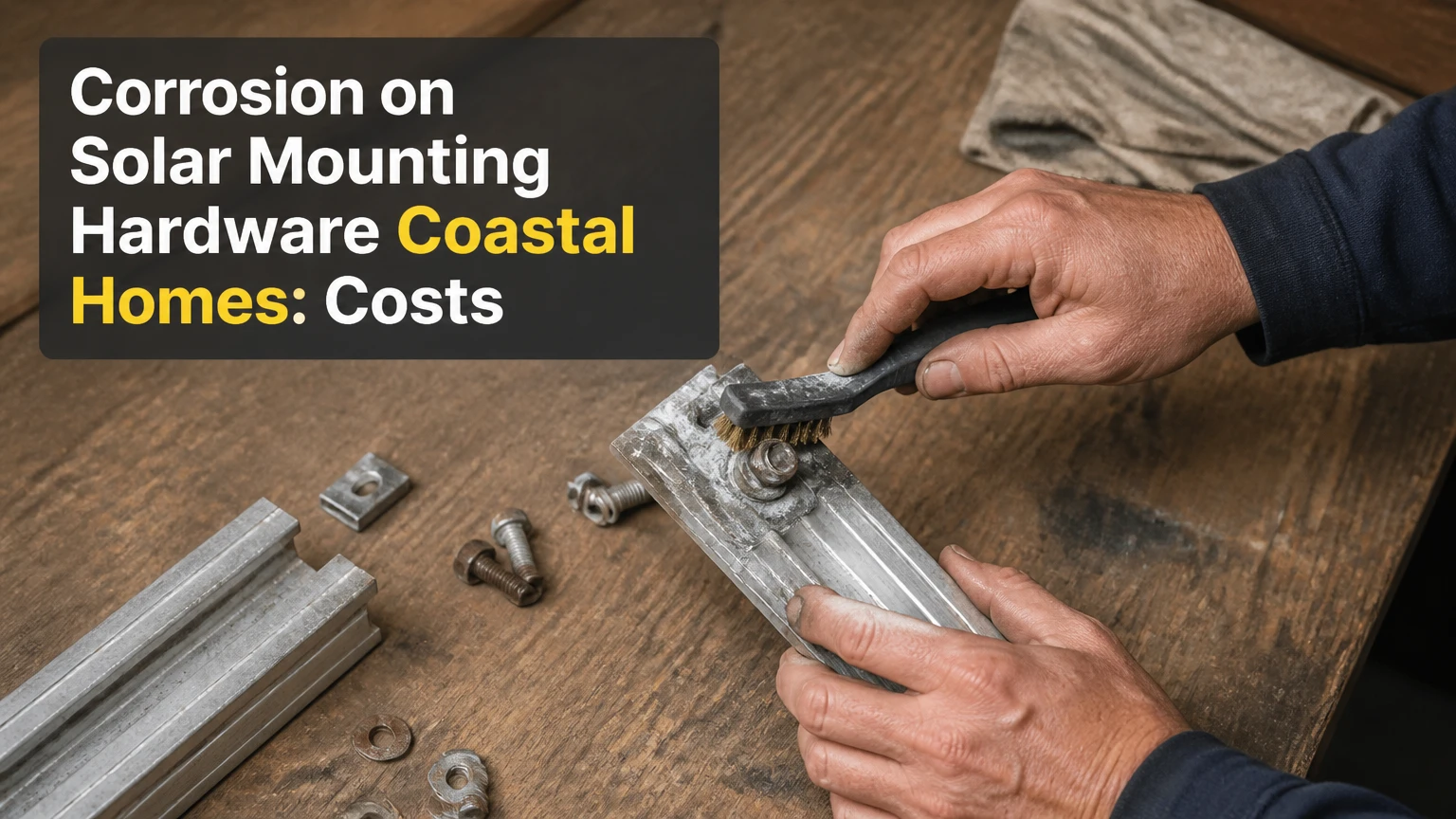
Corrosion on solar mounting hardware coastal homes occurs when salt deposits, moisture, oxygen, and dissimilar metals create electrochemical attack on rails, clamps, bolts, roof attachments, and bonding parts. The safest residential specification usually combines corrosion-resistant aluminum rails with appropriately selected stainless steel hardware, electrical isolation where required, sound drainage, and scheduled inspections.
Key Facts / At a Glance
Chloride-rich salt deposits can produce a conductive moisture film on solar rails, clamps, fasteners, and roof attachments.
316 or A4 stainless steel generally provides more chloride resistance than 304 or A2 stainless steel, but 316 can still pit in severe marine exposure.
Anodized aluminum resists atmospheric corrosion, while drilled holes, cut edges, trapped water, and galvanic contact can remain vulnerable.
ISO 12944 C5-M and CX are exposure classifications, not universal distance rules; shoreline distance alone cannot assign a corrosivity category.
FRP does not rust, but FRP systems still require structural design, UV suitability, electrical-bonding decisions, and compatible metal connections.
Orange section loss, loose clamps, seized fasteners, cracked attachments, or failed bonding continuity require professional assessment before continued operation.
What Causes Coastal Corrosion?
Coastal solar mounting hardware corrodes because marine salt turns intermittent surface moisture into a conductive electrolyte. Wind deposits chloride-bearing particles on exposed metal, condensation dissolves those particles, and oxygen reduction at nearby cathodic areas drives localized metal loss at scratches, crevices, threaded joints, and dissimilar-metal interfaces.
Corrosion does not require visible ocean spray. Homes several kilometers inland can receive salt aerosols, especially where prevailing wind, topography, humidity, and storm events carry marine particles inland. The underside of rails and clamps often corrodes first because rain cleans those surfaces poorly.
The American Association for the Advancement of Science is not the relevant authority here; the commonly used technical definition comes from the Association for Materials Protection and Performance, whose glossary defines corrosion as “the deterioration of a material, usually a metal, that results from a chemical or electrochemical reaction with its environment.” That definition includes aluminum oxidation, stainless-steel pitting, zinc consumption, and carbon-steel rust.
How Does Salt Create an Electrochemical Cell?
Salt deposition becomes damaging when water dissolves the deposit and connects anodic and cathodic areas. The less noble metal loses electrons, while oxygen reduction consumes those electrons elsewhere; chloride ions also destabilize passive oxide films and concentrate inside pits and crevices.
Relative humidity is not a universal switch at exactly 75 percent. The deliquescence point varies with salt composition, temperature, contamination, and surface geometry. A shaded rail can remain wet long after a nearby roof surface dries.
Four mechanisms commonly overlap:
- General atmospheric corrosion: broad, slow surface oxidation.
- Pitting corrosion: small deep cavities, especially on stainless steel or damaged aluminum.
- Crevice corrosion: attack beneath washers, clamps, seams, and deposits where oxygen levels differ.
- Galvanic corrosion: accelerated attack when dissimilar conductive metals contact through a wet electrolyte.
How Does Galvanic Corrosion Start?
Galvanic corrosion starts when dissimilar metals touch electrically while a conductive liquid bridges them. The more active metal becomes the anode, and the risk increases when a small anodic area is connected to a large cathodic area, such as a damaged aluminum fastener hole touching a larger stainless component.
Aluminum and stainless steel can coexist in solar racking, but the joint requires a manufacturer-approved interface. Isolation may involve polymer washers, coatings, joint compounds, compatible anodized surfaces, or purpose-designed clamps. A random nylon washer is not automatically acceptable because it may alter clamp load, bonding, fire performance, or listed assembly geometry.
| Interface | Typical corrosion concern | Preferred control | Inspection clue |
|---|---|---|---|
| 316 stainless bolt to anodized aluminum rail | Aluminum pitting at damaged contact area | Listed washer or isolation system | White powder around bolt head |
| Carbon-steel bolt to aluminum clamp | Rapid galvanic attack and rust staining | Replace with specified stainless hardware | Orange residue and loose clamp |
| Copper conductor to aluminum rail | Galvanic attack and electrical incompatibility | Listed bimetallic lug or bonding device | Darkened joint or continuity failure |
| Galvanized steel post to aluminum rail | Zinc consumption and aluminum attack | Coated transition plate or isolator | White and red deposits together |
| Stainless washer under aluminum clamp | Crevice corrosion beneath washer | Drainable, approved joint geometry | Ring-shaped pitting |
| Stainless fastener in stainless nut | Thread galling during installation | Correct lubricant and controlled torque | Seized or torn threads |
Galvanic isolation must not interrupt the required equipment-grounding path. If a washer electrically separates a rail from a clamp, the installer must provide a separate listed bonding method and verify continuity according to the equipment instructions and local electrical rules.
Which Materials Resist Marine Exposure?
For most coastal residential rooftops, anodized aluminum rails paired with specified 316 stainless hardware provide the best weight-to-corrosion-resistance balance. Galvanized or ZAM steel can be appropriate where long spans, high uplift, carports, or ground-mount loading make steel’s strength and stiffness more valuable than low weight.
| Material or grade | Useful property | Coastal limitation | Typical application |
|---|---|---|---|
| 6005-T5 aluminum | Lightweight structural extrusion, commonly used in rails | Lower stiffness than steel and vulnerable at damaged oxide | Residential rooftop rails |
| 6063-T6 aluminum | Good extrusion finish and moderate strength | Strength depends on profile and temper | Clamps, rails, light brackets |
| Anodized aluminum, 15 microns | Thicker oxide than untreated aluminum | Cut edges, holes, and scratches remain exposed | Moderate marine rooftop exposure |
| Anodized aluminum, 25 microns | Greater coating thickness for severe exposure | Not a substitute for drainage or isolation | High-salt residential sites |
| 304/A2 stainless steel | Strong, widely available fastener alloy | Tea staining and pitting risk in marine air | Inland or sheltered locations |
| 316/A4 stainless steel | Molybdenum-bearing alloy with improved chloride resistance | Pitting remains possible; threads can gall | Coastal clamps and fasteners |
| Hot-dip galvanized steel | Zinc sacrificial protection and high strength | Cut edges and coating damage need repair | Posts, carports, ground mounts |
| ZAM-coated steel | Zinc, aluminum, and magnesium coating system | Product performance depends on coating mass and design | Structural steel in exposed sites |
| Pultruded FRP | Nonmetallic profile with no rusting | UV, creep, connection, and fire limits require review | Specialized high-salt structures |
Is Anodized Aluminum Suitable Near the Ocean?
Anodized aluminum is suitable near the ocean when the profile, coating, drainage, fasteners, and electrical interfaces are designed together. Anodizing thickens the aluminum oxide layer, but the coating is not self-healing after deep scratches, drilled holes, cut ends, or aggressive cleaning.
AA15 and AA25 are commonly used coating designations in architectural anodizing, with nominal thicknesses of approximately 15 and 25 microns. They are useful procurement references, not universal solar-racking requirements. The racking manufacturer’s tested coastal specification should control.
Avoid steel wire brushes, abrasive pads, chloride cleaners, and unsealed crevices. White powder is often aluminum oxide, but extensive pitting around a bolt hole can reduce bearing area and require replacement.
Is 316 Stainless Steel Always Necessary?
316 stainless steel is usually preferable to 304 stainless steel for exposed coastal fasteners, but “316 everywhere” is not a complete engineering specification. Fastener exposure, crevice geometry, salt deposition, manufacturer listings, cost, and the required grounding path determine the appropriate assembly.
316 contains molybdenum, which improves resistance to chloride-induced pitting compared with 304. It does not make a joint immune to corrosion. Salt trapped under a clamp can produce severe localized attack even when the visible bolt remains bright.
Thread galling is a separate problem. Installers should use manufacturer-approved anti-seize, avoid high-speed impact tools for final tightening, keep threads clean, and use a calibrated torque wrench. Nickel products may interfere with some stainless assemblies or electrical connections, so compatibility must come from the racking manufacturer rather than a generic lubricant label.
Can Galvanized Steel or ZAM Replace Aluminum?
Galvanized steel and ZAM can replace aluminum when structural loading, span length, uplift, or impact resistance justifies a heavier system. Neither coating eliminates maintenance, and neither should be field-cut without an approved edge-repair procedure.
Hot-dip galvanized performance depends on coating thickness, steel chemistry, drainage, and exposure. A nominal 85-micron coating is a specification value for some heavy-gauge categories, not a universal guarantee for every rail or bracket. ZAM performance likewise depends on the manufacturer’s coating mass and tested environment.
Field repairs typically require removing burrs, cleaning the surface, and applying a compatible zinc-rich repair coating at the thickness specified by the product. Do not assume ordinary silver paint restores sacrificial protection.
How Should Corrosivity Be Classified?
Corrosivity should be classified from the site environment, not from a universal one-kilometer shoreline rule. ISO 12944-2 describes atmospheric corrosivity categories from C1 through C5 and CX, but the applicable category depends on salt deposition, humidity, wetness, industrial pollution, shelter, orientation, and local conditions.
A beachfront roof facing prevailing wind can be more aggressive than a sheltered property at the same distance. Tidal spray, breaking surf, salt-laden storms, roof geometry, and nearby pools or seawater equipment also change exposure.
| Site condition | Typical exposure tendency | Specification emphasis | Review interval |
|---|---|---|---|
| More than 10 km inland, low salt | C2 or lower in many locations | Standard listed aluminum and fasteners | Every 3-5 years |
| 1-10 km inland, prevailing sea wind | C3-C4 possible | Anodized rails and corrosion-rated hardware | Every 2-3 years |
| 100 m-1 km from surf, open exposure | C4-C5 possible | 316/A4 hardware, drainage, isolation | Annually |
| Under 100 m from breaking surf | C5 or CX may be considered | Site-specific marine package and wind review | Every 6-12 months |
| Salt spray, tidal surge, or industrial marine air | CX may be appropriate | Engineer-reviewed materials and details | Six-month inspection |
These ranges are screening guidance, not an ISO assignment. A project engineer or manufacturer should review the site, especially for hurricane-prone roofs, elevated arrays, rooftop equipment, and ground mounts exposed to splash.
Which Specification Fits Coastal Homes?
A coastal home usually needs a complete corrosion-control system rather than one premium metal. The correct choice depends on distance from surf, direct spray, roof material, wind uplift, access for washing, and whether the mounting system must carry a bonding path.
| Home situation | Recommended baseline | Avoid | Reason |
|---|---|---|---|
| Sheltered home 5 km inland | Anodized aluminum, specified stainless hardware | Uncoated carbon-steel bolts | Salt exposure is lower but not absent |
| Tile roof within 1 km of surf | Marine-rated aluminum, 316/A4 fasteners, sealed compatible attachments | Improvised washers and exposed cut steel | Tile penetrations concentrate moisture |
| Standing-seam metal roof near surf | Listed seam clamps, compatible metals, 316 where specified | Drilling through the seam without design approval | Penetrations create leak and galvanic risks |
| Beachfront low-slope roof | Site-specific marine package, robust drainage, frequent inspection | Flat water-trapping rails | Direct salt spray and long wet periods |
| Ground array near tidal water | HDG or ZAM steel, aluminum transition details, engineered foundations | Bare aluminum posts in soil | Soil moisture and tidal contamination accelerate attack |
| Coastal carport | Coated structural steel, 316 exposed hardware, sealed drainage | Thin residential rail profiles | Long spans and uplift increase structural demand |
A roof attachment can fail before the visible rail. Inspect flashing, lag screws, tile hooks, seam clamps, washers, sealants, and the supporting roof member. Corrosion resistance does not compensate for insufficient embedment or wind design.
What Does Coastal Protection Cost?
Upgrading a residential mounting package to marine-oriented materials typically adds about 10-30 percent to racking hardware cost, while total installed solar cost often rises by a smaller percentage because modules, inverters, labor, and electrical work remain unchanged. These are typical planning ranges, not supplier quotes.
| Upgrade or service | Typical residential range | Main cost driver | Typical timing |
|---|---|---|---|
| Standard aluminum to marine aluminum | $150-$600 per array | Rail length and coating | At procurement |
| 304 to 316 exposed hardware | $75-$350 per array | Fastener count and brand | At procurement |
| Isolation and bonding components | $50-$250 per array | Number of interfaces | At procurement |
| Coastal inspection | $150-$500 per visit | Roof access and travel | Every 6-24 months |
| Freshwater rinse by contractor | $100-$350 per visit | Array size and access | One or two times yearly |
| Replace corroded clamps | $200-$900 | Labor, access, seized threads | As needed |
| Replace damaged rails or attachments | $800-$4,000+ | Structural damage and roof work | As engineered |
Direct ocean frontage, difficult roof access, hurricane engineering, and discontinued hardware can move costs above these ranges. A low initial price can become expensive when installers must drill out seized fasteners or remove panels to reach hidden attachments.
How Should You Inspect and Repair Corrosion?
Inspect coastal solar hardware at least annually when the array is within roughly one kilometer of surf, and inspect every two to three years at less exposed inland sites. A competent inspection checks structural section loss, fastener condition, clamp torque indicators, roof attachments, water traps, bonding continuity, and evidence of movement.
Inspection Sequence
- Photograph the array from the roof edge and underside. Record rail joints, clamps, attachments, and cable-bonding points.
- Classify deposits. White powder usually indicates aluminum oxidation; red-brown scale indicates ferrous corrosion; black staining may indicate contaminated or crevice-prone stainless steel.
- Check movement. Do not tighten visibly damaged clamps without determining whether rail, module frame, or attachment metal has lost section.
- Inspect interfaces. Look beneath washers, at cut edges, inside channels, around drain holes, and where copper bonding hardware touches aluminum.
- Test electrical continuity. Use the procedure and acceptance values specified by the equipment manufacturer and local code.
- Rinse safely. Use clean, low-pressure freshwater and a soft nylon brush. Avoid abrasive tools and aggressive acids.
- Replace compromised parts. Replace pitted fasteners, cracked clamps, perforated rails, failed roof attachments, and hardware with seized threads.
Surface cleaning cannot restore lost metal. Orange staining on a replaceable washer is different from deep corrosion at a rail splice or roof attachment, where an engineer or qualified solar contractor should determine whether panel removal and structural replacement are necessary.
What Are the Most Common Installation Mistakes?
The most damaging field mistake is treating corrosion protection as a product property rather than a joint-detail property. A 316 bolt can still create a failing assembly when water is trapped, aluminum is damaged, or the bonding path is improvised.
- Using carbon-steel accessories: Replace unlisted bolts, washers, and spring nuts before commissioning.
- Cutting coated steel without edge repair: Deburr the cut and apply the specified zinc-rich repair system.
- Over-torquing clamps: Follow the manufacturer’s torque value, often documented in newton-metres, rather than relying on feel.
- Using an impact driver for final torque: Use a calibrated torque wrench and record torque where the quality plan requires it.
- Blocking drainage holes: Keep rail channels and brackets oriented so saltwater cannot remain trapped.
- Mixing bonding products: Use listed bonding washers, jumpers, lugs, and clamps as one compatible system.
- Cleaning with steel wool: Nylon tools preserve anodized surfaces better than ferrous abrasives that embed particles.
A counterintuitive field rule is that the underside of a rail can need more attention than its upper surface. Rain regularly washes the top, while a shaded lower channel can retain concentrated salt solution for hours.
Does Corrosion Affect Grounding?
Corrosion can compromise solar grounding when oxidation increases electrical resistance, a bonding washer loses contact, a conductor lug corrodes, or an isolated rail no longer connects to the equipment-grounding network. Structural strength and electrical continuity must therefore be inspected separately.
Anodized aluminum is electrically less accessible than bare aluminum, and paint or heavy oxide can interrupt contact. Listed bonding devices are designed to penetrate or bypass the relevant surface treatment. Removing anodizing with an unapproved tool can create a corrosion site and may invalidate the assembly listing.
Never assume a metal rail is bonded because it touches another metal part. Verify continuity with the specified test method, inspect bonding hardware for corrosion, and replace damaged conductors or lugs with compatible listed components.
How Long Should Coastal Solar Hardware Last?
A well-designed coastal mounting system can be planned around a 25-30-year solar operating period, but that figure is not a guaranteed service life for every fastener, coating, roof attachment, or site. Direct spray, poor drainage, aggressive cleaning, storm damage, and neglected galvanic joints can shorten hardware life substantially.
Panel warranties and racking warranties are different documents. Procurement records should identify alloy, temper, anodizing or coating thickness, fastener grade, environmental rating, wind design basis, bonding method, and exclusions for saltwater exposure.
| Component | Planning life target | Main early-failure cause | Replacement trigger |
|---|---|---|---|
| Anodized aluminum rail | 25-30 years in designed exposure | Pitting at cuts or trapped water | Section loss or weakened connection |
| 316 stainless fastener | 20-30 years in suitable detail | Crevice pitting or galling | Pits, seizure, thread damage |
| 304 stainless fastener | Site-dependent, often shorter near surf | Chloride staining and pitting | Any load-bearing pit or seized joint |
| Hot-dip galvanized post | 20-30+ years with suitable coating | Soil, cut edges, tidal wetting | Exposed steel or significant zinc loss |
| ZAM-coated bracket | Product and exposure dependent | Coating damage and drainage failure | Structural section loss or coating failure |
| FRP profile | 20-30 years only if UV-rated | UV degradation, creep, connection failure | Cracks, fiber exposure, excessive deflection |
Manufacturers should provide test data and warranty conditions for the actual product, not a generic statement that a material is “marine grade.”
Frequently Asked Questions
Can I use ordinary solar mounting hardware near the beach?
Ordinary hardware is a poor choice where the array receives direct salt spray or persistent marine humidity. Replace generic carbon-steel fasteners with the manufacturer’s coastal specification, review aluminum coating and drainage details, and confirm that bonding components remain compatible. A local installer should inspect roof attachments as well as visible rails.
Is white powder on an aluminum solar rail dangerous?
White powder is usually aluminum oxide or corrosion product and may be superficial, but its location determines risk. Powder around a cosmetic rail surface differs from deep pitting at a splice, bolt hole, clamp, or roof attachment. Clean gently, photograph the area, and obtain a structural assessment when metal thickness or clamp engagement appears reduced.
Should coastal solar panels be washed with soap?
Freshwater rinsing is usually safer than strong detergent, acidic cleaner, steel wool, or pressure washing. Follow the module and racking manufacturer’s instructions, use low pressure, avoid spraying roof penetrations aggressively, and clean when surfaces are cool. Washing removes salt deposits, but it cannot repair pitting or restore a failed coating.
Can 316 stainless steel rust?
316 stainless steel can stain, pit, or develop crevice corrosion in concentrated chloride deposits, especially beneath clamps and washers. The alloy resists marine attack better than 304, but correct geometry, drainage, cleaning, torque, and fastener compatibility remain necessary. Orange corrosion on a load-bearing 316 component warrants replacement and investigation.
Does a coastal location require FRP racking?
FRP racking is not automatically required for a coastal home. FRP can reduce metallic corrosion and galvanic interaction, but designers must evaluate UV exposure, creep, fire classification, impact, connection details, module grounding, and local availability. Aluminum with specified stainless hardware is often simpler for residential roofs.
Who should repair corroded solar mounting hardware?
A qualified solar contractor should handle minor component replacement, while a structural engineer should review perforated rails, weakened roof attachments, major pitting, array movement, or storm damage. Do not remove load-bearing fasteners or panels on a roof without a temporary support and electrical-safety plan.
The Bottom Line
Corrosion on solar mounting hardware coastal homes is controlled by the complete assembly: material selection, coating quality, dissimilar-metal isolation, drainage, bonding, installation torque, and inspection frequency. Choose a manufacturer-documented marine configuration rather than applying a universal shoreline distance rule, and replace structural or electrical components when corrosion has caused pitting, section loss, looseness, or continuity failure.