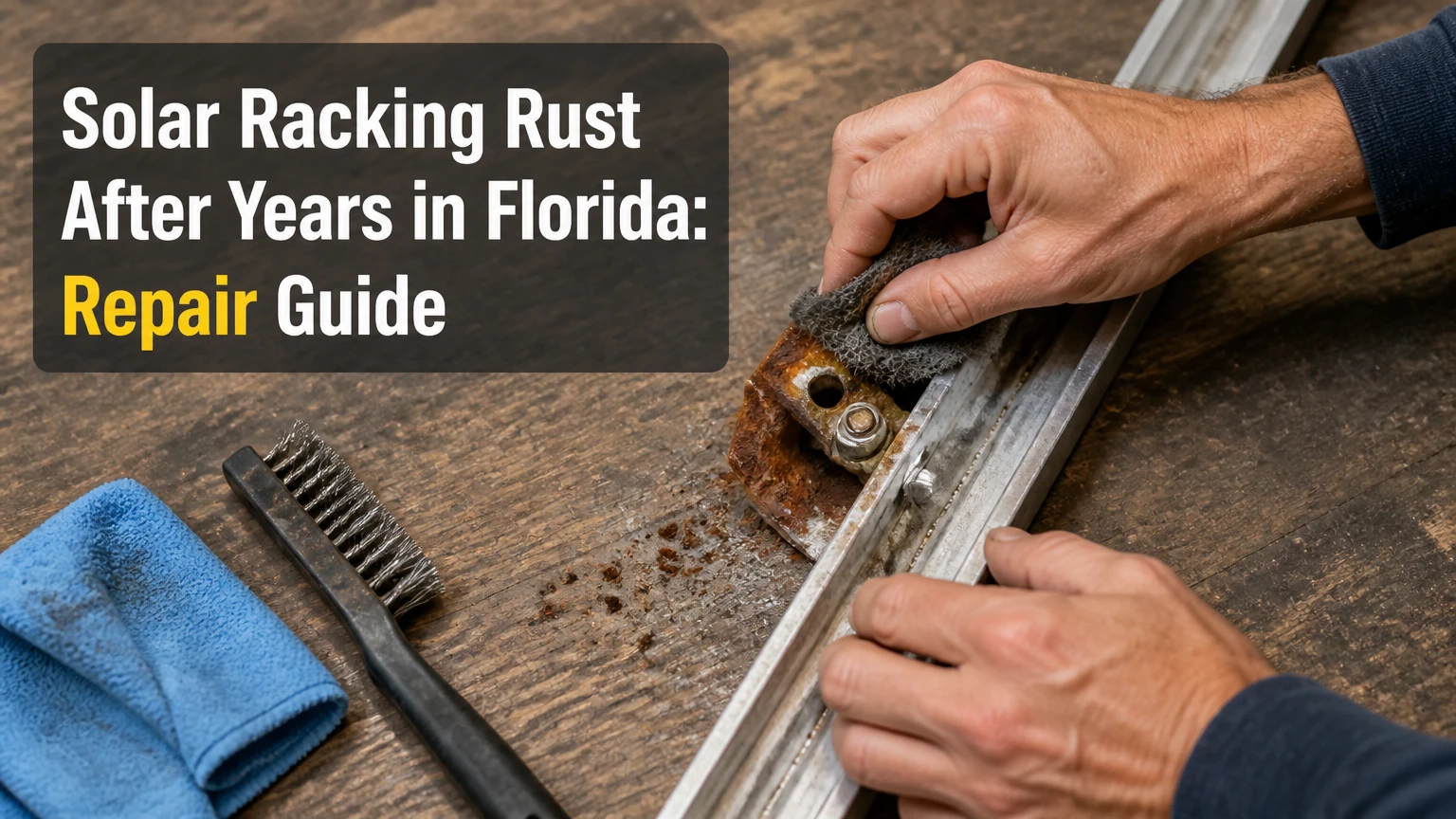
Solar racking rust after years in Florida usually results from persistent humidity, chloride deposits, trapped water, coating damage, or contact between dissimilar metals. Surface staining may be cosmetic, but corrosion at rails, clamps, roof attachments, fasteners, or ground-mount foundations can reduce wind resistance and requires a qualified solar or structural inspection before repair.
Key Facts at a Glance
- Florida solar racking does not have one statewide corrosion class; exposure varies with coast distance, wind direction, salt deposits, shelter, drainage, and local microclimate.
- Anodized aluminum rails usually resist atmospheric rust, but aluminum can pit, discolor, or corrode at isolated connections and damaged finishes.
- Galvanized steel remains structurally useful, but exposed cut edges, drilled holes, trapped moisture, and depleted zinc can produce red rust.
- White powder on galvanized steel usually indicates zinc corrosion, while white or gray deposits on aluminum require inspection because they may be oxidation, salt, or coating damage.
- Grade 316 stainless steel improves chloride resistance for many fasteners, but it does not make a poorly drained or badly bonded system corrosion-proof.
- Rust near a roof attachment is more urgent than staining on an accessible rail because hidden steel, flashing, or fastener damage can affect water entry and uplift resistance.
Why Does Solar Racking Corrode in Florida?
Florida solar racking corrodes because warm, humid air keeps metal surfaces electrolytically active while airborne chlorides attack protective coatings and vulnerable joints. Coastal wind carries salt inland, and condensation, rain, irrigation, pool chemicals, and hurricane spray can create repeated wet-dry cycles that accelerate damage.
The American Society for Testing and Materials, ASTM, and ISO corrosion frameworks evaluate exposure by environmental conditions, material, coating, geometry, and test method. ISO 9223 does not label every location in Florida C4 or C5 automatically. A beachfront structure and a protected inland rooftop can experience very different corrosion rates.
AMPP defines corrosion as “the deterioration of a material, usually a metal, that results from a chemical or electrochemical reaction with its environment.” Solar racking experiences several forms at once:
- Atmospheric corrosion: Water and oxygen react with exposed steel after zinc or paint protection is breached.
- Galvanic corrosion: Aluminum, carbon steel, zinc, and stainless steel form an electrochemical couple when an electrolyte connects them.
- Pitting corrosion: Chlorides create small, deep cavities that may remove significant strength without large surface stains.
- Crevice corrosion: Clamps, washers, seams, and overlapping plates retain moisture and restrict oxygen exchange.
- Cut-edge corrosion: Field-drilled or field-cut galvanized steel exposes unprotected substrate unless the edge receives an approved repair coating.
Salt is not the only issue. A roof with poor drainage can corrode faster than a more distant coastal roof that dries quickly after rain.
How Long Does Racking Last in Florida?
Florida solar racking commonly provides 20-30 years of service when the system uses compatible materials, listed hardware, adequate drainage, and installation practices suited to the site. A universal five-year or ten-year failure schedule is unreliable because coating thickness, salt loading, joint design, maintenance, and storm exposure control the actual rate.
Solar modules may carry 25-year performance warranties, but that warranty does not guarantee every structural component will remain undamaged for 25 years. Racking warranties also differ from engineering service-life assumptions. A manufacturer may warrant material defects while excluding installation errors, aggressive environments, unauthorized cutting, or neglected maintenance.
| Exposure or component condition | Typical visible change | Practical service expectation | Review trigger |
|---|---|---|---|
| Inland rooftop, anodized aluminum rails | Fading, dirt, isolated fastener staining | 25-30 years | Annual inspection |
| Inland rooftop, galvanized steel brackets | White zinc deposits, edge rust | 15-25 years | Inspect cut edges every 1-2 years |
| Coastal rooftop, aluminum with isolated hardware | Pitting, salt crust, fastener corrosion | 20-30 years, site dependent | Inspect every 6-12 months |
| Beachfront or direct salt-spray exposure | Rapid coating loss, pitting, seized hardware | Highly variable, sometimes under 20 years | Professional corrosion review |
| Ground mount with wet soil contact | Base rust, coating breakdown, foundation corrosion | 10-25 years, design dependent | Inspect after storms and annually |
| Poolside or irrigation exposure | Chloride deposits and persistent wet joints | 15-25 years, material dependent | Rinse and inspect quarterly |
These are planning ranges, not guarantees. A system that survived eight years without visible red rust may still have hidden pitting around a stainless fastener or roof attachment.
What Do White Rust and Red Rust Mean?
White rust on galvanized steel usually indicates oxidation of the zinc coating, while red rust indicates exposed iron or steel substrate. White powder on aluminum is different: aluminum oxide is normally thin and protective, but chalky deposits, pits, or flaking around joints can indicate localized corrosion or coating failure.
| Visual symptom | Likely material or mechanism | Risk level | Recommended response |
|---|---|---|---|
| Thin white powder on galvanized bracket | Zinc oxidation | Low to moderate | Clean, photograph, monitor coating |
| Orange stain at a steel cut edge | Exposed carbon steel | Moderate | Remove loose corrosion and use approved zinc repair |
| Deep black or gray pit on aluminum | Localized aluminum corrosion | Moderate to high | Measure section and consult manufacturer |
| Red rust around roof lag or flashing | Fastener or attachment corrosion | High | Stop cosmetic repair and obtain professional inspection |
| Rust streak below stainless bolt | Corroding adjacent steel or contamination | Moderate | Identify source before replacing hardware |
| Flaking metal, swollen bracket, or perforation | Section loss | High | Isolate area and arrange engineered replacement |
| White crust at aluminum-stainless joint | Salt, galvanic deposits, or oxidation | Moderate | Check isolation, bonding, drainage, and pitting |
A common diagnostic error is treating every white deposit as “advanced aluminum degradation.” Salt residue can look similar, and zinc hydroxide on galvanized steel can be temporary. The substrate, location, hardness of the deposit, and condition beneath the residue determine the diagnosis.
Which Racking Material Fits Your Location?
Anodized aluminum is usually the practical choice for residential Florida rooftops, while hot-dip galvanized steel suits heavy structural applications when coating repairs and drainage are controlled. ZAM-coated steel can be attractive for selected commercial systems, and 316 stainless steel is usually reserved for fasteners and highly exposed connection components rather than primary rails.
| Material or alloy | Typical use | Corrosion advantage | Limitation in Florida |
|---|---|---|---|
| 6005-T5 aluminum | Roof rails and structural profiles | No red-rust mechanism; low weight | Pitting, galvanic attack, and lower stiffness |
| 6063-T6 aluminum | Light rails and trim profiles | Good finish and oxidation resistance | Often less suitable for heavily loaded spans |
| Hot-dip galvanized steel | Brackets, piles, heavy frames | High strength and zinc barrier | Cut edges, holes, and depleted coating rust |
| ZAM-coated steel | Commercial rails and support steel | Zinc-magnesium-aluminum coating can protect edges | Availability, compatibility, and verification matter |
| 304 stainless steel | General indoor or mild exposure hardware | Better oxidation resistance than carbon steel | Chloride pitting risk near salt, pools, and marine air |
| 316 stainless steel | Coastal fasteners and clamps | Molybdenum improves chloride resistance | Higher cost and still vulnerable in crevices |
Aluminum is not automatically corrosion-proof. Direct contact between aluminum and stainless steel can become damaging when saltwater bridges the connection. Listed bonding clips, polymer separators, compatible washers, and drainage details must preserve both corrosion control and electrical continuity.
Galvanized steel is not automatically inferior. Its high stiffness can reduce member size in ground-mount structures, and a properly specified coating can perform well inland. The weak points are usually field modifications, exposed edges, water traps, and incompatible fasteners.
What Is the Best Coastal Combination?
For a coastal rooftop, specify anodized aluminum rails, corrosion-compatible clamps, and 316 stainless fasteners when the manufacturer permits them. Require a documented isolation and bonding detail rather than adding random nylon washers that might interrupt the equipment grounding path.
Near the shoreline, ask the installer to identify the racking system’s environmental limitations, coating specification, fastener grade, bonding method, and cleaning requirements. “Marine grade” is not a complete engineering specification. The exact alloy, finish, connection detail, and listed installation method still matter.
Material Comparison: Cost, Strength, and Maintenance
Typical residential racking material costs range from about $80-$150 per kilowatt before unusual roof work, premium coastal hardware, engineering, permits, or replacement labor. Installed replacement costs can be several times higher because crews must remove modules, expose attachments, restore waterproofing, and complete electrical and structural checks.
| Option | Typical material cost | Relative weight | Typical maintenance need | Best-fit scenario |
|---|---|---|---|---|
| Standard anodized aluminum | $80-$120/kW | Low | Annual visual inspection | Inland or ordinary coastal rooftop |
| Coastal aluminum package | $110-$180/kW | Low | 6-12 month inspection | Salt-exposed residential roof |
| HDG steel rooftop hardware | $70-$120/kW | High | Edge and joint coating review | Heavy-duty, engineered applications |
| ZAM commercial steel | $90-$150/kW | Medium to high | Annual coating inspection | Commercial ground mount |
| 316 stainless fastener upgrade | $3-$8 per bolt typical | Medium | Check seizure and crevices | Coastal connections and clamps |
| Full racking replacement labor | $2,000-$8,000 typical residential | Crew dependent | Includes removal and reinstallation | Extensive corrosion or attachment failure |
The cost range is a planning estimate, not a bid. A 10-kilowatt rooftop with accessible rails may cost less to retrofit than a smaller system with fragile tiles, steep roof geometry, failed flashings, or corroded attachment points.
One practitioner rule matters here: replacing visible bolts without checking the connected bracket can leave the weakened part in service. The fastener often looks worse because it is easy to see, while corrosion under a washer or inside a roof attachment remains hidden.
How to Inspect Existing Racking Safely
A Florida solar racking inspection should begin from the ground and attic, continue with a qualified roof-level visual review, and escalate to measurement or engineering when corrosion affects connections, attachments, or load paths. Homeowners should not walk on modules or climb a roof to investigate rust without suitable fall protection and electrical safety controls.
Step 1: Record the System and Exposure
Document installation year, racking manufacturer, module layout, roof type, property distance from saltwater, pool or irrigation exposure, and any hurricanes or roof repairs since installation. Photograph each elevation and label the rail, clamp, bracket, attachment, and ground connection locations.
Success checkpoint: The inspection record connects every visible defect to a component and location.
Common mistake: Photographing only the worst rust without recording unaffected connections for comparison.
Step 2: Identify the Metal
Use installation records, manufacturer markings, finish appearance, and component shape to distinguish aluminum, galvanized steel, stainless steel, and painted carbon steel. Do not assume a silver-colored rail is stainless steel; most residential rails are aluminum.
Success checkpoint: Each corrosion area has a probable substrate and protective system.
Common mistake: Scraping a coating or using a grinder before identifying the material.
Step 3: Map Corrosion at Connections
Inspect clamps, rail splices, end caps, flashing, lag heads, washers, brackets, and grounding hardware. Look for red rust, white zinc deposits, black pits, swollen seams, seized threads, missing washers, loose bolts, and water trapped by debris.
Success checkpoint: The map identifies whether damage is isolated staining or repeated at a specific connection design.
Common mistake: Focusing on exposed rail faces while ignoring the underside and roof attachment.
Step 4: Check Roof and Ground-Mount Interfaces
An attic review can reveal water stains below attachments, while a ground-mount review should include posts, base plates, welds, drainage zones, and soil contact. After a major storm, inspect for shifted rails, lifted flashing, elongated holes, and module movement.
Success checkpoint: The inspection evaluates the complete load path, from panel clamp to rail, bracket, attachment, roof framing, or foundation.
Common mistake: Treating a straight-looking rail as proof that the attachment remains sound.
Step 5: Escalate Before Cleaning or Painting
A solar contractor should evaluate ordinary corrosion, and a Florida-licensed structural engineer may be needed when section loss, attachment movement, perforation, cracked welds, or uncertain wind-load capacity exists. Thickness gauges can support an assessment, but a single number does not establish safety without the original member design and remaining load path.
Success checkpoint: A qualified reviewer provides a written repair or replacement scope.
Common mistake: Using an unsupported rule such as “3 millimeters lost means replacement.” The acceptable loss depends on the member, design load, geometry, and engineer’s assessment.
Can Rusty Solar Racking Be Repaired?
Rusty solar racking can be repaired when corrosion is superficial, the base metal remains sound, the connection retains its designed geometry, and the manufacturer-approved coating or replacement method is available. Pitting, perforation, loose attachments, cracked welds, elongated holes, and significant section loss generally require component replacement or engineered remediation.
| Condition | DIY cleaning appropriate? | Coating repair appropriate? | Replacement or engineering likely? |
|---|---|---|---|
| Salt film on anodized aluminum | No roof access without training | No coating needed | No |
| Loose white zinc powder, sound steel | Limited ground cleaning | Often, after approved preparation | No |
| Orange surface rust on accessible cut edge | No structural alteration | Yes, zinc-rich repair per product data | Sometimes |
| Pitting at clamp or splice | No | Coating alone is insufficient | Yes, obtain component review |
| Rusted roof lag or flashing | No | Paint is not a waterproof repair | Yes, qualified contractor |
| Perforated bracket or cracked weld | No | No | Yes, engineered replacement |
| Corroded bonding hardware | No | No | Replace with listed hardware and test continuity |
For minor steel corrosion, a qualified technician may remove loose scale, clean the surface, and apply a compatible zinc-rich repair coating according to the product’s preparation and dry-film instructions. “ASTM A123 compliant paint” is imprecise: ASTM A123 covers hot-dip galvanized coatings, while field repair products should be selected under the applicable repair guidance, such as ASTM A780 where appropriate.
Do not seal active corrosion under ordinary paint. Do not drill new holes in a load-bearing rail without written manufacturer approval. Do not insert random rubber or nylon washers into an electrical bonding path. Corrosion control and equipment grounding must be designed together.
When Does Corrosion Become a Wind or Roof Risk?
Corrosion becomes a structural or roof risk when it affects a load-bearing member, fastener, splice, roof attachment, weld, or electrical bond, especially after a hurricane or high-wind event. Orange staining alone does not prove imminent failure, but rust combined with movement, pitting, perforation, or water entry warrants prompt professional evaluation.
Solar racking transfers wind uplift through clamps, rails, splices, brackets, fasteners, roof attachments, and building structure. A weakened bolt can matter more than a broad stained rail because the connection may no longer transfer the design force.
Immediate escalation signs include:
- A panel or rail has shifted from its original alignment.
- A clamp is loose, tilted, cracked, or missing.
- A roof attachment has rust streaks, lifted flashing, or interior water staining.
- A galvanized bracket has deep pits, holes, swollen layers, or a visibly narrowed section.
- A ground-mount post or base plate has corrosion at the soil or drainage line.
- A bonding jumper, lug, or listed grounding clip is loose or heavily corroded.
- A storm has caused uplift, impact, debris strikes, or module-frame contact.
Turn off neither the system nor its disconnects casually. Photovoltaic conductors can remain energized in daylight, and a structural inspection may require coordination between a solar electrician, roofing contractor, and engineer.
How Do Fasteners, Isolation, and Bonding Work Together?
Solar racking fasteners must resist the site’s chloride exposure while maintaining the manufacturer’s required mechanical connection and equipment-grounding path. Stainless steel selection, anti-seize compatibility, isolation washers, bonding clips, and drainage must follow the racking manufacturer’s listed instructions rather than an improvised material substitution.
| Connection detail | Main corrosion concern | Electrical concern | Preferred control |
|---|---|---|---|
| Aluminum rail with stainless bolt | Galvanic coupling and crevice moisture | Bond may be acceptable only through listed hardware | Use approved clamp and washer system |
| Aluminum rail with bare carbon-steel bolt | Rapid steel rust and aluminum contact | Unreliable continuity | Replace with specified corrosion-resistant hardware |
| Galvanized bracket with 316 bolt | Local coating damage around hole | Bonding may change after corrosion | Use compatible washer and inspect coating |
| Nylon washer added randomly | Moisture separation may help | Can interrupt grounding | Use only where the listed design permits |
| Stainless bonding clip on anodized rail | Coating penetration or poor bite | Required continuity may be lost | Use listed clip and test continuity |
| Copper wire on aluminum without treatment | Galvanic attack | Bond degradation | Use approved transition hardware and compound |
316 stainless steel contains molybdenum that generally improves resistance to chloride pitting compared with 304 stainless steel. It remains susceptible in stagnant, contaminated crevices, particularly where salt deposits remain wet. A 316 bolt cannot compensate for a carbon-steel bracket with a failed coating.
Coastal, Inland, and Special Exposure Cases
Coastal Florida rooftops need more frequent inspections and better chloride-resistant connection details than protected inland systems, while poolside, irrigation, industrial, and ground-contact conditions can create severe exposure even away from the ocean. Distance from the shoreline is a useful screening factor, not a complete corrosion specification.
| Situation | Dominant exposure | Inspection interval | Design emphasis |
|---|---|---|---|
| Beachfront rooftop | Salt spray and wind-driven chloride | 6 months | Aluminum, 316 hardware, drainage |
| 1-5 miles inland | Salt deposition plus humidity | 6-12 months | Isolation, sealed records, rinsing where approved |
| Central Florida inland roof | Humidity, rain, heat | 12 months | Standard listed racking and clean drainage |
| Poolside installation | Chlorine aerosols and splash | 6-12 months | Hardware compatibility and frequent residue removal |
| Agricultural or irrigation site | Fertilizer, water, soil salts | 6 months | Coating inspection and splash control |
| Commercial ground mount | Soil moisture, runoff, wind | 6-12 months | Base plates, posts, welds, and drainage |
Freshwater rinsing may reduce salt deposits on accessible components, but it is not a universal maintenance requirement. Follow the racking and module manufacturers’ instructions, avoid abrasive cleaning, and never direct high-pressure water toward roof seals, connectors, or module edges.
What Should a New Florida System Specify?
A new Florida solar system should specify the racking alloy, anodizing or galvanizing standard, fastener grade, environmental limitations, field-cut repair method, bonding hardware, drainage provisions, and inspection documentation. Procurement should evaluate the entire connection assembly instead of choosing aluminum or stainless steel from a material label alone.
Request these records:
- Racking manufacturer and exact product series.
- Structural calculations for the site’s wind exposure and roof attachment layout.
- Aluminum alloy and anodized finish specification, or steel coating specification.
- Fastener grades, including whether hardware is 304 or 316 stainless steel.
- Listed bonding and grounding instructions.
- Written treatment for field cuts, drilled holes, and damaged coatings.
- Warranty exclusions for coastal, poolside, or aggressive environments.
- Module removal and reinstallation procedures for future roof work.
- Inspection and maintenance recommendations.
- Permit, final inspection, and as-built attachment records.
An expert procurement rule is simple: reject any proposal that names only “rustproof racking” without identifying the coating, alloy, connection hardware, and environmental qualification. The phrase has no measurable engineering meaning by itself.
Typical Repair and Replacement Costs
Minor corrosion cleaning may cost $150-$500 for a service visit, while a residential racking retrofit commonly costs $2,000-$8,000 before major roof repairs or full system replacement. Labor dominates because modules may need removal, electrical disconnection, roof access, waterproofing restoration, and post-repair structural verification.
| Work scope | Typical residential range | Typical duration | Main cost driver |
|---|---|---|---|
| Visual corrosion assessment | $150-$500 | 1-3 hours | Roof access and documentation |
| Minor coating touch-up | $300-$1,000 | 2-6 hours | Preparation and access |
| Replace isolated clamps or bolts | $500-$2,000 | 4-10 hours | Module removal and hardware access |
| Replace several brackets or attachments | $2,000-$6,000 | 1-2 days | Waterproofing and structural review |
| Full rooftop racking replacement | $5,000-$15,000 | 2-4 days | System size, roof type, and labor |
| Commercial ground-mount repair | $5,000-$50,000+ | Days to weeks | Equipment, foundations, and engineering |
These figures are typical planning ranges, not Florida bid averages. A contractor should separate labor, replacement hardware, roofing, engineering, permits, electrical testing, and module handling in the estimate.
Frequently Asked Questions
Does solar racking rust after 10 years in Florida?
Yes, galvanized steel components, carbon-steel fasteners, damaged coatings, and poorly drained connections can show rust within 10 years in Florida. Aluminum rails usually do not form red iron rust, but their joints and adjacent hardware can pit or corrode. The installation’s exposure and connection design matter more than age alone.
Can I paint over rusty solar brackets?
Painting over loose rust is not a reliable structural repair. A qualified technician must remove unstable corrosion, verify that the remaining steel is sound, use a compatible zinc-rich repair coating where permitted, and confirm that the coating does not interfere with bonding, drainage, or clamp movement.
Is aluminum better than galvanized steel for Florida?
Aluminum is usually better for lightweight residential rooftop rails because it avoids red-rust failure and handles ordinary atmospheric exposure well. Galvanized steel can be better for high-load ground-mount members when the zinc coating, cut edges, welds, and drainage are properly specified and maintained.
Should Florida solar owners rinse their panels and racking?
Rinsing can remove salt deposits, but owners should follow module and racking manufacturer instructions and avoid pressure that could damage seals or electrical components. Coastal systems may benefit from periodic low-pressure freshwater cleaning, while ordinary inland systems often need only inspection and removal of debris from drainage paths.
Can corroded racking damage solar panels?
Corroded racking can damage modules indirectly by allowing clamps to loosen, rails to shift, or metal debris to contact frames. Rust alone does not mean a panel is unsafe, but frame distortion, clamp movement, glass stress, cracked backsheets, and abnormal electrical readings require qualified inspection.
When should a Florida solar racking system be replaced?
Replace or engineer the system when corrosion causes perforation, deep pitting, cracked welds, loose or elongated connections, failed roof attachments, recurring water intrusion, or uncertain wind-load capacity. A cosmetic stain on a sound rail normally calls for monitoring, not automatic replacement.
The Bottom Line
Solar racking rust after years in Florida is a site-specific corrosion problem, not an automatic expiration event at five, ten, or twenty years. Inspect the complete load path, identify the actual metals, distinguish surface deposits from section loss, and treat roof attachments, bonding hardware, pitting, and post-storm movement as higher priorities than ordinary staining. For new coastal systems, choose a listed aluminum or engineered corrosion-resistant system with compatible 316 hardware, controlled isolation, reliable bonding, and documented drainage details.