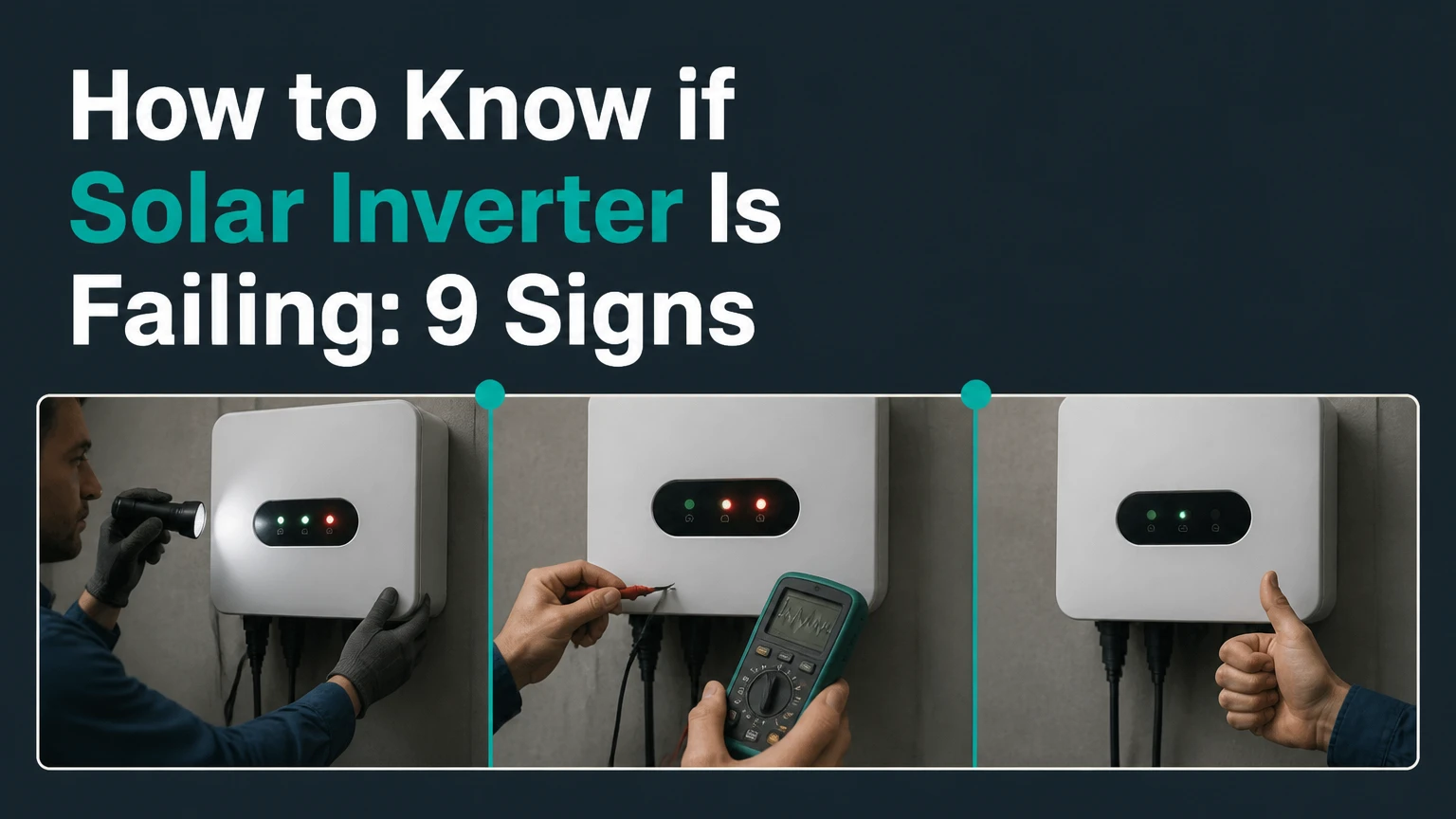
A failing solar inverter commonly shows zero or sharply reduced daytime output, persistent red or amber fault indicators, recurring error codes, abnormal fan or electrical noises, excessive heat, or a burning odor. Confirm the symptom against sunlight, panel condition, grid status, and monitoring connectivity before calling the inverter failed.
Key Facts at a Glance
A solar inverter can stop producing power because of a grid fault, low DC voltage, overheating, insulation failure, or internal hardware damage.
Zero production during strong daylight is serious, but it does not prove inverter failure until the AC supply, DC disconnect, grid, and monitoring system are checked.
A burning smell, smoke, melted connector, water ingress, or repeated breaker trip requires immediate shutdown by an appropriately qualified professional.
A green status light usually indicates normal operation, but LED meanings differ by manufacturer and model.
String inverters commonly last about 10-15 years; microinverter and warranty expectations vary by brand, environment, and operating temperature.
Homeowners should read displays and inspect external conditions, but should not open the enclosure or measure live DC circuits without suitable training.
How to Know if a Solar Inverter Is Failing
The strongest evidence is a persistent production loss accompanied by a fault indication, abnormal temperature, or a code that returns after the utility and solar array are confirmed available. A single low-production day is weak evidence because clouds, shade, soiling, snow, grid curtailment, and communications faults can create the same result.
Use a baseline rather than a fixed wattage threshold. Compare the system with a clear day from the same month, similar weather, and similar shade conditions. A 5-kilowatt array may produce only a few hundred watts in cloud, while a clear midday system might produce 3.5-4.5 kilowatts after normal losses. The meaningful signal is an unexplained change from its own previous pattern.
What are the nine main warning signs?
These symptoms deserve investigation:
- No AC output during strong daylight: The monitoring portal and inverter display both show no production after the normal morning startup period.
- A large unexplained production decline: Output falls 20-30% below comparable clear days without new shade, dirt, snow, or panel damage.
- Persistent red, amber, or fault LEDs: The warning remains after the inverter has had time to reconnect to the grid.
- Recurring fault codes: Isolation fault, ground fault, DC overvoltage, grid overvoltage, or repeated overtemperature codes return.
- Unusual mechanical noise: A failing fan may rattle, grind, pulse, or stop while the inverter becomes hot.
- Excessive heat: The enclosure is abnormally hot, repeatedly reports thermal shutdown, or loses output during hot afternoons.
- Burning odor, smoke, or discoloration: Heat-damaged plastic, terminals, cable insulation, or circuit-board components indicate an urgent electrical defect.
- Repeated AC breaker or disconnect trips: A breaker that trips again after one authorized reset points to a persistent electrical problem.
- Frequent restarting: The inverter starts, produces power briefly, then shuts down and repeats the cycle.
A symptom becomes more persuasive when two independent channels agree. For example, an app showing zero power plus a red fault LED is stronger evidence than an app outage alone.
What Does a Solar Inverter Do?
A solar inverter converts the direct current generated by photovoltaic modules into alternating current that household circuits or the utility grid can use. The device also tracks panel voltage and current, monitors grid quality, records faults, and disconnects when grid conditions are unsafe.
The U.S. Department of Energy Solar Energy Technologies Office describes the inverter as “the brains of a solar energy system.” That description is useful, but the inverter is not the only possible cause of low production. Panel wiring, connectors, protection devices, utility voltage, communications hardware, and the modules themselves can interrupt the energy path.
How does the conversion process work?
Solar modules send variable DC voltage to the inverter input. Maximum Power Point Tracking, or MPPT, continually adjusts the electrical operating point so the array can deliver useful power as sunlight changes.
Power semiconductors then switch the DC waveform at high speed. Filters produce a regulated AC waveform, usually synchronized to a 50-hertz or 60-hertz grid. Grid-tied units monitor voltage and frequency and use anti-islanding protection to stop exporting power during a utility outage. Hybrid models add bidirectional battery charging and discharge control.
Is Zero Daytime Production Proof of Inverter Failure?
Zero daytime production is a high-priority symptom, not conclusive proof of inverter failure. A tripped AC breaker, switched-off DC isolator, utility outage, low morning irradiance, severe shading, communication failure, or array fault can all produce an apparent zero reading.
Check the time and conditions first. Many inverters remain asleep near dawn, dusk, or during very low irradiance. If the system remains at zero around late morning on a clear day, compare the physical display with the monitoring app and record any code.
| Observation | More likely explanation | Safe next action | Escalation |
|---|---|---|---|
| App shows zero, inverter screen shows normal power | Wi-Fi, portal, or cellular problem | Check local display and router status | Monitoring support if data stays absent |
| App and screen show zero, green light | Low irradiance, disconnect, or array issue | Confirm sunlight and external switch position | Installer if zero persists in clear daylight |
| App and screen show zero, red fault code | Inverter protection or hardware fault | Photograph code; do not open unit | Solar technician |
| One string is low, other strings operate | String fuse, connector, shade, or module fault | Compare array layout and historical channels | Installer or electrician |
| All channels stop after utility outage | Grid loss or anti-islanding operation | Wait for grid restoration and manufacturer retry period | Utility or installer if persistent |
| Output cycles on and off every few minutes | Grid limits, thermal shutdown, or internal fault | Record cycle duration and temperature | Technician, especially if repeated |
What production pattern separates inverter failure from shading?
A shading problem follows the sun and affects a predictable part of the day, while an inverter fault often affects every operating period or causes abrupt repeated shutdowns. New tree growth may create a gradual morning or afternoon loss, whereas a failed cooling fan commonly causes output to collapse during the hottest hours and recover after cooling.
Panel soiling usually reduces output without generating an inverter fault code. A failed inverter may report a protection event even when the panels are clean and unshaded. A professional can compare string current, voltage, irradiance, and historical data to separate these causes.
What Do Inverter Lights and Fault Codes Mean?
Inverter LEDs provide status clues, but color meanings are model-specific. Green often means operating or ready, red often means a fault, and amber or yellow can mean a warning, standby state, or communications issue, so the installation manual is the controlling reference.
Read the exact code and its timestamp. Codes such as “Grid Fault,” “AC Overvoltage,” “Isolation Fault,” “Riso Low,” “DC Arc,” and “Overtemperature” describe protection conditions, not always failed components. The same code can result from a utility event, wet wiring, a loose connector, or an internal sensor.
| Display or code family | Typical trigger | What it does not prove | Appropriate response |
|---|---|---|---|
| Grid fault or utility loss | Voltage or frequency outside limits | A failed inverter | Check utility status and wait for the manual’s retry period |
| AC overvoltage | Local grid voltage above inverter limit | Permanent inverter damage | Record times; contact utility and installer if recurring |
| Isolation or ground fault | Leakage from DC conductors to ground | Defective inverter electronics | Keep clear and arrange qualified insulation testing |
| Overtemperature | Excess enclosure temperature or failed cooling | Immediate permanent failure | Clear external airflow obstruction; service fan or thermal system |
| DC overvoltage | Array voltage above input limit | Panel failure | Stop repeated resets; technician must verify design and wiring |
| Arc fault | Detected electrical arcing | A nuisance software error | Follow the manufacturer and local electrical safety procedure |
| Battery or BMS fault | Battery communication or protection event | PV conversion failure | Separate battery symptoms from solar input symptoms |
Are Heat, Buzzing, and Burning Smells Dangerous?
Burning odors, smoke, melted plastic, scorch marks, or crackling are emergency warning signs because they may indicate arcing, overheating terminals, failed switching components, or fire risk. Do not touch the inverter, cables, disconnects, or nearby metalwork; move people away and call emergency services if smoke or fire is present.
Normal inverters can produce a soft electronic hum or fan noise. A new grinding, rattling, clicking, or cyclic buzzing sound is abnormal when it coincides with heat, output loss, or repeated restarts. Do not spray water, remove covers, or use compressed air inside an energized enclosure.
Heat requires context. Outdoor enclosures can feel warm in direct sun, and power electronics normally dissipate heat. Repeated thermal shutdowns, blocked ventilation, a failed fan, discolored terminals, and sharply reduced afternoon production form a stronger failure pattern than surface warmth alone.
Which Inverter Type Changes the Diagnosis?
String inverters concentrate conversion in one wall-mounted unit, microinverters convert power at individual modules, and hybrid inverters coordinate solar, batteries, loads, and the grid. The inverter architecture determines whether one failure stops the whole array or affects only one panel channel.
| Inverter type | Conversion location | Typical service life | Failure pattern | Typical US replacement cost |
|---|---|---|---|---|
| String inverter | One wall-mounted unit | 10-15 years | Whole array can stop | $1,000-$2,500 for a residential 5-kilowatt unit |
| Microinverters | Behind individual modules | 15-25 years, brand-dependent | One or several module channels stop | $2,000-$4,500 for a 5-kilowatt system |
| Hybrid inverter | Central unit linked to battery and grid | 8-12 years, system-dependent | Solar, battery, or backup function may fail separately | $2,500-$5,000, excluding batteries |
| Off-grid inverter-charger | Central unit for loads and batteries | 8-15 years | AC loads, charging, or generator input may stop | $1,500-$5,000 |
| Battery-integrated system | Integrated power electronics | 8-15 years | Battery and PV symptoms can overlap | $4,000-$12,000 for major system replacement |
Microinverter systems need panel-level comparison. If one module reports zero while neighboring modules operate under similar conditions, the fault may be a microinverter, connector, module, or communication channel. A whole-system outage points more toward the gateway, AC supply, utility, or shared protection equipment.
Hybrid systems require an additional distinction. A battery management fault may prevent charging or backup operation while the PV inverter still exports power normally. Test and describe each function separately.
What Can a Homeowner Check Safely?
A homeowner can inspect the display, photograph codes, verify obvious external switch positions against the system labels, check for utility outages, clear stored objects from ventilation areas, and compare production data with a similar sunny day. A homeowner should not open the enclosure, remove connectors, probe live DC terminals, or climb onto the roof.
Use the following evidence log:
| Evidence to record | Useful detail | Why it matters | Safe method |
|---|---|---|---|
| Date and time | 10:30 a.m., 18 July | Links fault to heat or grid events | Monitoring screenshot |
| Weather | Clear, cloudy, snow-covered | Separates irradiance from equipment faults | Visual observation or weather record |
| Output | 0 watts, 2.1 kilowatts, cycling | Establishes severity and repeatability | App and local display |
| LED state | Solid red, flashing green | Narrows operating state | Photograph from outside |
| Fault code | Exact letters and numbers | Enables model-specific interpretation | Photograph or written note |
| Temperature symptoms | Fan stopped, thermal warning | Supports cooling-system diagnosis | Observe externally, do not touch hot parts |
| Utility condition | Neighborhood outage, flickering supply | Identifies grid-side causes | Utility outage page or phone report |
A multimeter is not a beginner diagnostic tool on a PV array. DC strings can remain energized whenever light reaches the modules, and an incorrect probe placement can create an arc. Certified electricians and solar technicians use rated instruments, insulated procedures, lockout controls, and manufacturer test points.
Can a reset prove the inverter is healthy?
A successful restart proves only that the inverter can initialize under those conditions. It does not prove that insulation, cooling, switching devices, grid sensing, or connectors are healthy.
Only perform a power cycle when the manufacturer’s manual permits homeowner operation and the external disconnects are clearly labeled. Follow the exact model sequence, waiting period, and restart order. The commonly published sequence of AC off, DC off, waiting 5-10 minutes, DC on, then AC on is not universal, and some systems require a different order or prohibit user resets after an arc or isolation fault.
If the same fault returns, stop resetting. Repeated cycling can worsen a damaged contact, conceal a persistent grid problem, or delay a safe repair.
When Is an Inverter Fault an Emergency?
An inverter fault is an emergency when smoke, fire, arcing, burning odor, melted insulation, water entering energized equipment, or repeated violent breaker trips is present. Turn away from the equipment, keep others clear, and call emergency services for fire or smoke; use external disconnects only if the labels and local emergency procedure make that action safe.
| Symptom | Urgency | Homeowner action | Professional needed |
|---|---|---|---|
| App data missing, local display normal | Low | Check communications and local output | Monitoring support if unresolved |
| One red code with no heat or smell | Medium | Photograph and consult manual | Installer if code persists |
| Repeated grid faults | Medium | Record times and contact utility | Electrician or installer |
| Isolation or ground fault | High | Do not touch wiring or connectors | Qualified solar technician |
| Repeated breaker trips | High | Do not repeatedly reset | Licensed electrician |
| Burning smell or smoke | Immediate | Evacuate area; call emergency services for fire | Fire service and electrician |
| Water intrusion after storm | High | Keep clear of equipment | Qualified electrical inspection |
How Long Should a Solar Inverter Last?
A residential string inverter commonly lasts about 10-15 years, while microinverter warranties and service expectations often extend toward 20-25 years. Hybrid and battery inverters can experience shorter service life when high temperatures, heavy cycling, poor ventilation, or oversized loads increase thermal stress.
Published warranty terms are more useful than lifespan averages for a specific product. Many central inverter warranties begin at 5-10 years, with extensions available to 15 or 20 years; exact coverage depends on registration, installer status, labor terms, and local law.
| Age or condition | Typical interpretation | Financial implication | Decision |
|---|---|---|---|
| 0-5 years, recurring fault | Possible installation, grid, or warranty issue | Parts may be covered | Preserve records and file warranty claim |
| 5-10 years, intermittent fault | Cooling, firmware, sensor, or component degradation | Repair may be economical | Obtain diagnosis and warranty terms |
| 10-15 years, major hardware fault | Expected central inverter replacement window | Repair can approach replacement cost | Compare repair and new warranty |
| Over 15 years, obsolete unit | Parts and communications may be unavailable | Downtime and labor risk increase | Replacement often has stronger value |
| Under 10 years, water or heat damage | Environmental or installation defect | Coverage varies sharply | Document conditions before authorizing work |
Should You Repair or Replace the Inverter?
Repair is usually sensible when the fault is an external fan, connector, firmware, sensor, or covered component and the inverter has several warranty years remaining. Replacement is usually more practical when a central inverter is 10-15 years old, has failed power electronics, lacks parts, or requires a repair approaching 50-70% of replacement cost.
Typical US residential costs vary by brand, system size, roof access, permitting, and labor region.
| Work item | Typical cost range | Typical duration | Main cost variable |
|---|---|---|---|
| Diagnostic visit | $150-$500 | 1-2 hours | Travel and testing equipment |
| Fan or external cooling repair | $300-$1,000 | 1-3 hours | Model and parts availability |
| Connector or wiring repair | $250-$1,500 | 1-4 hours | Roof access and damaged cable length |
| Central inverter replacement | $1,000-$5,000 | 2-5 labor hours | Capacity, permitting, rewiring |
| Microinverter replacement | $300-$800 per unit | 1-4 hours | Roof access and module removal |
| Hybrid inverter replacement | $2,500-$5,000 | 4-8 labor hours | Battery controls and commissioning |
A replacement may require a new rapid-shutdown configuration, updated communications equipment, utility approval, or a change in battery compatibility. Ask whether the quote includes permit fees, commissioning, monitoring setup, removal, disposal, and labor warranty.
Can Monitoring Failure Mimic Inverter Failure?
A monitoring failure can make a healthy inverter appear dead when the local display still shows power. Lost Wi-Fi, an expired cellular subscription, a failed gateway, a changed router password, or a cloud-service outage affects reporting and may not interrupt energy conversion.
Compare three signals: the inverter’s local display, the monitoring portal, and the utility meter or energy-management system. If the local display shows today’s kilowatt-hours increasing while the app remains at zero, diagnose communications first. If both local and remote readings are zero during clear daylight, investigate the power path.
Microinverter systems add a gateway layer. A gateway outage can hide panel-level production without stopping every microinverter, while a tripped shared AC breaker can stop both power and gateway communications.
What Should You Do After an Inverter Fault?
After a fault, preserve evidence, perform only labeled external checks, and contact the installer or a qualified technician when the fault persists. The most useful service request includes the exact model, installation date, code, timestamp, weather, output screenshot, LED photograph, and details of any recent storm or electrical work.
Use this sequence:
- Check the utility outage status.
- Compare the local display with the monitoring app.
- Photograph the code and indicator lights.
- Confirm that no new shade, snow, or debris explains the change.
- Check only clearly labeled external disconnect positions.
- Keep the area clear and avoid touching cables.
- Contact the installer, manufacturer, utility, or electrician based on the code.
- Request insulation, voltage, current, thermal, and grid-quality testing when appropriate.
Never bypass a breaker, install a larger breaker, bridge a disconnect, or remove an inverter cover. Internal capacitors and PV conductors can retain or generate hazardous voltage even after normal shutdown.
Frequently Asked Questions
Can dirty panels cause an inverter fault?
Dirty panels usually reduce solar output without causing a persistent inverter fault, although severe soiling can lower DC voltage enough to prevent startup during weak sunlight. Compare production with irradiance and inspect panels from the ground. Arrange professional cleaning when roof access, fragile modules, steep pitch, or electrical damage creates a fall or shock risk.
Why does my inverter shut down at noon?
A noon shutdown commonly results from overheating, high utility voltage, a cooling fan problem, or an array voltage issue. Hot afternoons expose marginal ventilation and grid-voltage conditions. Record the shutdown time, outdoor temperature, output before failure, and fault code, then give those details to a technician instead of repeatedly restarting the unit.
Can solar panels work if the inverter is broken?
Solar panels can still generate DC electricity when the inverter is broken, but a grid-connected home normally cannot use or export that energy through the PV system. A failed inverter disconnects the array from household AC circuits. Do not connect panels directly to home wiring, batteries, or appliances without correctly designed conversion equipment.
Does a red inverter light always mean replacement?
A red inverter light does not always mean replacement because the indicator can represent a temporary grid fault, low irradiance, isolation issue, software event, or communications condition. The exact model code determines the next action. Replacement becomes more likely when a qualified diagnosis confirms failed power electronics, unavailable parts, or an uneconomical repair.
How much power should solar panels produce at midday?
Midday output depends on array size, irradiance, temperature, orientation, tilt, shading, soiling, and inverter clipping. A 5-kilowatt array may produce roughly 3.5-4.5 kilowatts under favorable conditions, but a fixed figure cannot diagnose every system. Compare clear-day output with the system’s historical curve and local weather rather than using nameplate capacity alone.
How do I know if the problem is the inverter or the panels?
A whole-system outage with a local inverter fault code points toward the inverter, grid, or shared wiring. One low string or one missing microinverter channel points toward module-level equipment, connectors, shading, or that channel’s electronics. Professional testing of DC voltage, operating current, insulation resistance, AC voltage, and irradiance provides the reliable distinction.
Conclusion
To know if solar inverter is failing, look for persistent zero or sharply reduced daylight output, recurring fault codes, abnormal heat or noise, burning odor, repeated restarts, or breaker trips, then exclude shade, weather, grid, wiring, and monitoring faults. Photograph evidence, avoid opening the unit, and obtain a qualified diagnosis before repairing or replacing the inverter.