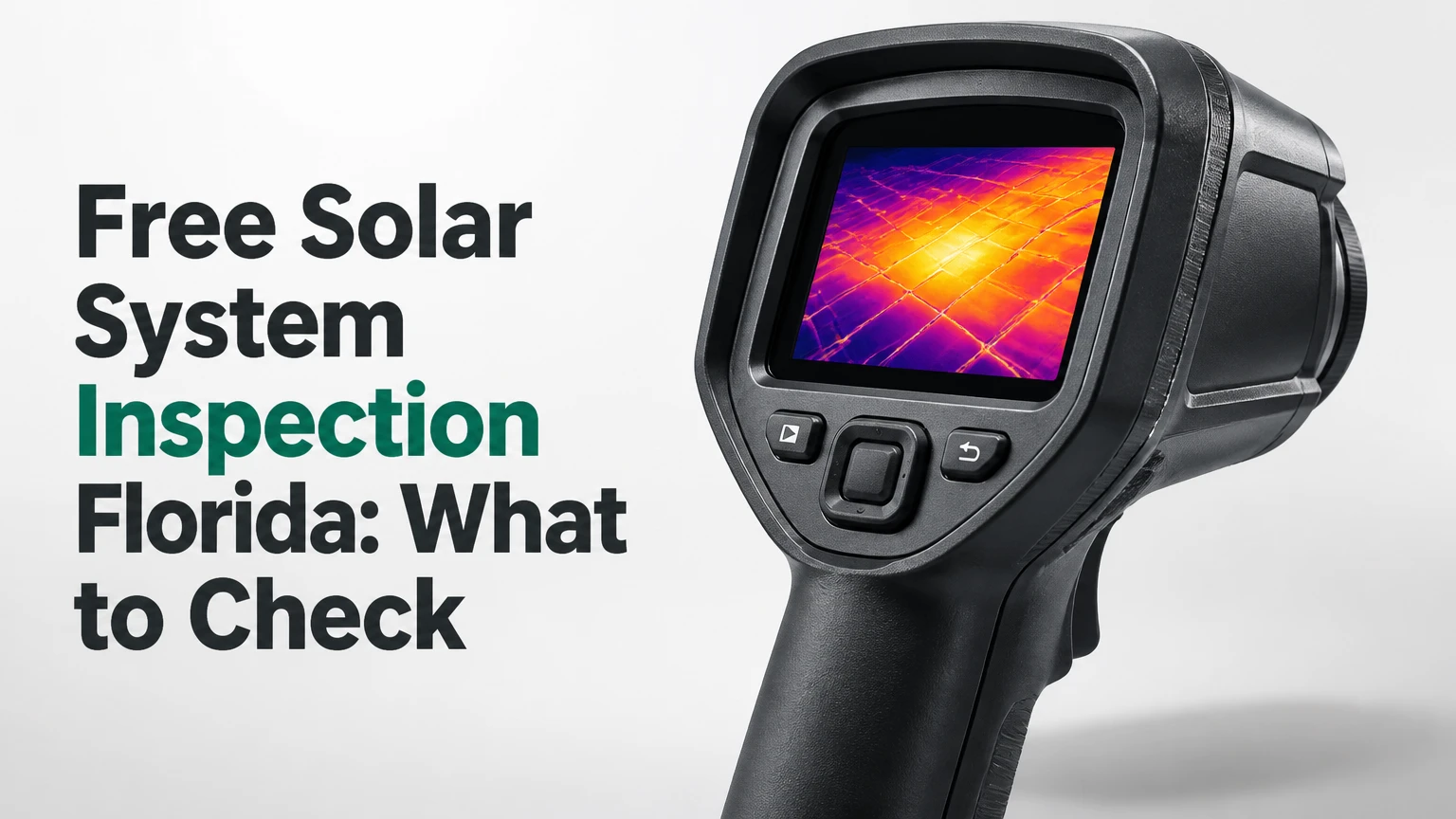
A free solar system inspection in Florida is usually a private contractor’s no-cost assessment of a roof, proposed solar design, or existing photovoltaic system. It can identify visible damage and sales opportunities, but it does not automatically replace a licensed technical inspection, local building inspection, utility approval, insurance documentation, or an independent engineering report.
Key Facts
A free solar inspection usually costs the homeowner $0, but the contractor may expect a repair, replacement, or installation opportunity.
A typical paid residential solar inspection costs about $150-$350, with drone thermography or difficult roof access adding roughly $150-$200.
A normal site visit takes 1-2 hours, while data review and a written report may require another 1-3 business days.
Florida’s Authority Having Jurisdiction, or AHJ, and the serving utility determine permitting and interconnection requirements.
A monitoring-app outage does not prove that panels stopped producing electricity because the internet gateway can fail independently.
A buyer, storm-claim claimant, or litigation party usually needs more independence and documentation than a free sales inspection provides.
What Does a Free Solar System Inspection Florida Include?
A free solar system inspection in Florida normally includes a visual review of the roof, modules, inverter, disconnects, visible wiring, monitoring status, and obvious production concerns. A pre-installation assessment also considers roof age, orientation, shade, structural conditions, electrical service capacity, and the proposed array location.
The word “inspection” has no single universal scope in private marketing. One company may send a salesperson for a 20-minute roof and bill review, while another sends a technician who downloads inverter data and photographs mounting hardware. Ask for the scope in writing before scheduling.
A free assessment is often commercially rational for a solar contractor. The contractor may earn revenue from a roof repair, inverter replacement, panel expansion, maintenance agreement, or new installation. That arrangement is not automatically dishonest, but it creates a financial incentive to recommend work.
A free visit is therefore a screening tool, not proof that a system is safe, code-compliant, or economically repairable.
What a pre-installation assessment determines
A new-solar site assessment determines whether the property can support a practical system before design and contract signing. The contractor should evaluate:
- Roof covering type, approximate remaining life, pitch, access, and visible deterioration.
- South, southeast, southwest, and east-facing planes, including shade from palms and nearby buildings.
- Main service-panel rating, available breaker space, meter location, and possible electrical upgrades.
- Roof penetrations, rafter locations, attachment areas, and the need for structural calculations.
- Annual energy use from utility bills, typically 12 months rather than one unusually high month.
- Local permitting, fire-access pathways, setbacks, utility interconnection, and equipment placement.
A contractor should not promise final production from satellite imagery alone. Tree growth, high-temperature losses, inverter clipping, soiling, roof geometry, and utility constraints can change the design.
What Happens During the Inspection?
A comprehensive existing-system inspection follows five stages: document review, roof and mounting examination, electrical and inverter testing, optional thermal imaging, and a written report. A technician needs system access, inverter access, monitoring credentials or screenshots, and permission to inspect the electrical equipment.
Stage 1: Review system and production records
The inspector should request the original proposal, one-line diagram, equipment list, warranty documents, utility bills, and production history. Monitoring data from Enphase Enlighten, SolarEdge, Tesla, or another platform can reveal when an outage or output decline began.
Production must be compared with a meaningful baseline. A 10-kilowatt system does not produce 10 kilowatts continuously because irradiance, temperature, shade, orientation, clipping, and grid status change throughout the day.
The most useful intake packet includes:
- Twelve months of utility bills.
- Twelve months of inverter or monitoring data.
- Panel, inverter, battery, and optimizer model numbers.
- Installation date and repair history.
- Roof replacement date and recent storm information.
Stage 2: Examine the roof and mounting system
The roof review checks visible flashing, sealant, rails, clamps, attachment points, conduit, junction boxes, and signs of water intrusion. The technician should photograph cracked tiles, lifted shingles, corroded metal, exposed cable, rodent damage, and vegetation contacting the array.
A roof walk is not always appropriate. Fragile tile, steep slopes, wet surfaces, unsafe attic conditions, or storm damage may require binocular inspection, a lift, or an aerial camera. Drone photographs can improve visibility, but a drone image cannot prove that a concealed lag screw reaches a sound rafter.
Florida adds weather-specific exposure. Coastal salt air accelerates corrosion, intense heat increases electrical stress, and hurricanes can damage modules or mounting points without producing an obvious roof leak.
Stage 3: Test electrical equipment and inverter operation
The technician should record inverter model, serial number, operating status, fault history, system voltage, visible disconnect condition, and any accessible current measurements. The inspection should also identify exposed conductors, improper cable management, damaged conduit, missing labels, and water intrusion.
Rapid shutdown equipment matters because modern photovoltaic systems require a method to reduce array voltage during emergency response. The exact equipment and test method depend on the installation date, adopted electrical code, inverter architecture, and local enforcement.
A visual inspection cannot certify every concealed connection. Opening energized equipment requires appropriate training, personal protective equipment, and electrical procedures. Homeowners should not remove inverter covers, open combiner boxes, or probe conductors.
Stage 4: Use thermal imaging when the problem justifies it
Infrared imaging can locate abnormal heat patterns caused by loose connections, bypass-diode problems, damaged modules, or overloaded components. Thermal results are meaningful only when the array has sufficient irradiance and the operator understands emissivity, wind, reflection, and inspection angle.
Thermal imaging does not automatically prove a cracked cell or failed panel. A suspected hotspot needs electrical testing, manufacturer criteria, or controlled follow-up before replacement. Drone thermography is useful for large, steep, or inaccessible arrays, but it is not necessary for every one-story residential system.
Stage 5: Deliver a usable report
A useful report identifies the property, inspection date, weather conditions, equipment models, areas inspected, instruments used, limitations, photographs, measurements, findings, and recommended next actions. “Panels look fine” is not a technical report.
The report should distinguish observed facts from interpretations. For example, “three modules have visible glass damage” is an observation, while “replace the entire array” is a recommendation that requires cost and warranty analysis.
Which Inspection Option Is Best?
The best inspection depends on the decision being made. A selling contractor is efficient for a routine service lead, an authorized service provider is appropriate for inverter diagnostics, and an independent inspector or engineer is stronger for a home purchase, insurance dispute, financing decision, or legal record.
| Situation | Best first provider | Typical cost | Main deliverable |
|---|---|---|---|
| New array design | Licensed solar contractor | $0 in many proposals | Roof, shade, electrical, and preliminary design review |
| Minor production concern | Solar service contractor | $0-$350 | Fault review, visual checks, and repair recommendation |
| Home purchase | Independent solar inspector | $150-$500 | Ownership, condition, production, and warranty report |
| Storm or insurance claim | Licensed contractor plus insurer-approved documentation | $200-$550 typical | Damage photographs, testing, and claim support |
| Serious structural concern | Florida-licensed engineer or qualified roofer | $300-$1,000+ | Structural opinion or roof evaluation |
Free contractor assessment
A free contractor visit is fastest when the homeowner already wants a quote or suspects an obvious maintenance issue. The contractor may have direct access to manufacturer portals and replacement parts, which can reduce diagnosis time.
The limitation is independence. A provider that recommends a new inverter also profits from selling that inverter. Request the measured evidence, the alternative of repair, the warranty route, and an itemized estimate before approving work.
Paid independent inspection
An independent inspection costs more because the fee is the primary compensation rather than a lead-generation expense. Independence becomes more valuable when a buyer might inherit a lease, a power purchase agreement, a financing obligation, or a roof replacement problem.
A paid report still needs credential verification. “Independent” does not automatically mean licensed, technically qualified, or accepted by an insurer. Ask whether the inspector can perform live electrical testing, interpret inverter data, inspect roof attachments, and produce documentation for the specific decision.
How Much Does a Solar Inspection Cost in Florida?
A typical standalone solar inspection in Florida costs $150-$350 for an accessible residential system, while difficult roofs, thermal drone work, travel, engineering review, or insurance documentation can raise the total to $500 or more. Permit and utility charges are separate costs and are not included in a private free inspection.
| Service component | Typical price | Typical duration | Main price driver |
|---|---|---|---|
| Basic visual assessment | $0-$175 | 30-90 minutes | Contractor lead or simple one-story roof |
| Production and inverter audit | $150-$350 | 1-2 hours | Monitoring access and electrical diagnostics |
| Drone thermal scan | $300-$550 | 1-3 hours | Array size, weather, and pilot availability |
| Independent buyer report | $250-$600 | 2-4 hours plus report | Ownership and warranty document review |
| Engineering or structural opinion | $500-$1,500+ | 3-10 business days | Roof design, damage, and stamped documentation |
A free offer may include only the first row. Ask whether the quote includes written findings, electrical measurements, thermal imaging, attic access, roof photographs, and a return visit.
Florida permit fees and utility charges vary by municipality, county, project size, and utility territory. The local AHJ, such as a city or county building department, controls permit inspection requirements. Florida Power & Light, Duke Energy Florida, Tampa Electric, Orlando Utilities Commission, and other utilities publish their own interconnection procedures.
Does a Free Inspection Replace a Florida Permit Inspection?
A private free inspection does not replace an AHJ inspection, required electrical inspection, utility interconnection review, or permission to operate. A contractor may help prepare permit documents, but only the responsible jurisdiction and utility can determine whether a new installation may legally connect to the grid.
SolarAPP+, where adopted by an eligible local jurisdiction, can streamline plan review for qualifying residential systems. It does not eliminate every permit, inspection, code requirement, or utility approval. Florida House Bill 683 changed aspects of solar permitting and inspection administration, but homeowners must confirm current implementation with their AHJ rather than rely on a statewide promise.
| Approval stage | Responsible party | Typical timing | Homeowner question |
|---|---|---|---|
| Building permit | City or county AHJ | 5 business days to several weeks | What documents and fee apply here? |
| Electrical inspection | AHJ inspector | Scheduled after installation | Does the installation pass the adopted code? |
| Utility interconnection | Serving utility | Several days to several weeks | Has permission to operate been issued? |
| Final system activation | Utility and contractor | After approval | Can the system export electricity legally? |
A new system should remain off or in the state required by the contractor until approvals are complete. A free contractor checklist can identify missing labels or equipment, but it cannot grant permission to operate.
What Should Homebuyers Check?
Homebuyers should verify system ownership, outstanding financing, production, roof condition, warranties, maintenance history, and transfer requirements before accepting a solar-equipped property. A free seller-provided inspection is insufficient when the buyer must assume a lease, PPA, or loan.
Request these documents:
- Purchase contract or finance agreement.
- Lease or PPA transfer rules, including escalator clauses.
- UCC-1 filing information and payoff or transfer instructions.
- Original permit, final inspection, and utility permission to operate.
- Module, inverter, battery, racking, and workmanship warranties.
- Twelve months of production data and utility bills.
- Roof installation date and any leak or repair records.
A UCC-1 financing statement can indicate a secured interest in equipment, but county records, the lender, title company, and contract documents should be reviewed together. A buyer should not assume that “paid off” means the equipment is free of every transfer requirement.
The buyer’s inspection should test actual production against the contract’s modeled expectation, adjusted for weather and shading. A system can be operational while still producing substantially less than expected because of a failed optimizer, shade growth, clipping, or inaccurate original modeling.
When Is a Storm Inspection Necessary?
A storm inspection is warranted after suspected wind uplift, flying debris, hail, flooding, roof leakage, inverter shutdown, or a sudden production decline. Florida homeowners should document damage before moving panels or authorizing repairs, then notify the insurer and preserve photographs, monitoring data, and contractor records.
Storm documentation should include the inspection date, weather event, array-wide photographs, close-ups of damaged modules, racking and roof attachments, inverter status, wiring, and interior leak evidence. Aerial photography can document inaccessible areas, but the insurer may require a specific licensed professional or adjuster format.
Do not wash, walk on, disconnect, or remove damaged equipment unless an emergency requires immediate mitigation. Solar modules can remain electrically energized in daylight even when the grid connection is off.
| Finding after storm | Immediate action | Escalation | Avoid |
|---|---|---|---|
| Cracked module glass | Photograph from ground | Licensed solar contractor | Touching broken laminate |
| Roof leak near attachment | Protect interior contents | Roofer and insurer | Applying unapproved sealant |
| Inverter fault code | Record code and time | Authorized service provider | Repeated hard resets |
| Lifted rail or loose panel | Keep people away | Contractor and adjuster | Climbing onto roof |
How Do You Diagnose Low Solar Production?
Low solar production requires comparison with historical data, weather, shade, inverter status, system design, and utility conditions. A monitoring-app warning alone cannot identify the cause because communication failure, grid outage, inverter fault, shading, soiling, and module damage produce different symptoms.
Homeowners can safely complete a limited preliminary check:
- Confirm whether the monitoring gateway has internet or cellular connectivity.
- Look at the inverter’s external status display without opening its enclosure.
- Check whether the dedicated solar breaker or exterior disconnect appears tripped.
- Compare the production graph with a clear-day baseline from the same season.
- Record error messages, timestamps, utility outages, and recent roof work.
Only qualified personnel should perform current, voltage, insulation-resistance, grounding, or rapid-shutdown tests. A service technician can determine whether the failure is at module, string, optimizer, microinverter, central inverter, gateway, breaker, or utility level.
An offline app is a common false alarm. If the gateway lost Wi-Fi while the inverter continued operating, production may be normal and the repair may involve communications rather than generation equipment.
How Do Warranties Affect the Inspection?
Warranty protection depends on the manufacturer, installation contract, authorized-service rules, documentation, and cause of failure. A third-party inspection does not automatically void a warranty, but unauthorized alterations or repairs can complicate a claim and may exclude workmanship coverage.
Before approving work, identify:
- Module product and performance warranty.
- Inverter, optimizer, battery, and monitoring warranty periods.
- Installer workmanship warranty and service contact.
- Transfer conditions after a property sale.
- Required photographs, serial numbers, and fault logs.
- Whether the proposed provider is authorized by the equipment manufacturer.
A manufacturer warranty may cover a failed inverter but not roof leaks caused by installation workmanship. A panel performance warranty may address long-term output degradation but not hurricane impact, improper cleaning, or external shading.
Request a written diagnosis before replacing functioning equipment. One of the most expensive inspection mistakes is treating an unavailable monitoring portal as proof that every inverter or panel has failed.
Are Free Solar Panels Available in Florida?
Florida does not generally provide a universal state program that gives homeowners free solar panels with no contract, qualification, or repayment obligation. Advertisements using “free solar” commonly describe a lease, PPA, financing promotion, tax-credit assumption, or a sales consultation rather than government-donated equipment.
The Federal Residential Clean Energy Credit can reduce eligible costs for qualifying taxpayers, but a tax credit is not the same as free equipment and does not guarantee that every homeowner can use the full amount. Eligibility, placed-in-service timing, tax liability, ownership, and current federal law matter.
Ask the advertiser five direct questions:
- Who owns the panels?
- What total amount will the homeowner pay?
- Is there a lease, PPA, loan, escalator, or early-termination charge?
- Who pays for roof removal, repairs, insurance, and maintenance?
- What happens if the home is sold?
A legitimate free inspection should not require an immediate signature, bank information, or permission to place equipment on the roof. Verify a Florida contractor’s license through the Florida Department of Business and Professional Regulation before authorizing construction or electrical work.
What Makes an Inspection Report Useful?
A useful solar inspection report connects each finding to evidence, risk, and a specific next action. The report should state what the technician could not inspect, because inaccessible roof areas and concealed electrical connections limit the confidence of a visual assessment.
| Report element | Minimum useful detail | Why it matters | Example |
|---|---|---|---|
| Equipment inventory | Brand, model, serial number | Supports warranty claims | Enphase IQ8, serial recorded |
| Production evidence | Date range and kWh data | Establishes baseline | January 2025, 1,184 kWh |
| Roof findings | Location and photographs | Links damage to penetrations | Array row B, west attachment |
| Electrical findings | Measurement and test condition | Separates fact from opinion | 240 V AC at inverter input |
| Thermal findings | Weather and irradiance context | Makes images interpretable | Clear sky, 850 W/m² |
| Recommendations | Priority, cost, warranty route | Enables a decision | Submit inverter claim before replacement |
The report should use priority levels tied to action. An exposed conductor or active water intrusion deserves immediate attention; cosmetic frame discoloration may require monitoring; a production variance needs data analysis before replacement.
An inspection report is not necessarily an engineering certification, insurance determination, or code compliance certificate. Its authority depends on the professional’s credentials, scope, licensing, and the recipient’s requirements.
How Do You Choose a Florida Solar Inspector?
Choose a Florida solar inspector by matching credentials and scope to the risk, then verifying license status, insurance, manufacturer access, and report examples. NABCEP certification can indicate training in photovoltaic practice, but it does not replace Florida licensing requirements or prove that a provider is independent.
Ask each provider:
- Will a technician, engineer, electrician, or salesperson perform the visit?
- Which tests are included, and which cost extra?
- Will the report include measurements and serial numbers?
- Can the provider inspect tile roofs, batteries, optimizers, and rapid-shutdown systems?
- Is the provider authorized to service the installed equipment?
- Does the provider sell replacement systems or receive referral compensation?
- Will the insurer, lender, title company, or AHJ accept the report?
Expert rules that prevent expensive mistakes
A production claim needs a denominator. “Your system is underperforming” means little without system size, weather period, expected irradiance, shading, and comparable historical output.
Roof life can dominate solar economics. If a roof may need replacement within five years, inspect the roof before repairing or expanding the array because panel removal and reinstallation can add thousands of dollars.
A clean panel is not necessarily a healthy panel. Surface appearance cannot reveal an intermittent optimizer fault, insulation problem, internal cell damage, or degraded bypass diode.
Free is least useful when the decision is adversarial. A buyer, insurer, lender, or court is more likely to value an independent report that documents limitations and preserves original evidence.
What Are the Common Inspection Mistakes?
The most common mistakes are confusing monitoring with production, accepting an oral diagnosis, ignoring ownership documents, and authorizing repairs before checking warranty responsibility. Each mistake can delay a claim or convert a covered repair into an out-of-pocket replacement.
| Mistake | Typical consequence | Better control | Recovery action |
|---|---|---|---|
| Treating an offline app as a failed array | Unnecessary inverter replacement | Check gateway and inverter status | Obtain production data and fault logs |
| Signing during the first free visit | Unwanted lease or PPA | Take a 24-hour review period | Cancel within contract rights |
| Allowing unlicensed electrical work | Safety and warranty risk | Verify DBPR credentials | Stop work and document conditions |
| Skipping roof evaluation | Later panel removal expense | Get roof age and condition first | Obtain roofer’s written assessment |
| Relying on photos without measurements | Weak insurance or buyer evidence | Request test conditions and readings | Commission an independent audit |
A homeowner should stop and escalate when the contractor finds exposed live conductors, active water intrusion, structural movement, burned electrical components, repeated inverter faults, or suspected fire damage. Do not troubleshoot energized equipment beyond external controls and documented manufacturer instructions.
Free Solar System Inspection Florida: A Practical Decision
A free solar system inspection in Florida is worthwhile as an initial screen when the scope is written, the provider is qualified, and the homeowner keeps control of the decision. Use a paid independent inspection when the result affects a property purchase, insurance claim, financing obligation, structural dispute, or major replacement.
For a new installation, compare roof life, design assumptions, service-panel capacity, permit path, utility rules, ownership, and total contract cost. For an existing system, begin with monitoring data and external status checks, then escalate to authorized diagnostics when the evidence points to electrical or inverter failure.
Do not treat a free inspection as official approval or impartial proof. The right inspection is the one whose evidence matches the decision you need to make.
Frequently Asked Questions
Can a home inspector inspect solar panels?
A general home inspector can report visible solar conditions, roof concerns, labels, and obvious damage, but many home inspectors do not perform live photovoltaic testing or production audits. Buyers should hire a solar-qualified specialist when system ownership, output, electrical safety, or warranty transfer affects the transaction.
How long does a Florida solar inspection take?
A typical residential site visit takes 1-2 hours when the roof and inverter are accessible. A buyer review, storm documentation, or thermal scan can take 2-4 hours, and a detailed written report commonly arrives within 1-3 business days.
Should I turn off solar panels before an inspection?
Homeowners should follow the installer’s or manufacturer’s shutdown procedure and should not open energized equipment. Turning off the system can prevent useful operating measurements, so the technician should decide when a controlled shutdown is safe and necessary.
Does cleaning solar panels fix low production?
Cleaning can improve output when heavy dirt, pollen, bird residue, or salt deposits block sunlight, but cleaning will not fix inverter faults, failed optimizers, wiring defects, shade, cracked modules, or gateway communication problems. Roof access and module-cleaning instructions should be confirmed before work.
Will an inspection find a hidden roof leak?
An inspection can identify visible flashing failure, staining, damaged sealant, and water intrusion near solar attachments, but it cannot guarantee that every concealed leak is found. A roofer may need to perform targeted leak testing, attic inspection, or selective panel removal.
Can I sell a Florida home with leased solar panels?
A home can generally be sold with leased or PPA-financed solar equipment, but the provider’s transfer, credit, payoff, and approval requirements must be satisfied. The purchase contract should identify the obligation clearly, and the buyer should review the full agreement before closing.