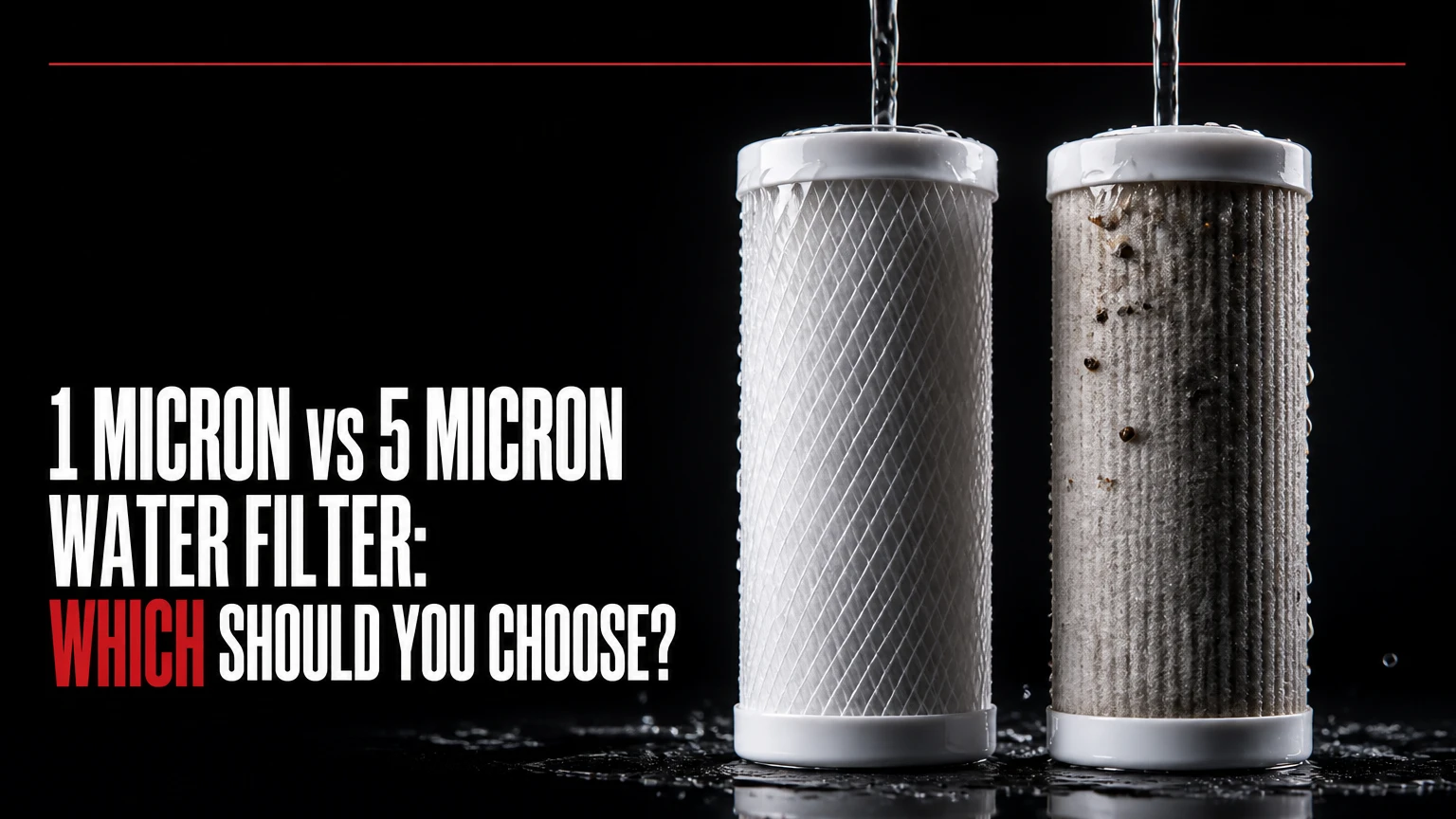
A 1-micron water filter removes smaller suspended particles than a 5-micron water filter, but it usually reduces flow faster and clogs sooner. Choose 5 micron for general sediment protection and higher household flow; choose an absolute 1 micron rating when fine-particle removal, RO protection, or cyst reduction is the specific treatment goal.
Key Facts at a Glance
- A micron is one-millionth of a meter, so a 1-micron rating describes a tighter filtration target than a 5-micron rating.
- A 5-micron cartridge usually provides higher flow and longer service life when source water contains substantial sediment.
- A nominal 1-micron cartridge is not equivalent to an absolute 1-micron cartridge because nominal ratings permit some smaller particles to pass.
- Neither sediment cartridge reliably removes dissolved salts, chlorine, most dissolved metals, or all bacteria without a treatment claim from the manufacturer.
- A larger 20-inch by 4.5-inch housing usually lowers pressure loss compared with a 10-inch by 2.5-inch housing using the same rating.
- Progressive filtration, such as 20 micron followed by 5 micron and then 1 micron, protects the finest cartridge from premature clogging.
1 Micron vs 5 Micron Water Filter: What Is the Difference?
The main difference is particle-size selectivity. A 1-micron filter has a tighter capture target and can produce clearer water, while a 5-micron filter permits more fine silt through but commonly maintains better flow under the same pressure and cartridge dimensions.
The rating does not describe a universal round hole in every filter. Spun polypropylene and string-wound cartridges are depth filters, so particles become trapped throughout a complex network of fibers. Pleated cartridges act more like surface filters, where contaminants accumulate across a broad sheet.
| Decision factor | 1-micron cartridge | 5-micron cartridge | Practical consequence |
|---|---|---|---|
| Relative filtration target | 1 µm | 5 µm | 1 micron targets smaller suspended particles |
| Typical 10-inch standard flow | 1-3 GPM | 3-7 GPM | 5 micron better suits multiple simultaneous fixtures |
| Typical initial pressure loss | 2-5 psi | Less than 1-2 psi | 1 micron needs more available pressure |
| Sediment tolerance | Low to moderate | Moderate to high | 5 micron generally lasts longer in dirty water |
| Common application | RO or point-of-use polishing | Whole-house sediment control | Application determines the better rating |
| Cyst-related objective | Possible with absolute rating and validation | Usually insufficient | Check the performance claim, not only the number |
Manufacturers test ratings differently. The Water Quality Association explains that nominal ratings represent a percentage reduction at a stated particle size, whereas absolute ratings indicate a defined maximum particle passage under specified test conditions. A cartridge marked “1 micron” therefore requires more scrutiny than its front-label number.
How Does Micron Filtration Work?
Micron filtration removes suspended solids by forcing water through a porous medium under pressure. Larger particles are intercepted at the surface or inside the filter depth, while dissolved substances and particles smaller than the effective capture rating can continue into the plumbing.
The process begins when water enters a housing at household or pump pressure. Typical residential pressure is approximately 40-60 psi, although a private well system may cycle between different cut-in and cut-out settings.
Surface filtration captures visible rust flakes, sand grains, and larger debris near the outer layer. Depth filtration uses tortuous paths inside the media, allowing fibers to retain particles at several layers rather than at a single membrane face.
A cartridge’s flow performance depends on more than the micron number. Media type, cartridge length, housing diameter, water temperature, sediment concentration, pressure, and the manufacturer’s test flow all change actual results.
What Does the Micron Rating Actually Mean?
A micron rating identifies a particle-size performance point, not a guarantee that every particle above that size is removed. A nominal rating may remove a percentage of particles at the stated size, while an absolute rating must include a defined efficiency or maximum-passage claim.
The term “absolute” also requires a test basis. Look for a stated efficiency, beta ratio, standard, or performance sheet rather than relying on the word alone. NSF International describes NSF/ANSI 42 filtration claims as addressing “aesthetic effects,” which can include particulate reduction, taste, and odor; that certification does not automatically establish pathogen protection.
| Label wording | What it usually communicates | What to verify | Buying implication |
|---|---|---|---|
| Nominal 5 micron | Rated reduction at approximately 5 µm | Percentage removed and test method | Suitable for general sediment control |
| Absolute 5 micron | Tighter maximum-passage claim | Efficiency percentage or beta ratio | Better for defined downstream protection |
| Nominal 1 micron | Fine sediment reduction at approximately 1 µm | Actual particle-reduction percentage | Not automatically cyst-safe |
| Absolute 1 micron | Defined fine-particle barrier | Certification and organism claim | Consider for validated cyst pretreatment |
| 0.5 micron carbon block | Mechanical and adsorption performance | Chlorine, VOC, and flow claims | Chemical treatment depends on contact time |
| “Microfiltration” | Broad process description | Membrane rating and validation | The phrase alone is not a safety specification |
Which Filter Provides Better Flow and Pressure?
A 5-micron filter usually provides better flow and lower pressure loss because its media presents less resistance to water movement. A 1-micron cartridge can work well when the housing is oversized or the flow demand is modest, but a small cartridge may restrict a shower, washing machine, or multiple fixtures.
A typical 10-inch by 2.5-inch cartridge may deliver approximately 1-3 gallons per minute at 1 micron and 3-7 GPM at 5 micron, but these are practitioner ranges, not universal specifications. Always use the manufacturer’s pressure-drop curve for final sizing.
The housing often matters as much as the rating. A Big Blue housing, commonly 10 inches or 20 inches long and 4.5 inches in diameter, has greater media area and usually supports higher flow than a slim standard housing.
How Much Pressure Loss Is Acceptable?
A practical residential target is to replace or service a cartridge when the pressure drop reaches roughly 10 psi above the clean-filter reading, or when downstream fixtures no longer meet their required flow. A pressure gauge before and after the housing makes the decision measurable.
| Installation condition | Clean pressure target | Service trigger | Recommended response |
|---|---|---|---|
| City water, under-sink | 40-80 psi supply | 8-10 psi loss | Replace cartridge or inspect blockage |
| Whole-house municipal supply | 50-70 psi supply | 10-15 psi loss | Check flow demand and housing size |
| Private well | 40-60 psi cycle | 10 psi loss or pump cycling | Inspect filter before adjusting pump |
| RO prefilter | 50-80 psi feed | Manufacturer-specific loss | Protect membrane and verify production rate |
| UV pretreatment | 40-70 psi feed | Noticeable flow reduction | Replace sediment stage before lamp service |
| Low-pressure system | 30-40 psi supply | 5-8 psi loss | Use larger housing or coarser prefilter |
A pressure drop that appears immediately after installation usually signals undersizing, a blocked cartridge, incorrect cartridge orientation, or a filter whose rated flow is below the home’s demand. A gradual drop usually reflects accumulated sediment.
Which Contaminants Can 1 Micron and 5 Micron Filters Remove?
A 1-micron filter can reduce fine sediment and may reduce protozoan cysts when the cartridge is absolute-rated and validated for that purpose. A 5-micron filter is more appropriate for sand, rust, visible dirt, and larger suspended solids, but it should not be presented as a complete microbial barrier.
Giardia cysts are commonly described as several microns in size, and Cryptosporidium oocysts are smaller, often around 4-6 microns. Particle size varies, and filter performance depends on organism shape, pore structure, integrity, flow, and testing. A nominal rating alone cannot establish safe pathogen removal.
Neither rating removes dissolved contaminants merely because their molecular size is small. Chlorine requires activated carbon, dissolved salts require reverse osmosis or another suitable process, and microbial inactivation requires validated UV, chemical disinfection, or another treatment method.
| Water concern | 5-micron sediment filter | 1-micron sediment filter | More suitable treatment |
|---|---|---|---|
| Sand and grit | Usually effective | Effective but may clog sooner | 20-micron prefilter for heavy loads |
| Rust flakes | Usually effective | Effective | Iron treatment if dissolved iron remains |
| Fine silt | Partial to moderate reduction | Better reduction | Turbidity testing and staged filtration |
| Giardia cysts | Not a dependable claim | Possible with absolute validated unit | Certified cyst-reduction filter |
| Cryptosporidium | Not a dependable claim | Possible only with validated performance | Absolute barrier plus disinfection |
| Chlorine taste | No meaningful removal | No meaningful removal | Activated carbon block |
| Lead or dissolved metals | No reliable removal | No reliable removal | Certified adsorption or RO |
| Dissolved salts and hardness | No removal | No removal | RO, softener, or ion exchange |
| Bacteria and viruses | No general guarantee | No general guarantee | UV, chemical, or membrane treatment |
The U.S. Environmental Protection Agency distinguishes particulate filtration from disinfection and contaminant-specific treatment. That distinction matters: clear water is not automatically microbiologically safe.
Which Filter Media Should You Use?
Spun polypropylene is a practical choice for disposable depth filtration, pleated polyester is useful when surface area and washability matter, string-wound media handles mixed sediment, and carbon block combines particulate reduction with adsorption. The media and rating must be selected together.
A 1-micron carbon block does not behave like a 1-micron spun sediment cartridge. Carbon block pressure loss can be higher, especially when chlorine, organic matter, and sediment load consume its available surface area. Carbon also needs adequate contact time for chemical reduction.
| Media type | Typical ratings | Strength | Main limitation |
|---|---|---|---|
| Spun polypropylene | 1, 5, 10, 20 µm | Low-cost depth filtration | Disposable and prone to pressure loss |
| Pleated polyester | 1, 5, 20, 50 µm | High surface area and some washable designs | Surface loading can cause rapid blinding |
| String-wound polypropylene | 1, 5, 10, 20 µm | Handles varied particle sizes | May shed fibers if poorly manufactured |
| Ceramic cartridge | 0.2-1 µm | Fine particulate and some microbial claims | Low flow and delicate handling |
| Carbon block | 0.5-5 µm | Chlorine, taste, odor, and some chemical reduction | Requires replacement before exhaustion |
| Hollow-fiber membrane | 0.01-0.1 µm | Very fine particulate and organism reduction | Higher cost and fouling sensitivity |
Do not wash a disposable melt-blown cartridge. Rinsing can disturb the graded internal structure and does not restore adsorption capacity. Wash only a pleated cartridge whose manufacturer explicitly identifies it as reusable.
How Long Do 1-Micron and 5-Micron Filters Last?
A 1-micron cartridge commonly lasts one to three months in lightly sedimented residential water, while a 5-micron cartridge may last three to six months under similar conditions. Heavy well sediment can shorten either interval to days or weeks, so pressure loss is a better replacement signal than the calendar alone.
Published service-life claims vary because manufacturers assume different water quality, daily volume, cartridge dimensions, and pressure conditions. A home using 300 gallons daily places a different load on a cartridge than a lightly occupied property using 80 gallons.
| Cartridge and setting | Typical replacement range | Main limiting factor | Better monitoring method |
|---|---|---|---|
| 10-inch, 1-micron spun | 2-8 weeks in dirty well water | Fine silt loading | Differential pressure |
| 10-inch, 1-micron point of use | 2-6 months | Daily drinking-water volume | Flow decline and taste |
| 10-inch, 5-micron whole house | 1-4 months | Rust, sand, and sediment | Pressure gauges |
| 20-inch Big Blue, 5 micron | 3-9 months | Total suspended solids | Pressure and visual inspection |
| 20-inch Big Blue, 1 micron | 1-6 months | Fine sediment and flow demand | Pressure differential |
| Carbon block, 0.5-1 micron | 6-12 months typical | Chlorine or organic loading | Rated gallon capacity and testing |
A cartridge can look clean while its internal layers are full. Conversely, a dark exterior does not prove that the cartridge is exhausted. Pressure and treated-water testing provide better evidence.
Which Rating Is Best for Well Water?
A 5-micron filter is usually the better first choice for well-water sediment because it balances particle reduction with useful household flow. Homes with visible sand or heavy turbidity should generally begin with a coarser 20-micron or washable prefilter, then use 5 micron, reserving 1 micron for a defined downstream requirement.
A practical progressive arrangement is:
- Install a spin-down or washable 20-50 mesh separator if the well produces sand.
- Add a 20-micron pleated cartridge for larger suspended solids.
- Add a 5-micron depth cartridge for finer sediment.
- Add an absolute 1-micron cartridge only before RO, UV, or a validated cyst-control stage.
- Test for bacteria, nitrate, arsenic, iron, manganese, hardness, and turbidity through an accredited laboratory.
A 1-micron cartridge is a poor standalone solution for a dirty well. It may produce clear water briefly, then create a pressure bottleneck that affects every fixture.
Which Rating Is Best for City Water?
A 5-micron whole-house sediment cartridge is usually adequate for municipal rust, pipe scale, and occasional particulate matter. A 1-micron cartridge is more appropriate at a single drinking-water tap when fine-particle reduction matters and the limited flow does not affect showers or appliances.
Municipal water already receives regulated treatment, but distribution pipes can contribute sediment. A sediment filter does not replace the public supplier’s disinfection system, and a poorly maintained cartridge can become a hygiene problem.
For chlorine taste or odor, use a certified carbon cartridge rather than changing from 5 micron to 1 micron sediment media. The micron number controls particulate performance; activated carbon performs adsorption.
Should You Use 1 Micron or 5 Micron Before RO and UV?
Use 5 micron as a general RO sediment prefilter and use absolute 1 micron when the RO manufacturer or water-quality assessment calls for finer protection. UV systems need low-turbidity water and a validated pretreatment train, but the correct micron rating alone does not guarantee organism removal.
Reverse-osmosis membranes are sensitive to fouling from sediment, iron, and organic matter. A common residential sequence is sediment filtration, carbon filtration, then the RO membrane. Carbon protects against chlorine when the membrane uses polyamide material.
UV requires clear water because suspended solids can shield microorganisms from light. Precede UV with a sediment stage sized for the manufacturer’s flow and turbidity limit, then maintain lamp intensity and sleeve cleanliness according to the equipment manual.
What Filter Sequence Works Best?
The best sequence depends on the contaminant load, but progressive filtration places the coarsest effective stage first and the finest stage later. That arrangement preserves pressure and extends the service life of expensive fine media.
| System goal | Stage 1 | Stage 2 | Stage 3 | Final treatment |
|---|---|---|---|---|
| Sandy well water | Spin-down separator | 20 µm pleated | 5 µm depth | Softener or iron treatment |
| Fine well sediment | 20 µm pleated | 5 µm spun | Absolute 1 µm | UV if validated |
| Chlorinated city water | 5 µm sediment | Carbon block | Optional 1 µm carbon | Point-of-use faucet |
| Reverse osmosis | 5 µm sediment | Carbon block | Manufacturer prefilter | RO membrane |
| Rainwater system | 20 µm washable | 5 µm cartridge | Absolute fine filter | UV or approved disinfection |
| Whole-house cyst concern | 20 µm prefilter | 5 µm sediment | Validated absolute barrier | UV or other disinfection |
How Much Do These Filters Cost?
Typical replacement prices range from $5-$15 for a standard 10-inch by 2.5-inch sediment cartridge, $15-$40 for a larger 10-inch or 20-inch by 4.5-inch cartridge, and approximately $15-$60 for specialized carbon or membrane cartridges. Installed housings, gauges, shutoff valves, and labor add substantially to the initial cost.
A 1-micron cartridge may cost slightly more than a 5-micron cartridge, but cartridge price is only one part of ownership cost. Frequent pressure loss, emergency replacements, wasted water, and pump cycling can make an undersized fine filter more expensive.
Estimate annual cost with this formula:
Annual cartridge cost = cartridge price × 12 ÷ replacement interval in months.
For example, a $10 cartridge replaced every two months costs about $60 per year before labor. A $12 cartridge replaced every five months costs about $29 per year.
Common Installation Mistakes and Fixes
Installing a Fine Cartridge Without Measuring Flow
A 1-micron cartridge in a small housing may supply a drinking faucet but fail to support a 6 GPM household demand. Measure peak flow, compare it with the manufacturer’s rated flow, and choose a larger housing when the pressure margin is narrow.
Treating Nominal and Absolute as Identical
A nominal 1-micron filter can allow a portion of 2-micron or even larger particles through, depending on its test definition. For cyst or downstream membrane protection, verify the efficiency claim, certification, and operating flow.
Putting the Finest Filter First
Fine media should usually follow coarse sediment stages. A 20-micron prefilter removes the load that would otherwise blind a 5-micron or 1-micron cartridge.
Ignoring Cartridge Seals
A missing, flattened, or displaced O-ring can allow water to bypass the media. Re-seat the cartridge, inspect the top and bottom seals, lubricate the housing gasket with approved silicone lubricant, and check for bypass after repressurizing.
Leaving a Clogged Filter in Service
A clogged cartridge increases pressure loss and may encourage users to open a bypass or remove the filter. Install pressure gauges and replace the cartridge when the differential reaches the chosen service threshold.
Using Sediment Filtration for Dissolved Contaminants
A sediment rating does not remove hardness, nitrate, dissolved salts, chlorine, or most dissolved metals. Select carbon, ion exchange, RO, UV, or laboratory-directed treatment for those targets.
How Should You Choose Between 1 Micron and 5 Micron?
Choose based on source water, peak flow, contaminant objective, cartridge size, and acceptable maintenance frequency. The correct choice is not the smallest rating available; the correct choice is the smallest rating that meets the treatment objective without creating an avoidable pressure problem.
Choose 5 Micron If You Have These Conditions
- Whole-house city-water sediment control
- Visible rust, sand, or pipe scale
- A private well with moderate sediment
- Multiple simultaneous fixtures
- Limited pressure or a small filter housing
- A preference for longer cartridge intervals
- A coarse prefilter already protecting downstream equipment
Choose Absolute 1 Micron If You Have These Conditions
- A manufacturer specifies fine pretreatment
- An under-sink drinking-water application needs fine particulate reduction
- A validated cyst-reduction claim matches the source-water risk
- A UV system requires fine sediment control
- An RO system benefits from additional fine-particle protection
- The housing can supply the required flow with acceptable pressure loss
Persona-Based Verdicts
| User profile | Recommended rating | Housing or sequence | Reason |
|---|---|---|---|
| City-water household, normal pressure | 5 µm whole house | 20-inch Big Blue if demand is high | Controls sediment without excessive restriction |
| Well owner with visible sand | 20 µm then 5 µm | Spin-down separator plus staged cartridges | Protects the fine stage from rapid clogging |
| Under-sink drinking faucet | 1 µm carbon block | Dedicated point-of-use housing | Provides fine filtration without whole-house pressure loss |
| RO owner | 5 µm sediment then carbon | Follow RO manufacturer’s sequence | Protects the membrane from particles and chlorine |
| UV-treated private supply | 5 µm then validated 1 µm | Install immediately before UV where specified | Reduces shadowing and supports disinfection |
| Low-pressure home | 5 µm or larger | Oversized housing and pressure gauges | Preserves usable fixture flow |
What Can You Use Instead of a 1-Micron or 5-Micron Filter?
Sediment cartridges are only one part of water treatment. A spin-down separator handles coarse sand, activated carbon reduces chlorine and many taste compounds, reverse osmosis reduces many dissolved contaminants, and UV inactivates microorganisms when pretreatment and maintenance meet the equipment specification.
| Treatment technology | Primary target | Typical operating issue | Does it replace sediment filtration? |
|---|---|---|---|
| Spin-down separator | Sand and large particles | Requires flushing | No, it is usually a prefilter |
| Activated carbon | Chlorine, taste, odor, some VOCs | Capacity exhaustion | No, sediment protection remains useful |
| Water softener | Calcium and magnesium hardness | Salt and regeneration | No |
| Reverse osmosis | Dissolved salts and selected contaminants | Wastewater and lower flow | No, sediment and carbon prefilters remain necessary |
| UV disinfection | Bacteria, viruses, and some protozoa | Turbidity, lamp maintenance | No, clear pretreatment is required |
| Ultrafiltration membrane | Fine particles and some organisms | Fouling and pressure loss | Sometimes, if validated for the target |
| Distillation | Many dissolved solids and organisms | Energy use and slow output | Usually requires prefiltration |
FAQ
Is a 1-micron filter always better than a 5-micron filter?
No. A 1-micron filter is finer, but a 5-micron filter is often better for whole-house sediment because it supports higher flow and tolerates more dirt. A 1-micron cartridge becomes the better choice only when fine-particle reduction or a validated downstream requirement justifies its additional pressure loss and maintenance.
Can a 5-micron filter remove Giardia?
A 5-micron filter should not be assumed to remove Giardia. Organism dimensions vary, and nominal sediment ratings do not establish pathogen protection. Use a cartridge with a verified cyst-reduction claim, preferably within a complete treatment system that includes appropriate disinfection and laboratory-informed source-water control.
Can a 1-micron filter remove bacteria?
A 1-micron sediment cartridge cannot automatically be treated as a bacterial barrier. Many bacteria are smaller than 1 micron, and depth-filter integrity varies. Use a validated microbiological membrane, UV system, chemical disinfectant, or another treatment specifically certified for the organism and operating conditions.
Will a 1-micron filter reduce water pressure?
A 1-micron filter can reduce water pressure more than a 5-micron filter, particularly in a small housing, at high flow, or with sediment-loaded water. Oversizing the housing, installing a coarse prefilter, and replacing the cartridge at a measured differential pressure can limit the effect.
Should a sediment filter be installed before or after a water softener?
Sediment filtration should normally be installed before a water softener because sand, rust, and suspended solids can foul control valves and resin beds. A 5-micron cartridge often works well after a coarse separator, while the softener addresses dissolved hardness that neither micron rating can remove.
How do I know whether my filter is nominal or absolute?
Read the technical data sheet, not only the cartridge label. Look for the words nominal or absolute, a removal percentage, beta ratio, test standard, certified contaminant claim, and rated flow. If the manufacturer provides none of those details, treat the micron number as an approximate marketing description rather than a safety specification.
The Bottom Line
The 1 micron vs 5 micron water filter decision comes down to treatment objective and available flow. Use 5 micron for economical whole-house sediment control, especially with well water, visible rust, or limited pressure. Use an absolute, validated 1-micron cartridge for fine-particle protection, RO or UV pretreatment, or a specific cyst-reduction goal, preferably after a coarser prefilter.